What Is a Steering Torque Sensor?
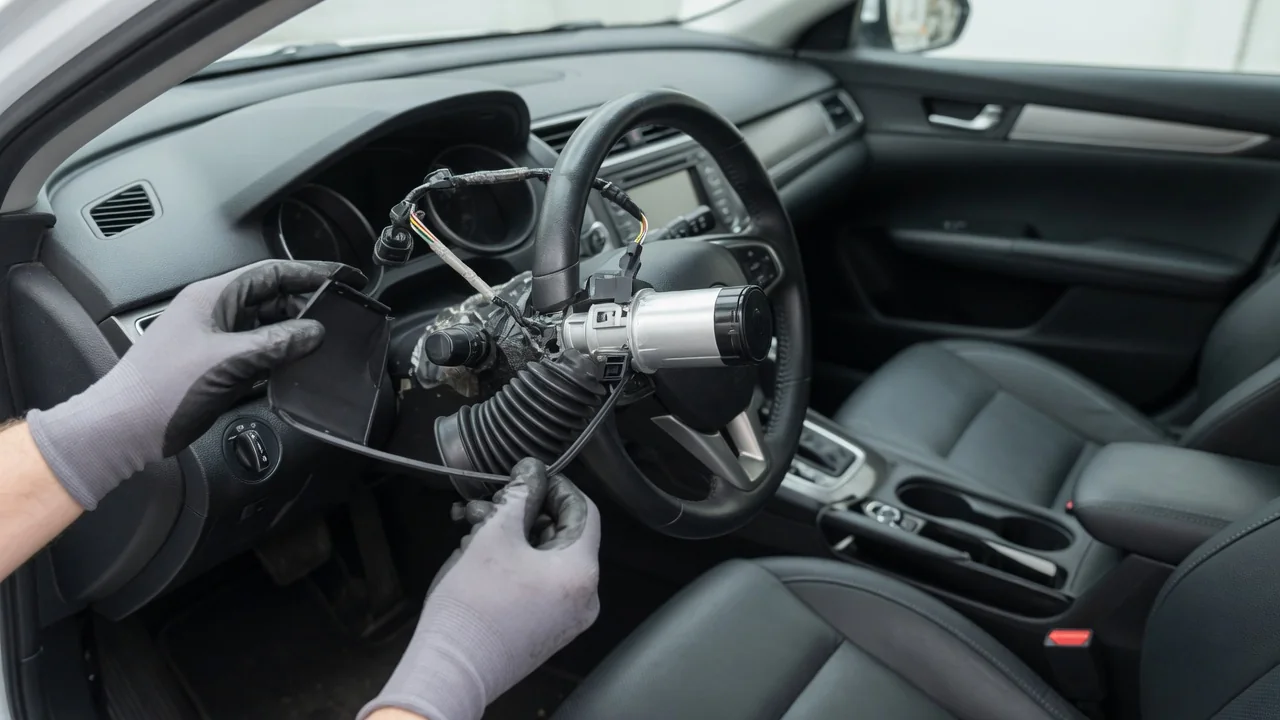
A steering torque sensor measures how hard the driver is twisting the steering wheel, not just where the wheel is pointed. In an electric power steering system, that measurement is the main signal the control module uses to decide how much help the electric motor should add. This article explains how an electric steering torque sensor reads driver input, how that reading becomes an assist command, and what typically happens when the sensor or its circuit develops a fault.
Driver Input: Reading Steering Effort
Most torque sensors are built around a torsion bar, a short, deliberately flexible shaft that links the upper steering shaft, connected to the wheel, with the lower shaft that leads toward the steering gear. When the driver turns the wheel and the tires resist, the torsion bar twists slightly. The twist is small, but it rises in proportion to the torque the driver applies. The sensor measures the angular difference between the two ends of the bar and converts it into an electrical signal. Because it reads twist rather than position, the sensor can distinguish a driver holding the wheel steady against a crosswind from a driver applying no effort at all, even with the wheel in the same place.
Several sensing methods are in use. Older designs relied on contacting potentiometers, while many current systems use non-contact principles, such as magnetic rings read by Hall-effect elements or inductive coils that detect the relative movement of the shafts. Non-contact designs avoid wiper wear, which matters for a part that moves every time the wheel turns. The sensor also has to report direction, so its output typically sits at a neutral value with no torque applied and moves one way for left-hand effort and the other way for right-hand effort.
Many electric steering torque sensors provide two independent output channels rather than one. The control module compares them continuously, and agreement between the channels is part of how the system confirms the reading is trustworthy. Some assemblies combine torque measurement with steering angle or rotation sensing in the same housing, though the exact arrangement depends on the system design.
Assist Command: Turning Torque Into Motor Help
The power steering control module treats the torque signal as a request. A light effort at the wheel produces a small assist command, and a heavier effort produces a larger one, up to the limits the system is designed for. The module calculates a target motor current or motor torque, and the electric motor applies it to the steering column, the pinion, or the rack, depending on where the motor is mounted. The driver supplies only part of the force needed to turn the wheels, and the motor supplies the rest.
Torque alone rarely sets the command. Vehicle speed is a common second input: assist is usually strongest during parking and low-speed maneuvering, where tire scrub is high, and reduced at highway speed so the steering feels steadier. Many systems also use steering angle, steering rate, and motor feedback to add functions such as damping, which calms quick oscillations, and active return, which helps the wheel come back toward center after a turn. These features are tuned in software, so vehicles with similar hardware can feel quite different.
Hydraulic power steering uses the same basic idea in mechanical form. A torsion bar inside the rotary control valve twists under driver effort and opens fluid passages in proportion to that twist. In electric systems, the torque sensor takes over that sensing role with an electrical measurement, which lets the module shape assist more flexibly than a fixed valve can.
Faults: What Happens When the Signal Goes Wrong
Because the assist command depends so heavily on the torque reading, the control module monitors the sensor closely. Typical fault conditions include a signal outside its expected range, an open or shorted circuit, disagreement between the two output channels, or a reading that does not make sense compared with other inputs. When the module detects such a condition, it normally stores a diagnostic trouble code and turns on a steering warning light. The response beyond that varies by design, but a common strategy is to reduce or shut off assist, often gradually rather than abruptly, so the driver is not surprised by a sudden change in effort.
A subtler problem is a shifted neutral point. If the sensor reports a small torque when the driver is applying none, the module may command assist in that direction. The driver may notice the vehicle pulling to one side, the wheel not returning evenly, or steering that feels lighter in one direction than the other. Some systems require the torque sensor's zero point to be learned or calibrated with a scan tool after certain repairs, such as replacing the steering column or the control module, and an incomplete calibration can produce similar symptoms.
Not every loss of assist is a sensor failure. Low system voltage, an overheated motor after repeated parking maneuvers, wiring or connector problems, and faults inside the control module or motor can all reduce or disable assist. Diagnosis usually starts with stored codes and live data, which can show whether the torque signal changes smoothly and symmetrically as the wheel is turned.
Practical Implications and Limits
With assist off, a conventional electric power steering system still steers. The steering wheel remains mechanically connected to the steering gear, so the vehicle can be guided to a safe stop, although effort can be much higher than usual, especially at low speed. A wheel that suddenly feels heavy should be treated as a fault to address soon, not a condition to keep driving around.
Symptoms that resemble a torque sensor issue often have other causes. A pull to one side is more commonly linked to tire condition, inflation pressure, or wheel alignment, and an off-center steering wheel is usually an alignment matter rather than a torque reading problem. As a general distinction, a mechanical pull exists regardless of assist, while an assist-related pull comes from the motor acting on an incorrect signal. Confirming which case applies typically requires a scan tool and the manufacturer's service information.
Repair options also depend on the vehicle. On many designs the torque sensor is integrated into the steering column or steering gear assembly and is not offered as a separate part, so replacement may involve a larger assembly followed by calibration. Procedures, part availability, and calibration requirements differ between manufacturers, so the vehicle's own repair documentation should guide any hands-on work.