What Is a Rear-Engine Car?
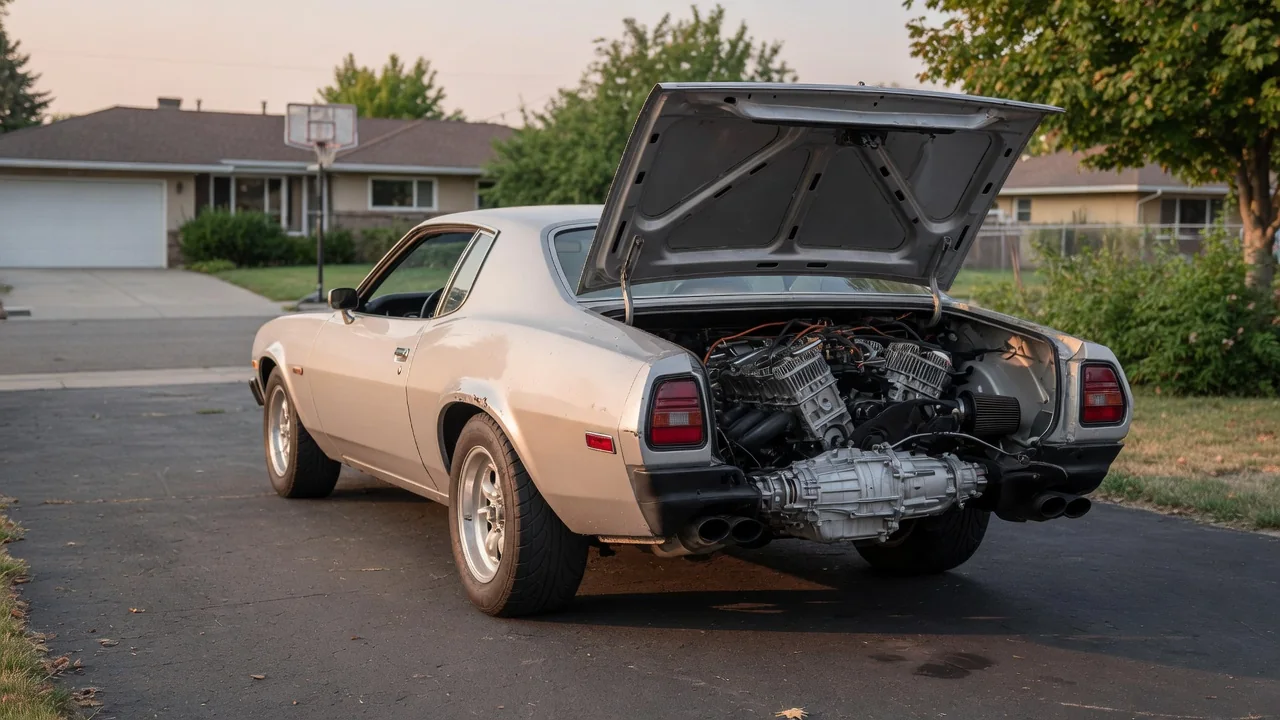
What is a rear engine car? In simple terms, it is a vehicle whose engine sits at the back, behind the rear axle line, rather than under a front hood or between the seats and the rear wheels. That single packaging decision shapes where luggage goes, how mechanics reach components, and how the car feels on the road. Here is how the layout works in practice.
Powertrain position
A rear-engine car carries its engine at or behind the centerline of the rear axle, usually driving the rear wheels through a transaxle that combines the gearbox and differential in one housing. This differs from a mid-engine layout, where the engine sits ahead of the rear axle but behind the occupants. The Volkswagen Beetle and Porsche 911 are the best-known examples, and the Chevrolet Corvair brought the idea to American driveways. Because the engine sits so close to the driven wheels, no long driveshaft runs under the floor.
From the outside, clues include cooling vents or louvers on the rear deck or rear fenders, exhaust outlets tucked close beneath the rear bumper, and a short front end with no grille opening feeding a radiator, though water-cooled designs may still mount radiators up front. Details vary widely: some engines are air-cooled, others liquid-cooled; some are horizontally opposed, others inline units laid low under the trunk floor. A few rear-engine models also send power forward for all-wheel drive, so the owner's documentation remains the reliable reference for any specific vehicle.
Cabin/cargo layout
With the engine at the back, the front compartment becomes a luggage space, commonly called a frunk. Its shape is dictated by what shares that space: steering components, a fuel tank in many designs, a spare tire or inflator kit, and sometimes radiators. The result is often a deep but narrow well rather than a wide, flat trunk. Some cars add a shelf or small compartment above the engine at the rear, though heat and engine height limit what fits there.
Inside the cabin, the absence of a driveshaft can allow a low, fairly flat floor, which small city cars use to maximize passenger room within a short body. Sports cars with this layout frequently fit small rear seats that fold into a parcel shelf, tucked ahead of the engine bulkhead. Rear seat room, front trunk volume, and whether a spare wheel is carried all differ by model and generation, so checking the actual car with your own luggage or child seats tells you more than general descriptions.
Service access
Service access depends heavily on how tightly the engine is packaged. On older, simpler designs, lifting the rear lid exposes much of the engine, and routine checks are straightforward. On more modern rear-engine cars, the opening may reveal little more than fluid fill points and a cover panel, with most components reached from underneath or through removable panels in the trunk floor or wheel wells. Larger jobs may involve lowering the engine and transaxle together, which is workshop work requiring proper lifting equipment.
Components are also spread across the length of the car. The battery, brake fluid reservoir, and washer fluid often live in the front compartment, while water-cooled models route coolant pipes between front radiators and the rear engine. That means a leak or a warning can originate far from where a driver expects. If a warning light or stored fault code appears, treat it as a starting point for diagnosis rather than proof that a particular part has failed, and confirm locations in vehicle-specific service information.
Everyday Use and Observations
In daily driving, weight over the driven wheels gives rear-engine cars strong traction when pulling away, especially on wet pavement or hills. The lightly loaded front end tends to make steering feel light, and braking can be effective because weight shifting forward loads the front tires while the rear already carries substantial mass. The trade-off is that a heavy tail can swing wide if the driver lifts off the throttle abruptly mid-corner, a tendency that modern suspension tuning, wider rear tires and stability control greatly reduce.
Other observations are more mundane. Engine noise comes from behind, so the cabin sound differs from a front-engine car and may be more noticeable to rear passengers. Front and rear tires are often different sizes, which can limit rotation patterns, and rear tires may wear faster. Crosswind sensitivity was noted on some older, lighter designs. Loading heavy items in the front compartment can also change how the car feels, so recommended tire pressures and load limits on the door placard deserve attention.
Limits and Next Steps
The layout has limits that explain why it remains uncommon. Cooling an engine far from the car's nose requires ducting or long coolant lines, cargo space is split into awkward compartments, and the rearward weight bias demands careful chassis engineering. Front-engine, front-wheel-drive packaging gives most family cars more usable space for less complexity, while mid-engine designs offer more balanced weight distribution for outright performance. Rear-engine cars therefore survive mainly as sports cars with a long heritage and as a handful of compact city cars.
If you are trying to identify a particular car's layout, look for where the engine lid is, where the luggage space sits, and what the owner's manual says about fluid locations and jacking points. Electric vehicles with a rear-mounted motor share some packaging traits but are not usually described as rear-engine cars in the traditional sense. Before buying one, a test drive, a luggage check, and an inspection by a technician familiar with the layout will reveal more than any broad explanation can.