What Is a Brake Master Cylinder?
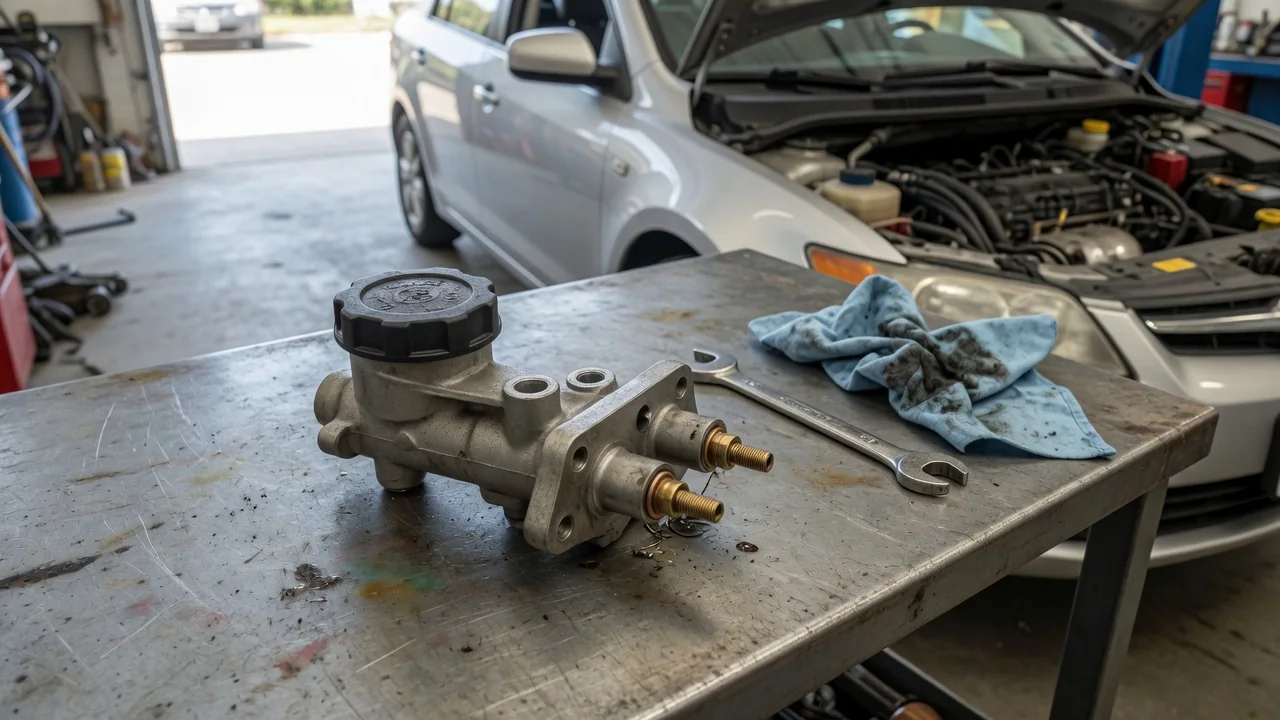
What is a brake master cylinder? It is the component that turns the push of your foot into hydraulic pressure the brakes can use. Mounted at the firewall and fed by a fluid reservoir, it sits between the pedal and the wheels, and understanding how it works makes brake behavior, warning signs, and service decisions far easier to interpret.
Fluid circuits
Modern passenger vehicles use a tandem master cylinder, meaning one housing contains two pistons arranged in line, each serving its own hydraulic circuit. The purpose is redundancy. If a line ruptures or a seal fails in one circuit, the other can still build pressure and slow the vehicle, though with a longer pedal stroke and reduced stopping power. The reservoir above the cylinder is usually divided internally so that a leak in one circuit cannot drain the fluid supply for the other.
How those circuits are divided depends on the vehicle. Some designs split front and rear, with one piston feeding the front brakes and the other feeding the rear. Others use a diagonal split, pairing one front wheel with the opposite rear wheel so each circuit keeps a front brake working. You can often see two or more steel lines leaving the cylinder body, but on vehicles with anti-lock brakes those lines typically run to a hydraulic control unit first, so the routing alone does not reveal the split.
Pressure path
Pressing the pedal moves a pushrod, usually through a brake booster that adds assist using engine vacuum or an electric or hydraulic source. The pushrod drives the primary piston forward in its bore. As the piston's seal passes a small compensating port, the fluid ahead of it is sealed off from the reservoir and has nowhere to go. Because brake fluid is practically incompressible, further pedal travel becomes pressure, and that trapped pressure also pushes the secondary piston forward to pressurize the second circuit.
From there, pressure travels through rigid steel lines and short flexible hoses to the calipers or wheel cylinders. The pistons at the wheels have a larger combined area than the master cylinder bore, so the modest pressure created by your foot is multiplied into a much greater clamping force on the pads or shoes. Releasing the pedal lets return springs push the master cylinder pistons back, reopening the ports so fluid can return and expand or contract with temperature. Bore sizes, booster types, and valve arrangements differ between vehicles.
Fault clues
The classic clue of an internal master cylinder problem is a pedal that slowly sinks toward the floor under steady pressure, such as while waiting at a stoplight, with no visible fluid loss. That pattern can indicate fluid slipping past worn piston seals inside the bore rather than escaping the system. A soft or spongy pedal, by contrast, more often points toward air in the lines, and a low, long pedal can come from worn friction parts or adjustment issues, so pedal feel alone is not conclusive.
External leaks leave different evidence. Fluid seeping from the rear seal may appear as dampness where the cylinder meets the booster, or it may be drawn into the booster and stay hidden. A falling reservoir level, dark or contaminated fluid, and a red brake warning light are all worth attention, yet each has several possible causes, including normal pad wear lowering the level. Any stored fault code related to brake pressure is evidence to interpret alongside these observations, and its meaning should be confirmed for the specific vehicle.
Everyday Use and Observations
In normal driving, a healthy master cylinder goes unnoticed. The pedal should feel firm, engage at a consistent height, and respond proportionally, so a light press produces gentle slowing and a harder press produces stronger deceleration. Consistency is the useful benchmark. Drivers who know how their pedal normally feels are well placed to notice when travel grows longer, the engagement point drops, or the pedal needs pumping to feel firm, all of which deserve investigation before they become a safety problem.
Under the hood, the reservoir is usually a translucent plastic container near the driver's side of the firewall, marked with minimum and maximum lines. The level can be checked through the plastic without opening the cap, which helps keep moisture and dirt out of the fluid. A gradual drop over many months often tracks pad wear, while a faster drop suggests a leak somewhere. Reservoir location, cap markings, and the specified fluid type vary, so the owner's manual is the right reference for a particular vehicle.
Limits and Next Steps
A master cylinder can only do its job if the rest of the hydraulic system is sound. It cannot compensate for air in the lines, swollen hoses, seized calipers, or fluid degraded by absorbed moisture, and those faults can imitate master cylinder failure closely. On many newer vehicles, including hybrids and electric models, the unit is integrated with electronic brake boosters or brake-by-wire modules, so pedal feel is partly simulated and diagnosis depends on manufacturer-specific procedures and equipment rather than simple observation.
If the pedal sinks, feels different from usual, or a brake warning light comes on, the sensible next step is a professional inspection rather than continued driving on the assumption that it will hold. A technician can check for external leaks, test whether pressure holds, and separate a master cylinder fault from problems elsewhere in the system. Because brake hydraulics are safety critical and replacement involves bleeding and sometimes electronic calibration, this work is best left to qualified hands using the vehicle's service information.