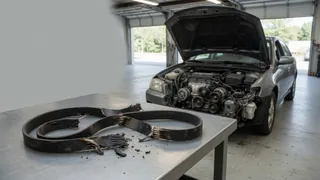
What Happens When a Serpentine Belt Breaks
A snapping serpentine belt changes a routine drive almost instantly. One moment the engine is running its accessories normally, and the next the steering can grow heavy, the battery warning lamp may glow, or the temperature gauge starts climbing. The exact symptoms depend on what the belt was turning and how quickly the driver reacts. Understanding the immediate failure sequence clarifies why this inexpensive ribbed belt is so central to predictable vehicle operation and why the first seconds after it breaks shape the safest response.
Essential answer
When the belt breaks, the accessories driven by the crank pulley stop receiving rotational force. Power steering assistance typically disappears, making low-speed steering noticeably heavier. The alternator stops charging, so the vehicle begins drawing down the battery while the charging warning light may illuminate. In many engines the water pump is also on the same belt route, which means coolant circulation can cease and the engine may start to overheat if operation continues.
The engine itself usually keeps running because the crankshaft still turns and the valvetrain is not driven by this external belt. What happens to a car when the serpentine belt breaks therefore depends on belt routing. If the water pump is belt-driven, continued driving creates the greatest risk. If the water pump is driven another way, the immediate concerns are limited charging and steering assist, giving the driver a short window to pull over safely.
How it works
A serpentine belt is a single, wide ribbed belt that wraps around the crankshaft pulley and several accessory pulleys in one continuous route. The tensioner maintains steady pull on the belt by using spring or hydraulic force, while idler pulleys can change the wrap angle or guide the belt between components. Good pulley alignment keeps the belt centered on each grooved accessory pulley so it transfers rotation without slipping excessively or walking off the edge.
As the belt degrades, cracks, glazing, fraying, or contamination reduce its grip. A failing tensioner may allow slack that lets the belt slip, overheat, and eventually snap. Abrupt breakage can also occur when a pulley bearing seizes, because the moving belt is dragged across a stationary surface and rapidly cuts through. This explains why noise, visible cracking, or a flickering charge light can be an early warning rather than an isolated cosmetic issue.
Strengths, limitations and suitability
The serpentine system’s main strength is simplicity. One belt replaces multiple older V-belts, reduces parts count, and makes belt routing easier to inspect. The automatic tensioner also removes the guesswork of periodic manual adjustment. For most drivers, this means predictable accessory operation with limited routine attention. The design works especially well when pulleys are clean, bearings are sound, and the belt is replaced before age or environmental exposure compromises its structure.
The trade-off is single-point dependence. Because one belt drives the power steering pump, alternator, and often the water pump, a single failure can disable several systems at once. Vehicles used in dusty, high-heat, or stop-and-go conditions may expose the belt to more heat cycling and abrasive contamination. The system suits owners who inspect or replace the belt by the vehicle maker’s interval, but it is less forgiving for those who ignore noise or visible wear.
Procedure
An inspection starts with the engine off and the key removed. Looking at the belt’s ribbed side and outer surface can reveal cracks, glazing, missing chunks, frayed cords, or fluid contamination. A quick check of the tensioner and idler pulley should focus on smooth rotation and absence of wobble at the accessory pulley. Belt routing is often shown on a diagram under the hood, which helps confirm the belt is sitting fully inside each grooved pulley.
Replacement requires releasing tension from the automatic tensioner, routing the new belt exactly as shown, and confirming that the ribs seat evenly in every accessory pulley. After installation, starting the engine and listening for squeal, flapping, or misalignment can identify a routing error before the belt is damaged. If pulley damage, coolant leakage near the water pump, or a seized bearing is found, those components may need attention before a fresh belt will last.
Diagnosing a problem
A sudden loss of power assist and a glowing battery light are the most common clues after a break. If the temperature gauge then rises, the water pump is likely on the same belt and the engine should be shut off promptly to reduce the chance of heat damage. A belt that appears intact but rides partly off an accessory pulley suggests a tensioner or alignment problem, while a burning rubber smell often points to a seized pulley dragging against the belt.
A diagnostic code is evidence to interpret rather than proof that one component has failed. Charging system codes may appear because the alternator stopped turning, not because the alternator itself is defective. The immediate check is visual: locate the belt, see whether it is broken or displaced, and inspect which pulleys turn freely by hand with the engine off. Vehicle-specific belt routing and component locations should be confirmed before concluding the cause.