What Happens When a Serpentine Belt Breaks: Can You Drive Without It
A serpentine belt coordinates several under-hood accessories from one long, ribbed loop. When it fails while driving, the immediate symptom is often a heavy steering feel, an illuminated battery warning, or a rising temperature gauge. The question of whether you can continue running a car without it depends on which accessories that particular engine drives and how long the remaining battery reserve will last. The safest course is usually to stop promptly and have the vehicle inspected, because the belt does far more than spin a single pulley.
Essential answer
No, you should not knowingly keep driving after a serpentine belt breaks. Without belt rotation, the alternator stops charging, so the vehicle begins consuming the battery state of charge rather than replenishing it. On many engines, the water pump is also driven by the same belt, meaning the engine can overheat within a short distance. You might be able to move the car a few yards to a safer spot, but the belt remains a required link for safe continued operation.
The type of failure matters when you interpret what happened. A running car without a serpentine belt may feel normal for moments until warning lamps appear, while a snapped belt can wrap around nearby pulleys and damage other components. If the engine was already hot before the failure, the margin is smaller. Treat the event as a demand to stop and shut the engine off rather than testing how far the vehicle can travel on battery power alone.
How it works
The belt transmits mechanical energy from the crankshaft pulley to accessories such as the alternator, power steering pump, air conditioning compressor, and frequently the water pump. When the crankshaft turns, its pulley drives the belt through friction against the grooved ribs, causing each driven pulley to rotate. This shared drive explains why one broken loop can disable several systems at once and why belt routing and tension are important to efficient operation.
Important starting and charging functions depend on that same rotation. The alternator must spin to produce current and support the electrical system once the engine is running. During starting, the starter circuit draws heavily on the battery through the ignition switch and starter, but once the engine starts, the alternator normally takes over. Without belt-driven alternator rotation, the vehicle is operating on stored battery energy, which eventually reduces cranking speed and can prevent a future restart.
Strengths, limitations and suitability
The main strength of a serpentine layout is packaging and service access: one tensioner and one routed belt replace several older V-belts while still driving every accessory. The compromise appears at failure because the loss is broad rather than isolated. In cold weather, a worn belt may slip and squeal more noticeably; in high electrical demand, the alternator load increases. These conditions do not make the belt stronger, but they can expose a drive system already near the end of its useful life.
Suitability depends on expected use and warning signs. Drivers who notice cracking, glazing, oil contamination, or chirping at startup have an opportunity to replace the belt before a roadside failure. Someone who frequently drives in hot weather should pay extra attention because the cooling load can be high while the belt also powers the water pump. The system is practical when maintained, but a vehicle with an unknown belt history should not be used for a long trip without an inspection.
Procedure
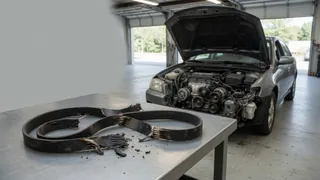
The first action after a belt failure is to stop the engine safely and switch off electrical loads. Leaving the engine running without the alternator can drain the battery and may allow the engine to overheat if the water pump is not turning. After the vehicle is stopped, open the hood only when the engine has cooled, and inspect for a missing, loose, or shredded belt. Also check whether any pulley is seized, because simply installing a new belt on a locked component will not solve the problem.
Replacement should follow the specific routing diagram for the vehicle and use the correct length and rib count. The tensioner must move freely and maintain enough tension to prevent slip under load. After installation, start the engine and confirm that the battery warning clears, steering assist returns, and coolant temperature stabilizes. Because belt routing and required belt length vary, the exact replacement procedure should be confirmed for the particular make and model before parts are purchased.
Diagnosing a problem
Several observable clues help separate causes when a belt has failed. If the car was running and then overheated, the belt likely drove the water pump, and continued heat buildup can be expected. If the steering became hard at the same time, the pump for power assist stopped turning. A serpentine belt broke and the car won't start afterward could indicate a drained battery from continued operation rather than a defect in the starter itself, but a separate electrical or fuel delivery problem is still possible.
Diagnostic checks should begin with visible belt condition and accessory rotation rather than replacing parts on a guess. A fault code is evidence to interpret, not proof that a sensor or component has failed. If battery voltage falls after the engine starts, alternator output may be absent because the belt is not driving it. If cranking speed is slow, the battery may be discharged from running without charging support. Start circuit, fuel delivery, and ignition function should also be verified rather than assuming the belt explains every no-start condition.