What Does TPMS Mean on a Car and How Does It Work?
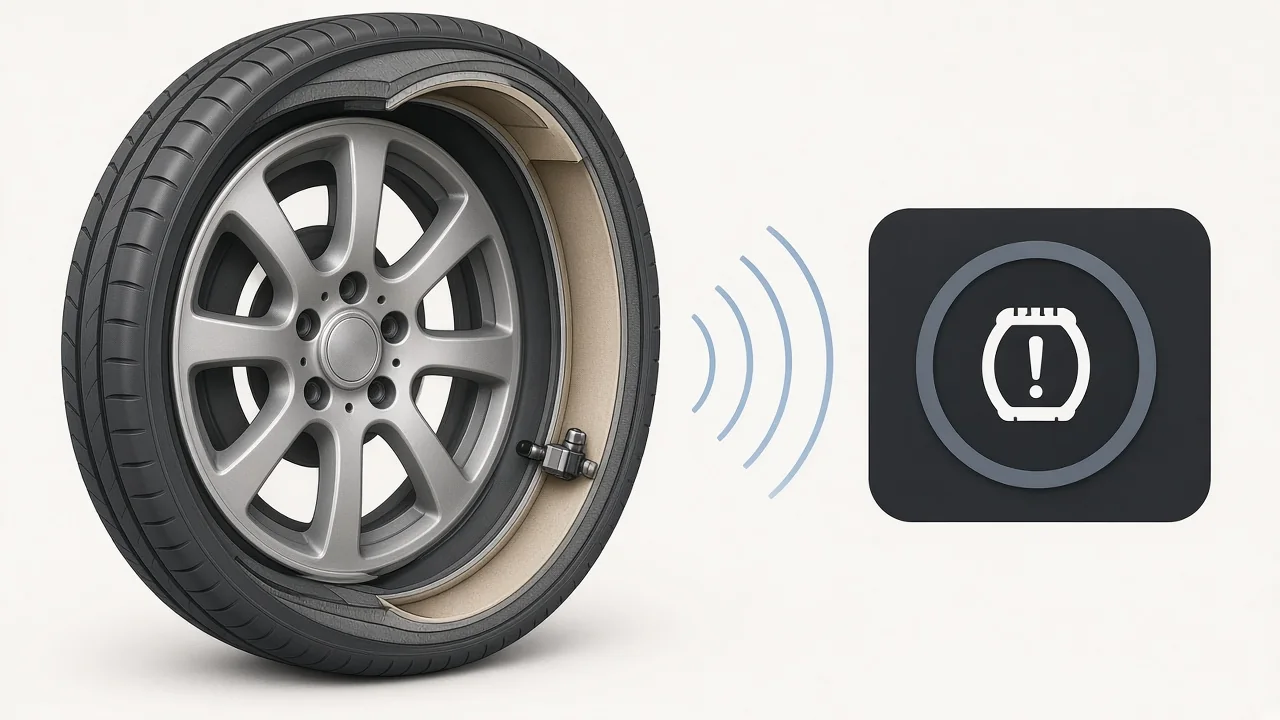
If you have seen the letters TPMS in an owner's manual or on a dashboard message, they refer to a safety system that watches your tires for low air pressure. Understanding how TPMS in tires works, what the sensors do, and what the warnings can and cannot tell you helps you treat the system as a helpful alert rather than a substitute for regular pressure checks.
What TPMS Stands For and What It Does
TPMS stands for tire pressure monitoring system. Its job is to alert the driver when one or more tires has lost enough air to become significantly underinflated, a condition that can be hard to spot by eye, especially on tires with short, stiff sidewalls. The term describes the whole system rather than a single part: something has to sense tire condition, electronics have to process that information, and the car has to present an alert on the instrument cluster or information display.
Correct inflation matters because air pressure supports the vehicle's weight and shapes the contact patch that meets the road. An underinflated tire flexes more, builds more heat, can wear unevenly, and may make steering and braking feel less precise. It also tends to increase rolling resistance, which can affect fuel use. Keep in mind that TPMS only monitors and reports. It does not add air, seal a leak, or compensate for temperature changes, so the driver still has to act on the information.
What a Tire Pressure Sensor Is and Where It Sits
In a direct system, each monitored tire contains a pressure sensor, a small electronic device that measures the air pressure inside the tire. The sensor typically lives inside the tire and wheel assembly, and many designs attach to the inner end of the valve stem so they sit against the wheel rim. Other mounting arrangements exist, including sensors held by a band or fastened elsewhere inside the wheel, so the exact layout depends on the vehicle and wheel design.
Inside the housing, a pressure-sensing element converts air pressure into an electrical signal, a transmitter sends that data by radio, and a small power source, commonly a sealed battery, keeps the unit running. Many sensors also report temperature or status information. Because the sensor is hidden inside the tire, the outside of the wheel reveals little. A valve stem that looks ordinary, with a standard cap and a rubber or metal body, does not tell you whether a sensor is attached behind it.
How Direct TPMS Sends Pressure Information to the Car
As the wheel turns, a direct TPMS sensor measures pressure and sends a coded radio message that includes its own identification. A receiver in the vehicle picks up those transmissions and passes the data to monitoring electronics, which may be a dedicated module or a function built into another control unit. The identification lets the car recognize its own sensors and ignore signals from nearby vehicles, and on some systems it also allows the car to associate each reading with a wheel position.
The monitoring electronics compare reported pressures against the low-pressure criteria programmed for that vehicle and turn on a warning when those conditions are met. Some cars go further and show each tire's pressure on the cluster or infotainment screen, while others provide only a general warning light. Sensors do not broadcast nonstop; they transmit on schedules that can change with driving and pressure changes, and displays update accordingly. A displayed value is a recent report, not necessarily a live, instantaneous measurement.
How Indirect TPMS Uses Wheel Rotation
Indirect TPMS takes a different approach. Instead of placing sensors in the tires, it relies on the wheel speed sensors already used by the anti-lock braking and stability systems, combined with software that looks for patterns linked to underinflation. The underlying idea is simple: a tire that loses air changes shape slightly as it rolls, and that change can alter how fast the wheel turns or how it vibrates compared with the other wheels under similar driving conditions.
A softer tire has a slightly smaller rolling radius, so it may rotate a bit faster over the same distance, and its extra flex can change the vibration characteristics the software watches. Because the system infers a problem from wheel behavior, it does not measure the actual air pressure inside each tire and typically cannot display pressure values. It depends on vehicle-specific learning of normal tire behavior, and driving conditions affect how quickly it recognizes a change; setup procedures vary by manufacturer.
What TPMS Alerts Can Tell the Driver
The most familiar TPMS alert is an amber symbol shaped like a tire cross-section with an exclamation mark in the center. Its basic purpose is to tell the driver that the system has detected a condition worth checking, most often low pressure. Beyond that, the detail varies. Some vehicles identify the affected tire or show a text message, while many simply light the symbol, and no system explains why pressure dropped, whether from a puncture, a slow leak, or cold weather.
An unlit warning is not a clean bill of health. The system alerts at its own threshold, so a tire can sit below its recommended pressure without triggering anything, and TPMS does not detect cuts, bulges, or worn tread. That is why regular checks with a gauge remain important. Compare readings with the recommended cold pressures, measured before driving warms the tires, which are usually listed on the tire information placard. The owner's manual explains the specific messages your vehicle can display.
Which Cars Have TPMS and How to Check Yours
TPMS is standard equipment on most modern passenger vehicles sold in the United States, but availability still varies with a vehicle's age, class, and the market it was originally built for. Older cars, some heavier vehicles, and imports may differ. The most reliable starting point is the owner's manual, which normally states whether the car has TPMS, how the warning behaves, and what the display can show. Window stickers, build sheets, and other equipment records can also confirm the feature.
Many vehicles include a tire-pressure page in the instrument cluster or infotainment menu, and exploring it can reveal which display features are available. Not seeing individual pressure readings, however, does not mean the car lacks TPMS; an indirect system or a warning-only direct system may simply present less detail. When documentation is missing or unclear, the manufacturer's customer support or a qualified tire or service shop can identify the installed system. Replacement sensor compatibility is a separate question that needs vehicle-specific confirmation.