What Does Engine Displacement Mean?
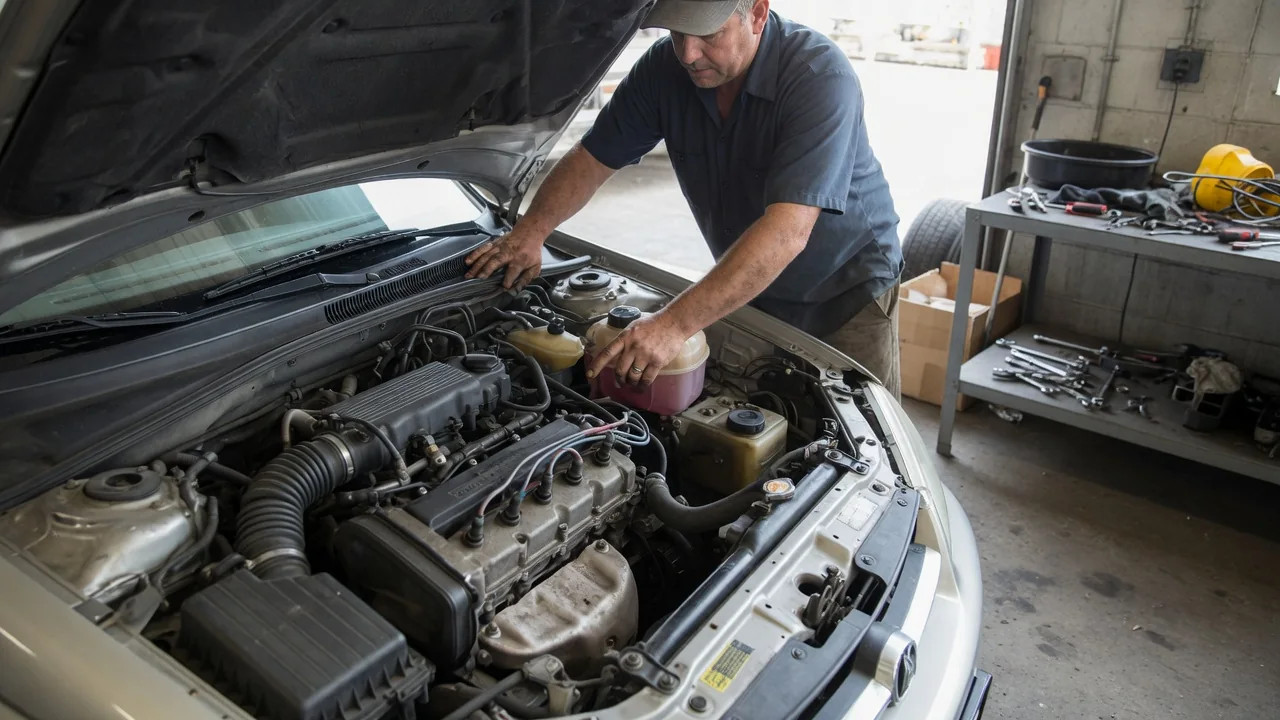
Anyone asking what does engine displacement mean is really asking about volume. Displacement is the total space that an engine's pistons sweep as they travel from the top of their cylinders to the bottom, added together across every cylinder. It describes the engine's physical size as a measured quantity, usually expressed in liters, cubic centimeters or cubic inches, and nothing more than that.
Bore and stroke
Bore is the diameter of a cylinder, and stroke is the distance the piston travels between its highest point, called top dead center, and its lowest point, bottom dead center. Together these two dimensions define a cylindrical space. The swept volume of one cylinder is the area of the bore circle multiplied by the stroke length, and multiplying that result by the number of cylinders gives the engine's total displacement.
As an illustration, imagine a hypothetical four-cylinder engine with a bore of 86 millimeters and a stroke of 86 millimeters. Each cylinder would sweep roughly 500 cubic centimeters, so the four together come to about two liters. A different engine could reach the same total with a wider bore and shorter stroke, or the reverse. Neither dimension is visible from outside the engine, so the actual figures have to come from the manufacturer's published specifications for that particular vehicle.
Unit conversion
Displacement appears in three common units, and they all describe the same volume. One liter equals 1,000 cubic centimeters, so an engine listed at 1,500 cc is also a 1.5-liter engine. Cubic inches, a unit long used in American specifications, convert at roughly 61 to the liter. A 5.0-liter engine therefore works out to about 305 cubic inches of swept volume, although the number used in a model name may differ slightly from the calculated value.
Which unit a reader encounters depends on the vehicle and its market. Passenger cars and trucks sold in the United States are generally described in liters, motorcycles and small engines often in cubic centimeters, and older American vehicles in cubic inches. Published figures are usually rounded, so an engine marketed as a 2.0-liter may measure a little under or over 2,000 cubic centimeters. When the exact value matters, the precise figure in the vehicle's documentation is the one to rely on.
Limits
Displacement measures only the volume swept by the pistons. It does not include the combustion chamber space that remains above the piston at the top of its travel, which is why swept volume and total cylinder volume are different quantities. The relationship between the two is described by compression ratio, a separate specification. A displacement figure also says nothing about how completely each cylinder fills with air during operation, which varies with engine design and conditions.
For that reason, displacement on its own is a statement about geometry, not a prediction of how an engine behaves. Two engines with identical swept volume can differ in cylinder count, valve arrangement, fueling method and whether they use a turbocharger or supercharger. Conventional piston engines fit the definition neatly, while rotary engines are measured by a different convention and electric motors have no displacement at all. Comparing figures across those categories requires care, because the number does not mean the same thing.
Everyday Use and Observations
Most drivers meet displacement as a number rather than a measurement. It may appear on a trunk or fender badge, on the plastic engine cover, in the owner's manual specification tables or on the emissions label under the hood, which on many vehicles lists engine size in liters. Registration and insurance paperwork sometimes records it as well. Where it appears, and whether it appears at all, varies by manufacturer, model year and market.
The figure becomes practical when identifying which engine a vehicle actually has. Many models are offered with more than one engine, and parts such as filters, spark plugs, belts and gaskets are often cataloged by engine size. Knowing the displacement helps narrow a parts lookup or a service information search, though it is rarely sufficient alone, since two engines of the same size in the same model line can use different components. The vehicle identification number usually settles which version is fitted.
Limits and Next Steps
Badges and model names deserve some caution. A number on the trunk lid may reflect a marketing designation and not the measured volume, and some manufacturers use numbering that no longer corresponds to engine size at all. Engines can also be swapped or rebuilt over a vehicle's life; machining the cylinders to a larger bore during a rebuild changes the swept volume slightly. A printed figure is therefore a starting point that describes the engine as originally specified.
Confirming the displacement of a specific vehicle is straightforward. The owner's manual, the under-hood emissions label and a VIN-based lookup through a dealer or parts counter should agree, and any disagreement is worth resolving before ordering parts. Readers who want to verify the math can apply the bore, stroke and cylinder count from the manufacturer's specifications to the swept-volume calculation described earlier. For questions about what a given engine needs in service, vehicle-specific information remains the appropriate reference instead of displacement alone.