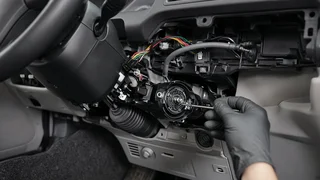
Volvo Steering Angle Sensor Reset and Calibration

A steering angle sensor gives the stability and chassis systems a live measurement of where the front wheels are pointed. When that signal drifts or loses its zero reference after a wheel alignment, suspension repair, or steering component replacement, a Volvo may require a reset or calibration procedure to restore accurate behavior. The process depends on the model and the diagnostic equipment available. Understanding the difference between clearing a stored adaptation and performing a full calibration helps owners interpret warning messages and avoid unnecessary parts replacement.
Essential answer
The essential answer is that a Volvo steering angle sensor reset typically clears the existing learned center position, while a calibration teaches the module a new zero point and validates the signal across steering travel. These tasks overlap in normal workshop language but are not always identical. A reset alone may temporarily satisfy a control module after a battery disconnect, whereas calibration is usually required after the steering rack, column, tie rods, or suspension geometry has been disturbed enough to change the relationship between the steering wheel and the front wheels.
Volvo S60 and XC90 steering angle sensor reset and calibration procedures generally begin with centering the steering wheel, confirming the front wheels are straight, and using a compatible scan tool to command the relevant control module. Some vehicles may also accept a dynamic calibration by driving slowly in a straight line while the system relearns the center reference. The exact routine varies by platform and generation. For that reason, a fault code indicating a steering angle plausibility error should be treated as a diagnostic starting point rather than proof that the sensor itself has failed. Wiring, alignment, mounting points, and incorrect adaptations can all produce similar symptoms.