Volvo S40 inner CV joint
A worn or failing inner CV joint changes how a Volvo S40 puts power down, often before it becomes obvious from the driver’s seat. Because the S40 was offered across different model generations, powertrain configurations, and front- or all-wheel-drive layouts, the exact axle arrangement can vary with the model year, trim level, and market specification. The inner joint is the inboard connection where the drive axle meets the transmission or intermediate shaft, and it handles both engine torque and suspension movement. Symptoms such as vibration under acceleration, clunking when loading or unloading the driveline, or grease slung near the inboard boot deserve prompt diagnosis before a small wear issue becomes a stranded vehicle.
The direct answer
The immediate answer is that a Volvo S40 inner CV joint should be evaluated as a wear item that may need replacement when it produces vibration, noise, or visible grease loss, but the correct repair path depends on the body style, powertrain configuration, and market specification of the car. Inner joints typically fail more gradually than outer joints because their operating angles are smaller, yet they still work hard as the suspension moves through its travel. A heavy shudder under hard acceleration, especially from low speed, points toward excessive play in the inboard joint rather than a tire or wheel concern.
Before buying a replacement, confirm whether your S40 uses a one-piece axle assembly or a serviceable inner joint with a separate boot kit. Different model generations and trim levels may use different axle lengths or spline counts, so a part described only as fitting a Volvo S40 is not automatically correct for every car. The condition that materially changes the answer is whether the axle shaft, seal, or adjacent bearing has also been damaged. If the boot has been torn long enough for contamination to enter, replacing only the boot can leave a joint that is already scored and noisy.
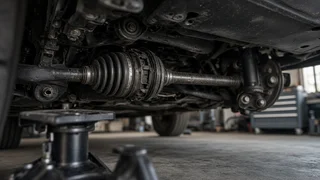
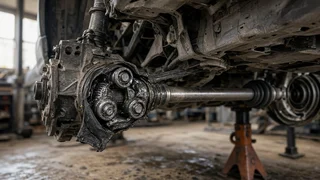
The inner CV joint’s primary job is to transmit torque while allowing the axle to change length and angle as the suspension compresses and rebounds. On a front-wheel-drive S40, the inboard joint uses a tripod or ball-and-housing design that slides on rollers or balls, which is why abrupt throttle inputs can reveal radial play as a shudder through the floor or steering wheel. Because the joint also accommodates plunge, a failing inner joint may feel different from an outer joint failure: the classic outer CV click during tight turns is often replaced by a thrumming sensation when accelerating straight ahead.
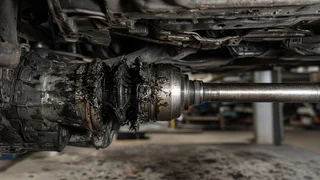
Grease retention is another key function of the joint. The inboard boot sits near the transmission or intermediate shaft and is exposed to engine heat, road debris, and repeated flexing. Once a boot splits, centrifugal force flings grease outward and lets water or grit enter. A torn inner boot can produce a fine spray of dark grease on the underbody, transmission case, or exhaust heat shield, while the joint slowly loses its lubricant film. Catching that sign early can preserve the joint and reduce the scope of the repair.
Several plausible causes can mimic a bad inner CV joint, so the diagnosis should isolate the inboard axle connection before ordering parts. Engine or transmission mounts that have collapsed allow the drivetrain to shift under load and can create a clunk or torque-induced vibration similar to joint wear. A worn intermediate shaft bearing on some configurations, or a failing wheel bearing, may also produce speed-related noise that seems to come from the axle area. Separating these possibilities matters because replacing a good CV joint will not cure a mount or bearing problem.
Vehicle-specific confirmation is important for manufacturer-dependent codes and for parts selection. A fault code related to the drivetrain is evidence to interpret, not proof that an inner joint has failed, and many CV joint problems produce no diagnostic trouble code at all. When a code does appear, it may reflect a secondary issue such as an ABS signal disturbance from axle movement or a transmission sensor reading. Verify the axle part number against the model generation, engine, and gearbox rather than assuming that any S40 axle from the same era will interchange.
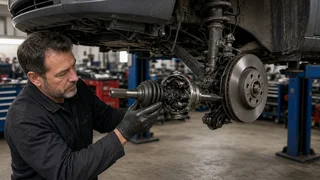
A practical first step is to inspect the inboard boots with the front of the car safely supported and the wheels off the ground. Look for cracks, splits, loose clamps, or grease weeping at the large and small ends of the boot. Rotate each wheel by hand and feel for roughness or excess free play at the inner joint while holding the axle near the transmission. A small amount of plunge movement is normal, but a distinct step or metallic looseness when changing direction suggests wear. Compare both sides when possible, because noise and wear often start on one axle first.
If the joint itself is confirmed worn, replacement of the complete axle assembly is a common repair approach because it restores both joints, fresh boots, and new grease in one step. A separate inner joint may be available for some S40 variants, but it requires careful disassembly and exact compatibility with the shaft. Whichever route you choose, inspect the transmission side seal and the mating surface before installing the new part. A leak at the seal can contaminate the new joint area and lead to repeated failure, so the repair should address both the joint and its immediate sealing environment.