Understand electronic diesel control (EDC)
Electronic diesel control, often shortened to EDC, describes the computer-managed side of a modern diesel fuel system. Diesel combustion relies on high fuel pressure and precisely timed delivery, and an EDC vehicle uses sensors, actuators, and an engine control module to coordinate that process continuously. Instead of a purely mechanical governor, the system adjusts injection quantity, timing, and fuel pressure in response to load, throttle position, temperature, and engine speed. Understanding EDC helps owners interpret performance changes and diagnose fuel-related behavior without assuming a mechanical fault is always responsible.
Essential answer
EDC is the electronic management layer that governs how a diesel engine receives fuel. The control module reads inputs such as accelerator position, crankshaft speed, coolant temperature, and boost pressure, then commands the fuel pump and injectors accordingly. Fuel pressure becomes an actively managed variable rather than a fixed mechanical result. The system can raise pressure for cold starts, reduce delivery during overrun, and adjust injector timing to improve combustion quality. This closed-loop approach is the central difference from older mechanically injected diesels.
The system also performs constant fuel trim adjustments. If sensor feedback indicates that actual fueling differs from the requested amount, the module modifies injector duration or rail pressure to compensate. A restricted fuel filter, a weak fuel pump, or a failing injector can therefore appear first as a change in engine smoothness or response. EDC does not cause those mechanical problems, but it reacts to them. That distinction matters because a stored fault code describes what the control system observed, not necessarily which component has failed.
Identification and location
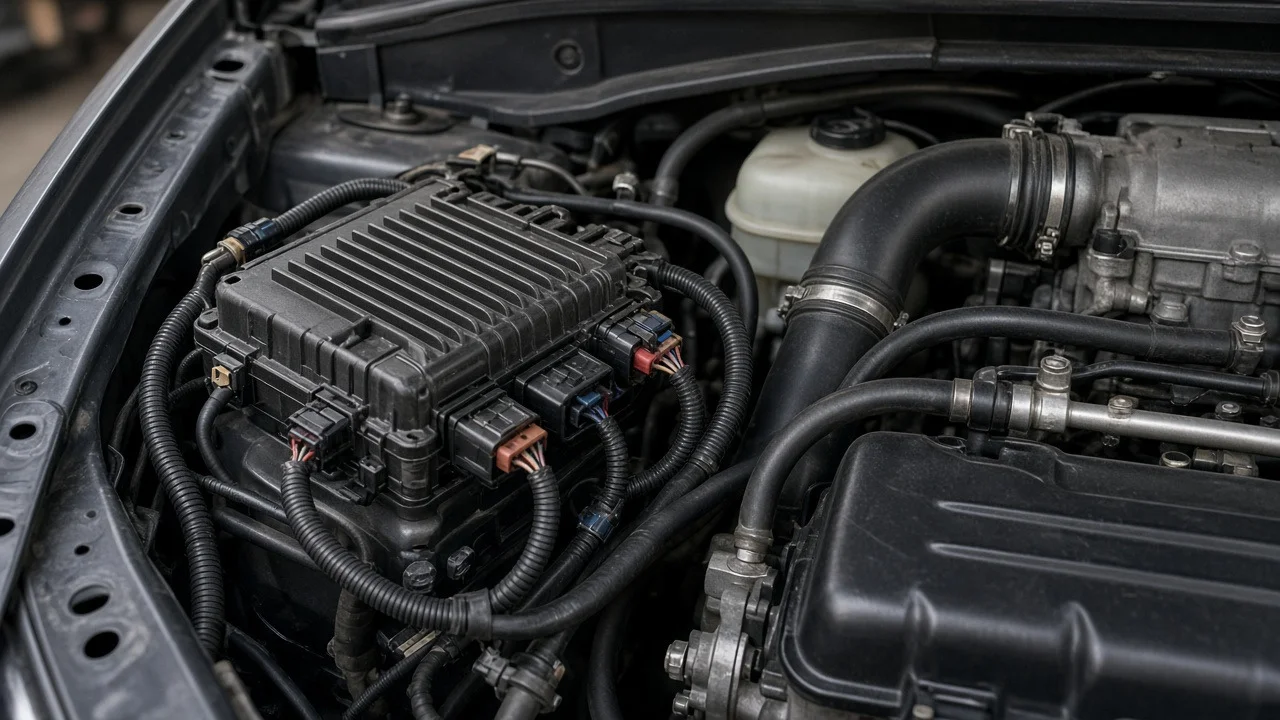
Identifying an EDC-equipped diesel usually begins with the vehicle information label or the engine compartment layout. The system itself is distributed rather than housed in a single visible part. A high-pressure fuel pump, a common rail or unit injector arrangement, an electronic throttle pedal, and several pressure and temperature sensors connect through an engine wiring harness. On many vehicles, the engine control module is mounted near the firewall, the inner fender, or inside a protected enclosure. The presence of an OBD port alone does not confirm EDC, since that port appears on gasoline vehicles as well.
Location cues depend on engine configuration. A common rail diesel typically shows a thick metal rail feeding individual injector lines, while an older electronically governed rotary pump may look similar to a mechanical pump but carries an additional wiring connector. The fuel filter housing often includes a water-in-fuel sensor and sometimes a temperature or pressure switch tied to the control system. When checking underhood components, treat similar-looking connectors with care. Manufacturer-dependent control layouts mean that a sensor or module position on one EDC vehicle does not reliably identify the same part on another engine family.