UK VIN Numbers Explained: What They Are, Where to Find Them and How to Read Them
A UK VIN number is the vehicle identification number assigned to a car, van or motorcycle by its manufacturer. It identifies that specific vehicle for its whole life. Most vehicles on UK roads use the same 17-character format found across Europe and North America. A UK VIN does not change when the car changes owner or number plate, which makes it the most dependable way to confirm a vehicle's identity when buying, insuring, ordering parts or checking for recalls. One qualification affects how you read a VIN. The 17-character standard is shared internationally, but European rules require less encoded information than US rules. A vehicle identification number in the UK may not contain a reliable model year or check digit, two features that US readers often expect. Older vehicles and some imports may also carry shorter chassis or frame numbers instead of a full 17-character VIN.
What a UK vehicle identification number is, and what it is not
A VIN is a factory identifier, not a registration. It is easily confused with several other numbers that appear on UK vehicles and documents.
Registration number (number plate): issued by the DVLA and displayed on the plates. It can change if a private plate is transferred on or off the vehicle, while the VIN stays the same. Engine number: stamped on the engine itself. It identifies the engine, which can be replaced, rather than the vehicle. Chassis or frame number: on older vehicles and on some imports, this was the vehicle's main identifier before the 17-character VIN became standard. On modern vehicles, documents may use 'chassis number' and 'VIN' to mean the same thing. Paint, trim and option codes: usually printed on a separate manufacturer's label or plate. They are not part of the VIN.
Where to find the VIN on a UK car
Manufacturers place the VIN in several locations so it can be cross-checked. The exact positions vary by make, model and generation, so treat the list below as typical places to look rather than a guarantee for any particular vehicle. The owner's handbook for your specific vehicle should show where its VIN appears.
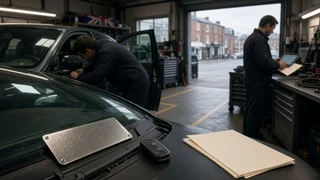
Base of the windscreen: many modern cars have a VIN plate visible through the glass from outside. On UK-market cars it is often on the nearside (the left, passenger side). Door pillar or door edge: a sticker or plate is often visible when a front door is opened. Under the bonnet: the number may be stamped into the bulkhead, an inner wing or a strut tower, or shown on a manufacturer's plate. Bodyshell or floorpan: some vehicles have the VIN stamped into the metal, sometimes under a flap in the carpet near a front seat or in the boot area. V5C registration certificate (logbook): the VIN or chassis number is recorded in the vehicle details section. Other paperwork: MOT certificates, insurance documents, service records and dealer invoices commonly show the VIN.
When checking a car, compare the VIN on the V5C with at least one physical location on the vehicle, ideally two or more. Every instance should match exactly. If plates look tampered with, stampings are damaged or reworked, or the numbers disagree with the documents, treat that as a serious warning sign and resolve it before going any further.
How a 17-character VIN is structured
The modern VIN follows an international standard that divides the 17 characters into three sections. The letters I, O and Q are not used, which avoids confusion with the numbers 1 and 0.
Position: 1 2 3 | 4 5 6 7 8 9 | 10 11 12 13 14 15 16 17; Section: WMI | VDS | VIS; Maker | Vehicle | Vehicle identifier; ID | descriptor | (incl. serial number)
Section | Positions | What it generally identifies; World Manufacturer Identifier (WMI) | 1–3 | The region and country associated with the manufacturer, and the manufacturer itself; Vehicle Descriptor Section (VDS) | 4–9 | Vehicle attributes defined by the manufacturer, such as model line, body style or engine type; Vehicle Identifier Section (VIS) | 10–17 | Manufacturer-defined information, which may include model year and assembly plant, followed by a production serial number
The first character indicates a geographic region. Vehicles whose manufacturer codes are registered in the United Kingdom typically have a WMI beginning with S. This reflects where the manufacturer code is registered, not necessarily the market a car was sold in. A UK-market car built in continental Europe or Asia will carry that maker's own code, not a UK one.
Within the VDS and VIS, manufacturers decide what each position means. The same character in the same position can therefore mean different things for different brands. Accurate decoding beyond the basic structure depends on the specific manufacturer's coding scheme.
How UK and European VINs differ from US VINs
Readers who know North American VINs should keep two differences in mind. They are where most misreadings of UK vehicles come from.
Model year: in North America, position 10 is used for a model year code. European rules do not require this. Many manufacturers selling in the UK still encode a model year there, but some use the position differently or not at all, so don't assume position 10 gives the year. The V5C records the date of first registration, which is a separate fact from the model year or build date. Check digit: in North America, position 9 is a calculated check digit used to detect errors and some forgeries. European vehicles are not required to use one. A UK-market VIN that fails a US-style check digit calculation is not necessarily invalid. Assembly plant: North American VINs typically use position 11 for the assembly plant. Many manufacturers follow a similar convention elsewhere, but it is not universal on European-specification vehicles.
Some online decoders are built mainly around North American conventions. They may report a wrong model year or flag a check digit error on a perfectly genuine UK vehicle. Treat decoder output as a starting point, and confirm important details against the V5C, the vehicle's own labels or the manufacturer.
What a VIN can and cannot tell you about specification
The VIN itself usually reveals the manufacturer, the broad model line and, depending on the brand, details such as body style or engine family. Most VINs do not directly spell out the trim level, colour, option packs or full factory equipment list.
That information is normally held in the manufacturer's build records, which are linked to the VIN. A franchised dealer or the manufacturer's customer service team can often retrieve a build specification from the VIN. The details available vary by brand and by the age of the vehicle. Paint and trim codes are often printed on a separate label, commonly found on a door pillar, under the bonnet, in the boot or in the service book.
Market specification is another consideration. A UK-market car is built to the right-hand-drive specification sold through UK dealers. Equipment and lighting may differ from versions sold elsewhere. The VIN does not always state the intended market outright, but build records can confirm it. This matters most with imported vehicles.
Older vehicles, imports and vehicles without a standard VIN
The 17-character format became standard in the early 1980s. Earlier vehicles commonly carry shorter chassis numbers whose format depends entirely on the manufacturer. For classic cars, marque clubs and specialist registers are often the best way to interpret these numbers.
Imports can differ too. Vehicles built for the Japanese domestic market, for example, often carry a shorter chassis or frame number rather than a 17-character VIN. That number is recorded on UK registration documents in the same way. Where a vehicle has no identifiable VIN, as can happen with some kit cars, rebuilt vehicles or vehicles whose identity cannot be established, the DVLA may allocate an identification number to be stamped on the vehicle as part of the registration process.
Practical uses for a UK VIN
Buying a used car: match the VIN on the car with the V5C, and use it alongside the registration number when running a vehicle history check for outstanding finance, write-off records or theft markers. Recalls: manufacturers and dealers can check by VIN whether a specific vehicle is affected by a safety recall and whether the work has been done. Parts ordering: quoting the VIN helps a parts counter identify the correct components where a model had changes during production. Insurance and registration: insurers and the DVLA use the VIN to tie records to the physical vehicle. Specification checks: a dealer or manufacturer can often confirm original factory equipment from the VIN, which helps when assessing whether a car matches its advertised trim.
Key points
A UK vehicle identification number is the permanent, manufacturer-assigned identity of a vehicle. On most modern vehicles it is 17 characters long and divided into maker, descriptor and identifier sections. You can usually find it at the base of the windscreen, on a door pillar, under the bonnet or stamped into the body, and it is recorded on the V5C. Don't assume a UK VIN encodes the model year or uses a check digit the way US VINs do. For trim, colour and factory equipment, use the manufacturer's build records linked to the VIN rather than the VIN alone.