VIN Meaning on a Car: What the 17 Characters Tell You and How to Read Them
What VIN Means on a Car
VIN stands for Vehicle Identification Number. It is a unique code assigned to an individual vehicle, and no two vehicles share one. In the United States, cars and light trucks built for model year 1981 and later use a standardized 17-character VIN made of letters and numbers. Registration, titling, insurance, safety recalls and vehicle history records all rely on it to identify that exact vehicle.
Two conditions change the answer. Vehicles built before the 1981 model year often have shorter VINs that do not follow a common format, so the decoding method in this guide does not apply to them. Some details also vary outside North America. For example, the check digit described below is required for vehicles sold in North America, but manufacturers in other markets do not always use it.
How a VIN Is Structured
A VIN is a set of fixed fields, so each position always carries the same kind of information. The 17 characters fall into three main sections: the World Manufacturer Identifier (WMI), the Vehicle Descriptor Section (VDS) and the Vehicle Identifier Section (VIS). Two single positions inside these sections have special jobs. Position 9 holds the check digit and position 10 holds the model year.
Position: 1 2 3 | 4 5 6 7 8 | 9 | 10 | 11 | 12 13 14 15 16 17; Section: WMI | VDS | CD | MY | PL | Production sequence; WMI = World Manufacturer Identifier; VDS = Vehicle Descriptor Section; CD = Check digit; MY = Model year; PL = Assembly plant; (Positions 10-17 together form the Vehicle Identifier Section)
Positions | Name | What it identifies; 1-3 | World Manufacturer Identifier | The manufacturer and the region or country associated with it; 4-8 | Vehicle Descriptor Section | Vehicle attributes such as model, body style, restraint system, engine or vehicle type, as defined by the manufacturer; 9 | Check digit | A calculated character used to detect errors or invalid VINs; 10 | Model year | The vehicle's model year, which can differ from the calendar year it was built; 11 | Plant code | The assembly plant, as coded by the manufacturer; 12-17 | Production sequence | The serial number that makes the individual vehicle unique
The first character usually indicates the region or country associated with the manufacturer code, which is typically where the vehicle was assembled. Common examples include 1, 4 or 5 for the United States, 2 for Canada, 3 for Mexico, J for Japan, K for South Korea and W for Germany. A brand can build vehicles in several countries, so this character tells you about the vehicle's origin, not the brand's home country.
The letters I, O and Q never appear in a VIN because they are too easily confused with 1 and 0. If you see something that looks like an O, it is a zero.
What a VIN Can and Cannot Tell You
A VIN reliably identifies the manufacturer, model year, assembly plant and the specific vehicle. The meaning of positions 4 through 8 and position 11 depends on the manufacturer, so reading them requires that manufacturer's coding or a decoder that has it. This guide does not list manufacturer-specific codes because those tables vary by brand, model and year.
The VIN itself does not usually record paint color, every optional feature, ownership history, accidents or mileage. Vehicle history reports and recall lookups use the VIN as a search key to pull those records from separate databases. How complete those records are depends on the data source, not on the VIN.
How to Read a VIN Step by Step
You will need access to the vehicle or its documents, a way to write the VIN down accurately (a photo works well) and, if you want full details, a VIN decoder. In the US, the National Highway Traffic Safety Administration (NHTSA) provides a free public VIN decoder, and many manufacturers and parts retailers offer their own.
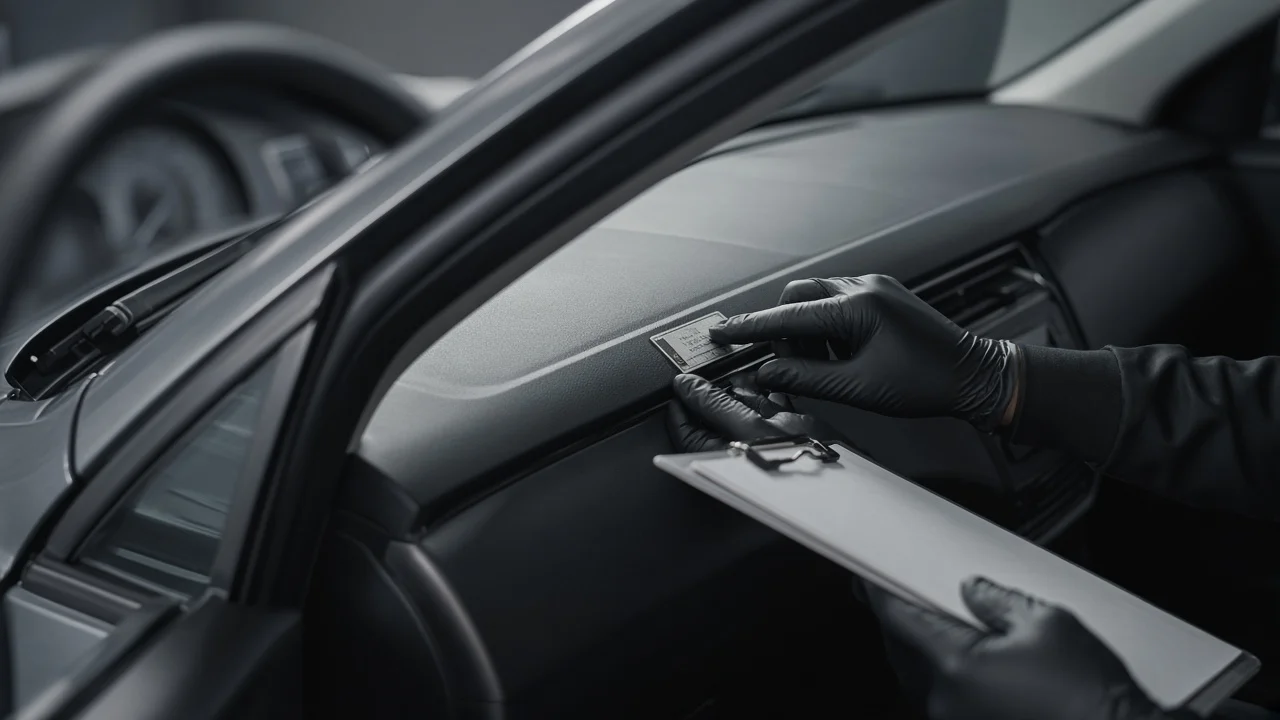
1) Find the VIN. Common locations are the lower corner of the windshield on the driver's side, where a dashboard plate is visible through the glass, and the label on the driver's door jamb. It also appears on the title, registration and insurance documents. Some vehicles have additional stamped or labeled VINs on the frame or body, and these locations vary by manufacturer. Check with the vehicle parked and the engine off. 2) Copy all 17 characters exactly. Read them in order from left to right and count them. A post-1980 US-market VIN with more or fewer than 17 characters has been copied incorrectly or is not a valid standard VIN. 3) Check for forbidden letters. If your copy contains I, O or Q, re-read the plate, because these letters are not used. 4) Compare every location. The VIN on the dashboard, door label and paperwork should match character for character. Stop here if they do not, or if a plate or label looks altered, loose, painted over or replaced. A mismatch can point to a records error, but it can also indicate a rebuilt, salvaged or stolen vehicle. Do not complete a purchase until the discrepancy is resolved through the seller's documentation and, where needed, your state motor vehicle agency or law enforcement. 5) Split the VIN into its sections: positions 1-3 (manufacturer), 4-8 (descriptor), 9 (check digit), 10 (model year), 11 (plant) and 12-17 (serial number). 6) Read the model year from position 10 using the table below. 7) Validate the check digit using the method in the next section. This step applies to North American VINs. 8) Run the VIN through a decoder to translate the manufacturer-specific positions, then compare the results with the actual vehicle, including its make, model, body style and engine.
Reading the Model Year Code
Position 10 uses letters and digits but skips I, O, Q, U, Z and the number 0. The sequence repeats every 30 years, so the same character can stand for two different model years. For example, A can mean 1980 or 2010. The vehicle's age and other decoded details usually make the correct year obvious. Under US rules for passenger cars, multipurpose vehicles and light trucks, position 7 also helps. It is a number for the 1980-2009 cycle and a letter for the 2010-2039 cycle. That rule may not apply to heavier vehicles or other markets.
Code | Model year | Code | Model year | Code | Model year; A | 1980 / 2010 | L | 1990 / 2020 | Y | 2000 / 2030; B | 1981 / 2011 | M | 1991 / 2021 | 1 | 2001 / 2031; C | 1982 / 2012 | N | 1992 / 2022 | 2 | 2002 / 2032; D | 1983 / 2013 | P | 1993 / 2023 | 3 | 2003 / 2033; E | 1984 / 2014 | R | 1994 / 2024 | 4 | 2004 / 2034; F | 1985 / 2015 | S | 1995 / 2025 | 5 | 2005 / 2035; G | 1986 / 2016 | T | 1996 / 2026 | 6 | 2006 / 2036; H | 1987 / 2017 | V | 1997 / 2027 | 7 | 2007 / 2037; J | 1988 / 2018 | W | 1998 / 2028 | 8 | 2008 / 2038; K | 1989 / 2019 | X | 1999 / 2029 | 9 | 2009 / 2039
Checking That a VIN Is Valid
The check digit in position 9 is calculated from the other 16 characters. If you recalculate it and get a different result, the VIN was copied wrong or is not genuine. Online decoders run this check automatically, but you can also do it by hand.
1) Convert each letter to a number using the table below. Digits keep their own value. 2) Multiply each position's value by its weight. Positions 1-8 have weights 8, 7, 6, 5, 4, 3, 2, 10. Position 9 has weight 0. Positions 10-17 have weights 9, 8, 7, 6, 5, 4, 3, 2. 3) Add up all 17 results. 4) Divide the total by 11 and keep the remainder. 5) A remainder from 0 to 9 should match position 9 exactly. A remainder of 10 should appear as the letter X.
Letter | Value | Letter | Value | Letter | Value; A | 1 | J | 1 | S | 2; B | 2 | K | 2 | T | 3; C | 3 | L | 3 | U | 4; D | 4 | M | 4 | V | 5; E | 5 | N | 5 | W | 6; F | 6 | P | 7 | X | 7; G | 7 | R | 9 | Y | 8; H | 8 | | | Z | 9
Your reading is complete and verified when four conditions are met. The VIN has 17 characters with no I, O or Q. It matches on the vehicle and on every document. The check digit calculates correctly. The decoded make, model, year and engine match the vehicle in front of you. A passing check digit only confirms that the number is internally consistent. It does not prove the vehicle's history or ownership, so if you are buying, also run a recall search and a vehicle history report using the same VIN.
When to Get Official Help
Do not try to repair, replace or re-attach VIN plates or labels yourself. In the US, a missing, damaged or mismatched VIN is typically handled through a VIN verification or inspection by the state motor vehicle agency or law enforcement. Procedures and requirements differ by state, so contact the agency in the state where the vehicle is or will be titled.