Types of Automotive Steering Linkage: Identifying Your Layout
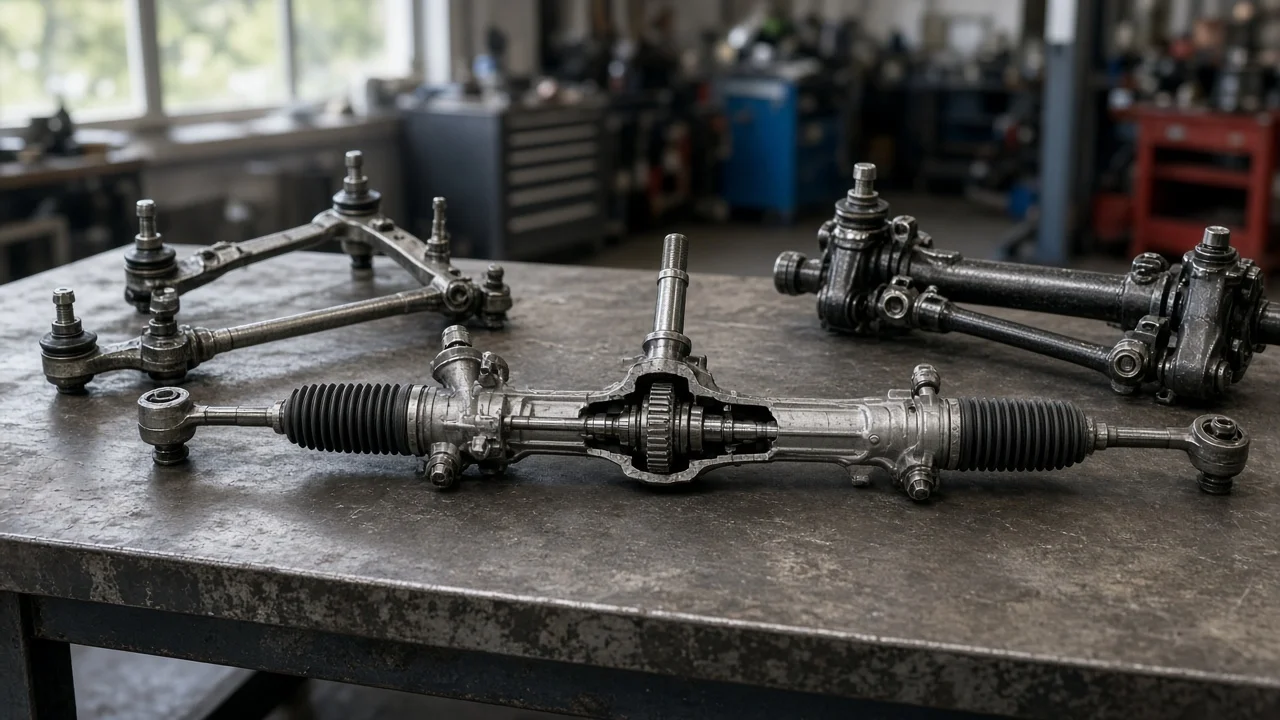
Most vehicles on the road use one of three steering linkage layouts: rack-and-pinion, parallelogram linkage driven by a steering gearbox, or a solid-axle arrangement built around a drag link and a long tie rod. Knowing which one your vehicle has tells you which parts wear, what play to look for and what a repair will involve. This guide explains how each layout works, what changes the picture and how to identify yours safely.
The Main Types of Steering Linkage
The answer depends mainly on the steering gear and the front suspension design. Rack-and-pinion steering is the dominant layout in modern passenger cars and crossovers, and it is also used on many pickups and SUVs with independent front suspension. A toothed rack slides side to side inside a housing, and inner and outer tie rods connect each end of the rack to the steering knuckles. Parallelogram linkage pairs a recirculating-ball steering gearbox with a pitman arm, a center link, an idler arm and two tie rod assemblies. It was standard on older rear-wheel-drive cars and remains on some trucks and vans with independent front suspension.
Vehicles with a solid front axle, such as many heavy-duty pickups and some off-road SUVs, use a third family of steering linkage types. A gearbox on the frame swings a pitman arm, a drag link carries that motion to the axle, and a single long tie rod connects the two knuckles. Within this family, the drag link either connects directly to one knuckle, often called cross-steer, or attaches to the tie rod itself, a design often called Haltenberger steering. Each layout has its own wear points, so identification is the first step before diagnosis or buying parts.
How Each Layout Moves the Wheels
In a rack-and-pinion system, the steering shaft turns a small pinion gear meshed with the rack. Rotating the steering wheel pushes the rack left or right, and the tie rods push or pull the steering arms on the knuckles. Inner tie rods use ball sockets that pivot as the suspension moves, and rubber bellows keep dirt and water out of those sockets and the rack. Outer tie rod ends thread onto the inner rods, and that threaded connection is where toe is usually set during a wheel alignment. With few joints, this layout tends to feel direct, and wear typically appears at the tie rod ends, the inner sockets or the rack bushings at its mounting points.
Parallelogram linkage converts gearbox rotation into side-to-side motion through several pivots. The pitman arm, splined to the gearbox output shaft, swings in an arc and moves one end of the center link. The idler arm, bolted to the opposite frame rail, supports the other end so the center link stays roughly parallel to the axle line as it travels. Tie rods run from the center link to each knuckle, usually with threaded adjusting sleeves for setting toe. More joints mean more places for play to build up, so a worn idler arm or center link can cause wander even when the tie rod ends are tight.
On a solid axle, the pitman arm moves the drag link, which steers one knuckle or the tie rod, and the tie rod carries that motion to the other wheel. Because the whole axle moves up and down with the suspension, the drag link must swing through that travel without pulling the wheels off course. Many of these vehicles also use a track bar to locate the axle side to side and a steering stabilizer to damp road shocks. Neither is strictly part of the steering linkage, but looseness in either can feel like linkage play from the driver's seat.
What Changes the Picture
Vehicle age and drivetrain are rough guides, not rules. Some trucks switched from parallelogram linkage to rack-and-pinion between generations, and the same model may use different hardware for two-wheel drive, four-wheel drive, light-duty and heavy-duty versions. Some older front-wheel-drive cars used center-take-off racks, where the tie rods bolt to the middle of the rack rather than its ends. Rear-wheel steering, fitted to some performance cars, luxury cars and trucks, adds actuators and links at the rear that follow their own manufacturer procedures. Power assist type, hydraulic or electric, changes how the rack or gearbox is driven but usually not which linkage layout is used.
Modifications also change the answer. Lift and leveling kits alter ride height, which changes the angles of the tie rods and drag link. On solid-axle trucks this can cause bump steer, where the wheel steers itself over bumps, and may require a dropped pitman arm, raised steering arms or a revised track bar setup. On independent suspension, a changed ride height alters tie rod angle relative to the control arms. Aftermarket heavy-duty tie rods and crossover steering conversions may not match the original layout at all, so a modified vehicle should be inspected as built rather than as described in factory documentation.
How to Identify Your Layout
Start with the vehicle's documentation. The owner's manual rarely names the linkage, but the factory service manual and parts catalogs do, and a parts lookup for your exact year, model, engine and drivetrain shows which components exist. Listings for an idler arm and center link indicate parallelogram linkage; a steering rack and inner tie rods indicate rack-and-pinion; a drag link and a long tie rod point to a solid-axle design.
A visual check confirms it. You can often see the parts by turning the steering to full lock and looking behind a front wheel with a flashlight, without lifting the vehicle. A horizontal tube with rubber boots near each end, mounted to the subframe or crossmember, is a rack. A boxy gearbox on the frame rail with a short arm hanging down, a long bar running across the vehicle and a second arm on the opposite rail is parallelogram linkage. A one-piece axle housing with a long rod between the knuckles and another rod angling toward the frame indicates a solid-axle layout. If you need to get underneath, use proper vehicle support: park on level, firm ground, chock the wheels, lift only at the manufacturer's jacking points and rest the vehicle on rated jack stands. Never work under a vehicle held up only by a jack.
Checking the Linkage for Wear
Clunks over bumps, wander, a delay before the vehicle responds, uneven tire wear or an off-center steering wheel can point to linkage wear, but they can also come from tires, wheel bearings, alignment or suspension bushings. A simple joint play check is to have a helper rock the steering wheel back and forth a short distance with the vehicle parked and the wheels on the ground while you watch each joint. Movement on one side of a joint that is not matched on the other side suggests play. Torn boots, missing grease, bent rods and loose or missing cotter pins are also worth noting.
If you find play or damage, the repair path depends on the layout. Tie rod ends, inner tie rods, idler arms, center links and drag links are separate parts on most vehicles, though some are sold only as assemblies. Whenever a toe-adjusting component is replaced or disturbed, a wheel alignment is needed, because toe changes as parts are threaded on and off. Fasteners must be tightened to the manufacturer's fastener specification, with new locking hardware where the service information calls for it. Steering joints are safety-critical, so if you are unsure about any step, leave the work to a qualified technician.
Limitations and Next Steps
This overview covers common layouts, not every design. Manufacturers mix and modify these arrangements, and exact components, alignment settings and torque values vary by model and year. A visual inspection cannot measure internal rack or gearbox wear, and the acceptable amount of play in a joint is defined by the manufacturer, not by feel. If the steering suddenly becomes loose, binds, grinds or pulls hard, or if you find a separated or badly worn joint, do not keep driving; have the vehicle towed or inspected before further use.
For a reliable next step, confirm your layout from the parts catalog or service information for your exact vehicle, then book a steering and suspension inspection if you notice symptoms. A technician can measure play with the vehicle properly supported, check related parts such as ball joints and wheel bearings, and perform any alignment the repair requires.