Parallelogram Steering Linkage: Components and Operation
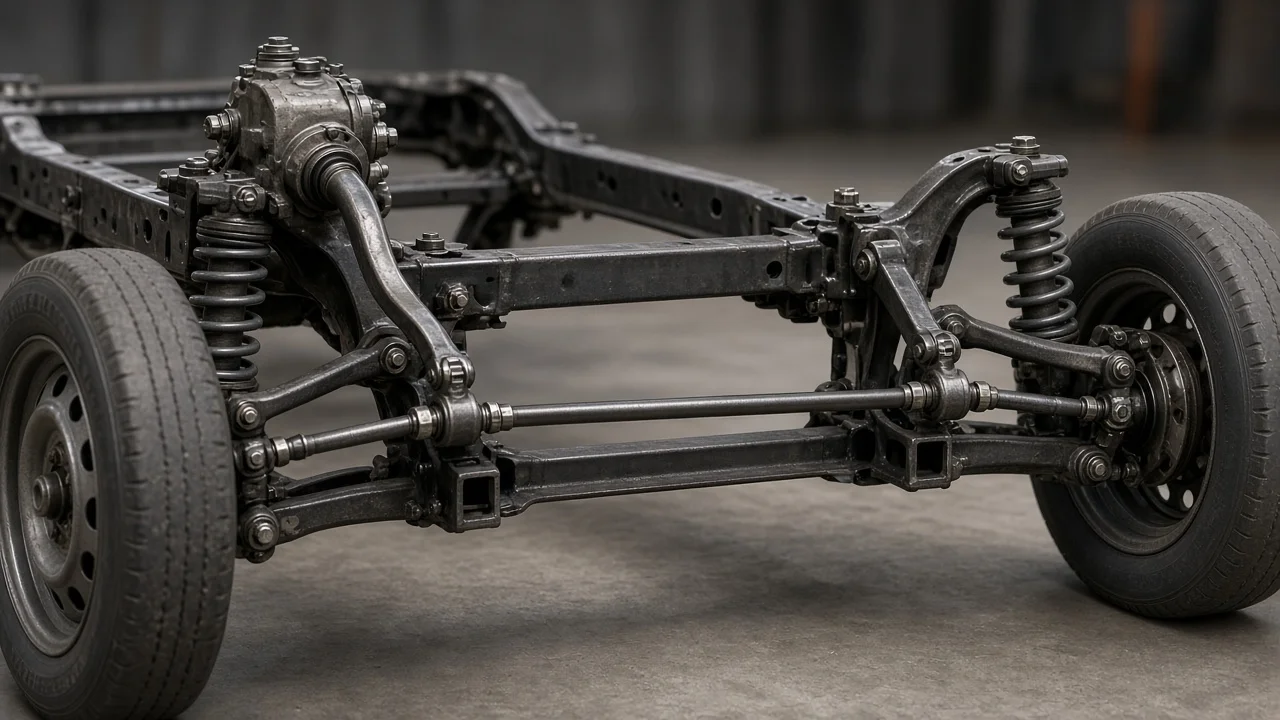
A parallelogram steering linkage is the set of arms and rods that carries motion from a steering gearbox to both front wheels. It is used on many trucks, full-size SUVs, vans and older rear-wheel-drive cars. Knowing what each part does helps explain loose steering, wandering and uneven tire wear. It also helps you judge which checks are reasonable at home and which belong to a shop with alignment equipment.
The components and what they do
The linkage has five main parts. The pitman arm is splined to the output shaft of the steering gearbox and swings when the steering wheel turns. On the opposite side of the vehicle, the idler arm pivots on a bracket bolted to the frame and has the same effective length as the pitman arm. The center link connects the ends of those two arms and runs across the vehicle. Depending on the manufacturer, it may also be called a relay rod or drag link. Two tie rod assemblies connect the center link to the steering arms on the knuckles. Each one usually has an inner tie rod end, an outer tie rod end and a threaded adjusting sleeve.
The pitman arm and idler arm are parallel and equal in length, so the four pivot points form a parallelogram. That shape gives the design its name. It keeps the center link moving sideways while staying roughly parallel to its original position. This layout is almost always paired with a recirculating-ball steering gearbox rather than a rack-and-pinion unit.
How the linkage moves the wheels
When the driver turns the wheel, the steering gearbox rotates its output shaft through an arc, and the pitman arm swings with it. The pitman arm pushes or pulls one end of the center link. The idler arm follows at the other end and supports that side so the link does not sag or twist. As a result, the center link shifts left or right as a unit and carries both tie rods with it. Each tie rod then pushes or pulls its steering arm, which rotates the knuckle around its steering axis and turns the wheel.
Every connection is a pivot, usually a ball-and-socket joint, because the parts move in more than one plane. The wheels steer side to side, but they also travel up and down with the suspension. The tie rods are positioned so their arcs closely follow the arcs of the control arms, which limits unwanted toe change over bumps. Toe is set by turning the adjusting sleeves to lengthen or shorten each tie rod. That same adjustment is used to center the steering wheel during a wheel alignment.
What changes the picture
Not every vehicle with a steering box uses a true parallelogram layout. Many solid-front-axle four-wheel-drive trucks use a drag link and a single tie rod instead, and those systems wear and adjust differently. Rack-and-pinion vehicles have no pitman arm, idler arm or center link at all. Parallelogram designs also differ in their details. Some center links have tapered holes that accept tie rod and pitman arm studs, while others carry built-in ball sockets. Some idler arms pivot on a rubber bushing and others on a ball-type joint. Some joints have grease fittings, while others are sealed. A steering damper may also be mounted between the frame and the center link.
Ride height matters too. Lifting or lowering a vehicle changes the angle of the tie rods relative to the control arms. This can introduce bump steer, where the wheels change toe as the suspension moves. Sagging springs or a heavy load can have a similar but smaller effect. Off-road driving, larger tires and heavy use put more load on the idler arm and the joints, so wear can differ between vehicles that look identical.
Checks an owner can make
Start with what you notice while driving. Common signs of linkage wear include: • A steering wheel that feels loose around center; • A vehicle that wanders and needs constant correction; • A clunk when turning or crossing bumps; • A steering wheel that is no longer straight; • Tires that show feathered tread or wear faster on one edge; Worn ball joints, wheel bearings, the steering gearbox or alignment alone can cause the same symptoms. Treat them as a reason to inspect, not as a diagnosis.
A dry-park check is a useful first look. Keep the vehicle's weight on its tires, set the parking brake and chock the wheels. Then have a helper rock the steering wheel back and forth a short distance while you watch each joint with a light. Look for any joint where one part moves before the other follows. Also look for an idler arm that moves up and down instead of only swinging. Check for torn boots, bent rods, loose sleeve clamps and missing cotter pins. If you need to raise the vehicle, lift only at the manufacturer's specified points and support it on rated jack stands on firm ground. Never work under a vehicle held only by a jack. Grease any fittings at the interval in the owner's manual.
An experienced home mechanic with the right tools can replace linkage parts, but the job has specific requirements. Castle nuts must be tightened to the fastener specification in the service manual. Align the cotter pin hole by following the manual's procedure, never by loosening the nut. Separate tapered studs with the correct puller rather than by hammering on the joint. Never heat or bend linkage parts to straighten them. Replacing a tie rod end, adjusting sleeve or center link changes toe, so the vehicle needs a professional wheel alignment afterward, even if you counted threads or matched the old part's length.
Limits and when to get help
There is no universal limit for acceptable joint play in a parallelogram linkage. Some manufacturers publish an idler arm movement limit with a specific test method. Others say any noticeable play in a tie rod end calls for replacement. Torque values, alignment settings and inspection procedures are specific to each model. Use the factory service information for your exact vehicle rather than generic numbers.
Steering components are safety-critical. If you find a loose, separated or damaged joint, a bent rod or a missing cotter pin, don't drive the vehicle until a qualified technician has inspected it. There is no way to estimate how many more miles a worn joint will last. A shop can measure play under the correct conditions and check the steering gearbox and suspension at the same time. It can also finish the repair with an alignment so the steering wheel is centered and the tires wear evenly.