Transmission Oil: What It Is, the Main Types and How to Choose the Right One

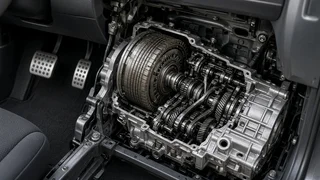
Transmission oil is the lubricant inside a vehicle's gearbox. The term covers several different fluids, and they are not interchangeable. A conventional manual transmission typically uses a thick gear oil. A conventional automatic uses automatic transmission fluid (ATF). Continuously variable transmissions (CVTs) and many dual-clutch transmissions (DCTs) each require their own dedicated fluids. The right choice is the fluid that meets the exact specification your vehicle's manufacturer lists for your model year, transmission and market. That requirement matters more than brand, price or the word "synthetic" on the label.
What transmission oil does
Every transmission fluid lubricates gears and bearings, carries heat away from working parts and protects metal surfaces from wear and corrosion. Beyond those basics, the job depends heavily on the transmission design.
Lubrication: keeps a protective film between gear teeth, bearings and shafts under heavy load. Cooling: absorbs heat from friction and moves it to the case or to a dedicated transmission cooler. Friction control: in automatics, clutch packs and bands need a specific friction characteristic to engage smoothly without slipping or shuddering. In manuals, synchronizers need the right friction to match gear speeds during a shift. Hydraulic function: in automatics and CVTs, the fluid transmits pressure that operates clutches, the valve body and, in many CVTs, the pulleys. Protection: additives resist oxidation, foaming, rust and seal deterioration.
The main types of transmission fluid
Type | Typically used in | Key characteristics; Manual transmission gear oil | Many manual gearboxes, plus differentials and transfer cases | Relatively thick; rated by SAE gear-oil viscosity grades and API GL categories; Automatic transmission fluid (ATF) | Conventional torque-converter automatics | Thinner, usually red-dyed, with tailored friction modifiers and hydraulic properties; built to manufacturer specifications; CVT fluid | Belt- or chain-type continuously variable transmissions | Formulated so the belt or chain can grip the pulleys without slipping; not the same as ordinary ATF; Dual-clutch transmission fluid | Wet-clutch DCTs | Combines gear protection with clutch friction control; dry-clutch DCTs may use a gear oil instead; Manufacturer-specific fluids | Some manuals, hybrids and newer automatics | Some manuals call for ATF or a specific engine oil; many hybrid and electrified units use proprietary fluids
Manual transmission gear oil
Gear oil for manual gearboxes is graded with SAE viscosity numbers such as 75W-90. Gear-oil grades use a different scale from engine-oil grades, so a gear oil labeled 75W-90 is not thicker than a 10W-40 engine oil in the way the numbers suggest. Performance is usually described by API categories. GL-4 is common in manual transmissions. GL-5 contains more extreme-pressure additives and is typically specified for hypoid differentials. In some older or specific gearbox designs, those GL-5 additives can be harsh on brass or bronze synchronizers. That is one reason not to substitute one for the other unless the manufacturer permits it. Some products are labeled as meeting both GL-4 and GL-5, but whether that suits a particular gearbox still depends on the manufacturer's requirement.
Automatic transmission fluid
ATF is far thinner than gear oil because it serves as a hydraulic fluid as well as a lubricant. In the US, automakers publish their own ATF specifications. Well-known examples include GM's Dexron family and Ford's Mercon family, and other manufacturers have their own proprietary fluids. Over time, many specifications have moved toward lower-viscosity fluids that support efficiency, and newer specifications are not always backward-compatible with older transmissions, or the reverse. "Multi-vehicle" ATFs claim to cover several specifications. Some owners use them successfully, but the safest course is a fluid that explicitly lists the specification your transmission requires.
CVT and dual-clutch fluids
A belt- or chain-type CVT relies on a carefully controlled amount of friction between the belt and the pulleys, so it needs fluid designed for that metal-to-metal contact. Putting conventional ATF in a CVT, or CVT fluid in a conventional automatic, can cause slipping, poor drivability or damage. Wet-clutch dual-clutch transmissions likewise need a fluid matched to their clutch materials and gear sets. With both designs, using the exact manufacturer-specified fluid is especially important.
How transmission oil differs from engine oil
Engine oil has to cope with combustion byproducts, fuel dilution and very high temperatures at the pistons and cylinder walls. That is why it contains heavy detergent and dispersant packages and is changed relatively often. Transmission fluid works in a sealed system that combustion does not contaminate. Its additives focus on gear protection, friction behavior and long-term stability. The two are formulated for different jobs. Engine oil should not go into a transmission unless the manufacturer specifically calls for it, which some manual gearboxes do.
How to choose the right transmission oil
Start with the owner's manual or the manufacturer's service information. Look for the named specification, not just a viscosity grade. Match the transmission type exactly: manual, conventional automatic, CVT or dual-clutch. Variants of the same model can use different transmissions depending on model year, engine, drivetrain or trim. Check the product label for the specification listed in your manual. A product that only says "compatible" is a weaker assurance than one that explicitly meets or is licensed to a specification. Don't assume synthetic is automatically better. Many modern factory fills are already synthetic or synthetic-blend. The specification is what determines suitability. Keep differentials and transfer cases separate in your planning. They often use different gear oils from the transmission itself.
Checking the fluid and spotting problems
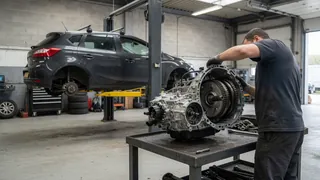
Some automatics still have a dipstick, and the manual explains the correct procedure, which often involves a warm engine running in park or neutral on level ground. Many newer automatics and most manuals have no dipstick. On those, the level is checked at a fill or check plug, sometimes at a specified fluid temperature, which usually makes it a job for a shop or an experienced home mechanic.
New ATF is usually bright red or pink. Over time it darkens with use. Very dark fluid or a burnt smell suggests overheating or wear. A milky or foamy appearance can indicate coolant or water contamination, or overfilling. Visible metal particles or debris on a dipstick or drain plug warrant inspection. Slipping, delayed or harsh engagement, shuddering, whining or grinding during shifts can point to low or degraded fluid, though they can also come from mechanical or control faults. Reddish drips under the front or middle of the vehicle often indicate an ATF leak.
How often to change transmission oil
There is no single universal interval. Recommendations vary widely by manufacturer, transmission type and driving conditions. Towing, frequent short trips, stop-and-go traffic, mountainous terrain and hot climates are commonly treated as severe service, which calls for more frequent changes. Some manufacturers describe their fluid as "lifetime" or sealed. In practice, that usually means no change is scheduled within the normal maintenance plan, not that the fluid never degrades. Many technicians recommend periodic changes anyway, especially for vehicles kept long-term or used in severe conditions.
For automatics, a drain-and-fill replaces only part of the fluid, because some remains in the torque converter, cooler and lines. Repeating it over successive services gradually refreshes most of the fluid. A machine flush exchanges more of it at once. The best approach varies by transmission and its condition, so follow the manufacturer's guidance or ask a technician familiar with that unit. A long-neglected transmission may warrant a cautious approach rather than an aggressive flush.
The bottom line
"Transmission oil" is an umbrella term. Manuals usually take gear oil, conventional automatics take ATF, and CVTs and dual-clutch units need their own dedicated fluids. These products differ in viscosity, friction behavior and additive chemistry, and the wrong one can cause poor shifting or lasting damage. Identify your exact transmission, find the specification the manufacturer requires, and choose a fluid that clearly meets it.