Transmission Fluid Change Service
The short answer
A transmission fluid change removes used lubricant from the gearbox and replaces it with fresh fluid that matches that vehicle’s specification. You typically need the service when the manufacturer’s maintenance schedule calls for it, when the fluid is dark, burnt-smelling, or contaminated, or when slipping, harsh, or delayed shifts line up with degraded fluid rather than a failed mechanical part. The interval, the exact fluid, and the method—drain-and-fill versus a machine exchange—depend on transmission type (hydraulic automatic, manual, continuously variable, or dual-clutch) and on the model year, market, trim, and powertrain. Those details live in the owner’s manual or OEM service information for that VIN; they are not interchangeable across nameplates.
What the fluid does
Transmission fluid lubricates gears, bearings, and clutches and carries heat away from hard-working parts. In a hydraulic automatic it also transmits pump pressure so the valve body can apply clutches and bands. Heat, shear, and contamination break down additives over time, the fluid oxidizes, and friction characteristics drift. A fluid change is scheduled maintenance. It is not a repair for worn clutches, a leaking seal, or a failing mechatronic unit.
When service is due
Follow the schedule written for that vehicle and how it is used. Many makers publish a normal interval and a severe-service interval. Towing, mountain driving, stop-and-go traffic, high ambient heat, and frequent short trips usually count as severe use and shorten the time between services. Some late-model automatics are described as filled for life. That claim still rests on a named fluid specification and an assumed duty cycle; it does not mean the fluid cannot degrade, and it does not replace a condition check if the vehicle is worked hard or kept to high mileage. If the printed manual and a dealer menu disagree, treat the OEM procedure for that transmission as the authority and record the conflict on the work order.
Drain-and-fill versus a flush
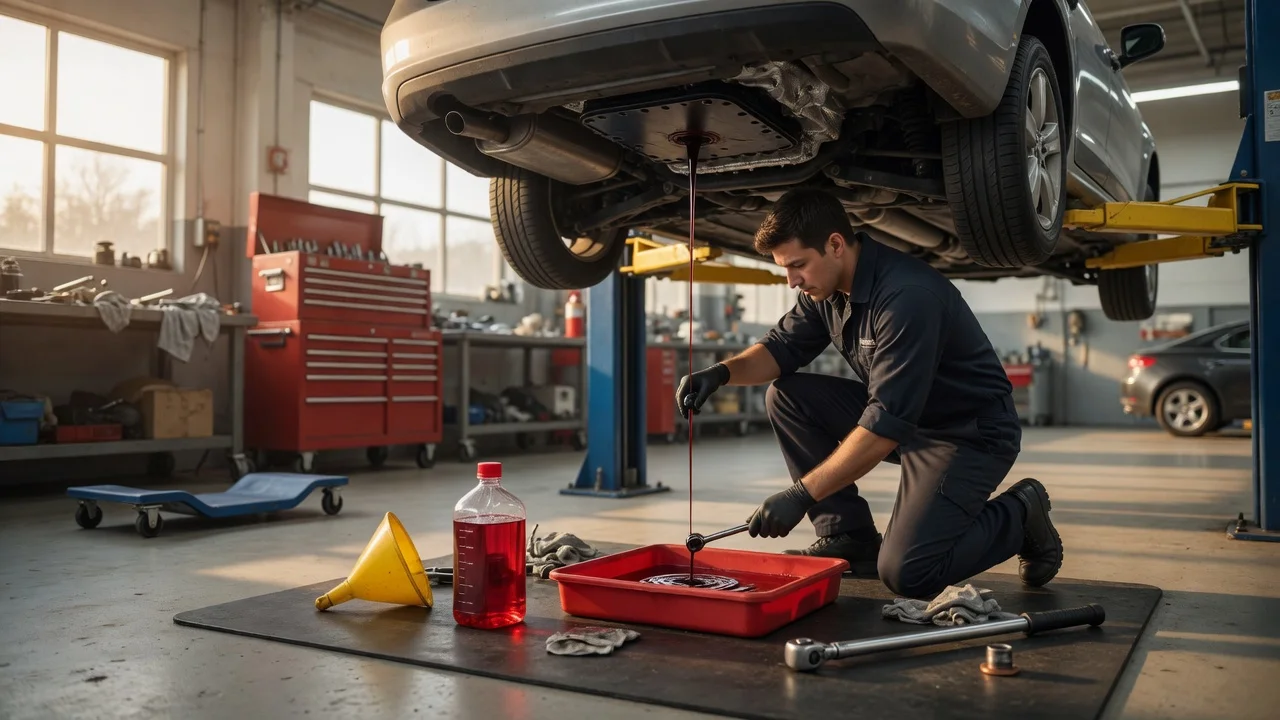
A drain-and-fill drops fluid from the pan—and from a case or converter drain when the design has one—then refills to the specified level. A large share of the old fluid can remain in the torque converter, cooler, and valve body, so some procedures repeat the drain after a short drive. A flush uses a machine to exchange a larger portion of the charge through the cooler lines. Flushing is not approved for every unit. A neglected automatic with heavy varnish or clutch debris can shed material into valves during an aggressive exchange. If service history is unknown or the fluid is already burnt, a measured drain-and-fill, plus filter and pan service where the case allows it, is the more conservative first step. CVT and dual-clutch transmissions often have their own exchange procedures; an automatic-flush machine is not a substitute unless the OEM method says it is.
Fluid type and fill level
Use only the specification named for that gearbox. Hydraulics automatics call for a particular automatic transmission fluid chemistry; CVTs need CVT fluid; many manuals use a dedicated gear oil or manual-transmission fluid with a stated viscosity and friction package. A bottle labeled for many applications is not proof of approval for your unit. Mixing leftover fluid from a different spec, or topping up with the wrong type, can cause shudder, slip, or seal trouble. If there is no dipstick, level is set at a specified temperature with a standpipe or fill-plug procedure. Guessing by poured volume is a common way to overfill or starve the unit.
Filter, pan, and related work
Where the transmission has a serviceable pan, the filter or screen and the pan gasket—or a reusable pan with a new filter kit—are often replaced with the fluid. Some designs use an external spin-on filter. Cooler lines, a cooler thermostat, and an auxiliary cooler matter if the vehicle tows or has overheated. After the fill, a road test and a recheck of level at the specified temperature confirm the job. Some electronically controlled automatics also need an adaptive shift relearn; that step is in the OEM procedure, not optional extra language on an invoice.
Symptoms that involve fluid—and symptoms that do not
Dark fluid, a burnt smell, slip between gears, harsh or delayed engagement, and a whine that changes with temperature can all involve fluid condition. The same symptoms can come from a failing clutch pack, solenoid, valve body, mechatronic unit, or leak. Fresh fluid will not restore a mechanically damaged gearbox. Metal in the pan or heavily contaminated fluid is a reason to diagnose the source before authorizing a flush. Paying for an exchange on a unit that already slips under load can hide a failure that is already underway.
A practical next step
Identify the transmission type and the OEM fluid specification from the manual, an underhood label, or dealer service information for the VIN. Choose drain-and-fill or a manufacturer-approved exchange from that procedure and from the fluid’s current condition. Confirm whether the filter, pan gasket, temperature-based fill, road test, and any shift relearn are part of the quoted job. If shifts are already abnormal, ask for inspection—codes, level, leaks, pan debris—before a flush. Keep the invoice with fluid brand, specification, and quantity for the next service.
What this article cannot specify for your vehicle
Mileage intervals, fluid part numbers, fill quantities, and prices were not supplied for a particular model year, market, trim, or powertrain, so they are omitted here. Look up the maintenance schedule and transmission specification for your VIN, or have a shop that stocks that OEM fluid confirm both the spec and the approved service method before work begins.