Toyota Camry Brake Pads: How to Choose the Right Set for Your Model Year

The right Toyota Camry brake pads are the ones matched to your specific car's model year, trim, powertrain and axle, front or rear. Within that fitment, the main choice is friction material. Ceramic pads suit most daily-driven Camrys because they are quiet and produce little dust. Semi-metallic pads give up some refinement for stronger heat tolerance. Before you buy, check whether your rotors are still within their wear limits, because worn or damaged rotors change what you need to order.
Start With Vehicle Fitment, Not the Model Name
"Camry" covers many generations sold over several decades. Brake pad shapes, sizes and mounting hardware have changed between generations, and sometimes within one. Do not assume a pad listed for one Camry fits another. Fitment usually depends on these factors:
Model year and generation: caliper and rotor designs change with redesigns. Trim level: sportier or higher trims on some generations use different brake hardware than base trims. Powertrain: four-cylinder, V6 and hybrid versions may not share the same brake components. Axle: front and rear pads are different parts and are sold separately. Rear brake type: depending on year and trim, some older Camrys use rear drum brakes with shoes instead of rear disc pads. Market: a Camry built for another region may differ from the US version.
The most reliable way to confirm fitment is to search by VIN, either with a parts retailer that supports VIN lookup or with a Toyota parts counter. If you only search by year and model, the catalog may show several pad options for different submodels. If so, compare the listing notes, such as trim or engine size, against your vehicle. When in doubt, compare the old pads' shape with the new set before you install them.
Choosing a Friction Material
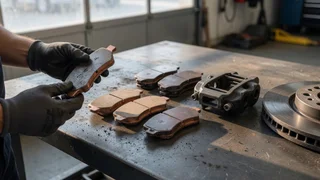
Friction material is the compound bonded to the pad's steel backing plate. It is the part that presses against the rotor. It affects noise, dust, stopping feel, pad life and rotor wear. Most aftermarket Camry pads fall into one of three categories.
Type | Typical strengths | Typical trade-offs | Good fit for; Ceramic | Quiet, low visible dust, smooth feel, generally gentle on rotors | Usually costs more; less suited to sustained heavy heat | Commuting and highway driving in most Camrys; Semi-metallic | Strong bite, handles heat well | More noise and dark dust; can wear rotors faster | Frequent hills, heavier loads, more spirited driving; Organic (NAO) | Quiet, soft pedal feel, usually inexpensive | Tends to wear faster and fade sooner under heat | Light-duty driving where low cost matters most
Brands label these categories inconsistently. Some sell "ceramic-metallic" or "low-metallic" blends, so read the product description rather than relying on the label alone. For a Camry used as a family car or commuter, a quality ceramic pad, or a pad marketed as an OE-equivalent replacement, is a sensible default. A Camry that sees mountain driving or regular towing of a light trailer, where its owner's manual permits towing, may benefit from a more heat-tolerant compound.
OEM vs. Aftermarket Pads
Genuine Toyota pads are designed to match the car's original braking feel and noise behavior. They are a safe choice if you were happy with how the brakes performed before. Reputable aftermarket brands sell pads in several tiers, from economy to premium. The premium lines often include shims, chamfers and slots meant to reduce noise, and some come with new hardware. Economy pads can be adequate, but they vary more in noise, dust and lifespan. Whatever you choose, buy from a seller with clear fitment information and a reasonable return policy in case the part does not match.
Considerations for Camry Hybrid Owners
Camry Hybrid models use regenerative braking, which lets the electric motor slow the car and recover energy. As a result, the friction brakes often do less work than on a gas-only Camry, and pads may last longer. Infrequent use can also let rust or deposits build up on the rotors, so condition matters as much as pad thickness. Make sure the pads are listed specifically for the hybrid if the catalog separates them. Hybrid brake systems may also need specific procedures before servicing, so check the service information or have a shop familiar with Toyota hybrids do the work.
Check Pad and Rotor Wear Limits Before You Order
Many Camry pads include a small metal wear indicator that makes a high-pitched squeal when the friction material gets thin. Grinding is more serious than squealing. It usually means the pad has worn down to its backing plate and is damaging the rotor. You can also inspect pad thickness through the wheel spokes or with the wheel removed. Your service information or the pad maker lists a minimum thickness for replacement.
Brake rotors, the discs the pads clamp onto, also have a wear limit. The minimum thickness is typically stamped on the rotor itself. Plan on new rotors or resurfacing, where enough material remains, if you notice any of the following:
The rotor is at or below its minimum thickness. The steering wheel shakes or the pedal pulses while braking. The rotor has deep grooves or scoring, especially from metal-on-metal contact. There is a pronounced lip at the rotor's outer edge. You see heavy rust or uneven discoloration from overheating.
Putting new pads on worn rotors often brings back noise or vibration and shortens pad life. Many buyers choose a pad-and-rotor kit for the axle so the parts are matched and the job is done once.
Calipers, Hardware and Brake Fluid
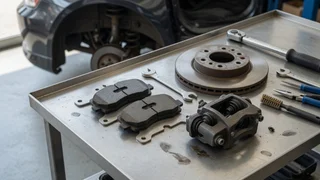
The caliper holds the pads and squeezes them against the rotor using hydraulic pressure. A pad change is a good time to check that the caliper slide pins move freely and are lubricated with a brake-specific grease. Also look for fluid leaks around the piston seal. A sticking caliper or seized slide pin can cause uneven pad wear, pulling to one side or a dragging brake. New pads will not fix those problems.
Abutment clips, the small spring-steel pieces the pads slide in, wear and corrode over time. Replacing them with new hardware helps reduce rattles and noise. Some pad sets include clips; others sell them separately.
Brake fluid absorbs moisture over time, which can lower its boiling point and contribute to internal corrosion. Pushing caliper pistons back during a pad change also raises the fluid level in the reservoir, so watch it to avoid overflow. Use the fluid type marked on the reservoir cap or listed in your owner's manual. If the fluid looks dark or is due by the maintenance schedule, a brake fluid flush can be done at the same visit.
Quick Buying Checklist
Confirm fitment by VIN, or at least by exact model year, trim and engine or hybrid powertrain. Order the correct axle; front and rear pads are different parts. On older Camrys, confirm whether the rear brakes are discs or drums. Choose a friction material that matches your driving: ceramic for most daily use, semi-metallic for heavier heat demands. Check whether shims and abutment clips are included. Measure or inspect the rotors and decide whether to replace them at the same time. Replace pads on both sides of an axle together, never one wheel only. Check the brake fluid type and condition.
DIY or Shop Installation
Replacing pads on a Camry with disc brakes is a common do-it-yourself job for people who have the right tools, a safe way to support the car, and a torque wrench for the caliper bolts and lug nuts. Hybrid models, cars that also need caliper work, and anyone unsure about brake procedures are better served by a qualified shop. Brakes are a safety system, and mistakes can have serious consequences.
After installing new pads, pump the brake pedal until it feels firm before driving, because the pistons need to move back out against the pads. Then follow the pad maker's bedding-in procedure. This is usually a series of moderate stops from speed that transfers an even layer of friction material onto the rotors. Proper bedding helps reduce noise and vibration and gives consistent stopping power. If the pedal feels soft, the car pulls, or noise continues after bedding, have the brakes inspected.