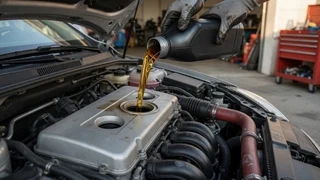
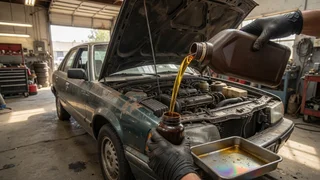
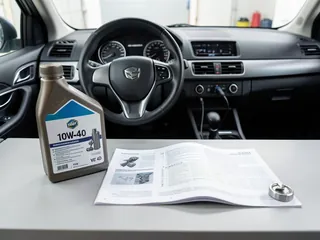
Total 10W-40 engine oil
The short answer
Total 10W-40 is a multi-grade engine oil from TotalEnergies (the Total brand). It is the right oil when the vehicle handbook specifies SAE 10W-40 for that engine and climate, and the bottle also carries the performance standard listed for that model year, market, trim and powertrain. Viscosity on the front label is not a complete match on its own.
The answer changes if the handbook calls for a different SAE grade, a low-ash oil for a particulate filter, or a named maker approval that the specific bottle does not carry. In those cases a 10W-40 product is the wrong oil even if the brand is familiar.
What 10W-40 means
SAE 10W-40 is a viscosity grade, not a quality rating. Viscosity is how thick the oil is. The 10W figure (W stands for winter) describes cold-start flow. The 40 figure describes thickness at normal operating temperature. A 10W-40 oil is thicker when hot than common modern grades such as 5W-30 or 0W-20, which is why some older engines, high-mileage engines, or warmer-climate applications specify it.
Marking What it tells you; 10W Cold-start viscosity grade; 40 Hot operating viscosity grade; API / ACEA / maker code Performance standard the oil is licensed or approved to meet
When Total 10W-40 is a suitable next step
Use a Total 10W-40 oil only when all of the following line up with the handbook for that exact vehicle, not a similar model or a different engine in the same range.
The service schedule, oil filler cap or owner's manual lists SAE 10W-40 for your climate. The bottle's API category and ACEA class match the handbook. ACEA is the European oil sequence; API is the American Petroleum Institute category. Both describe detergent, wear and sludge performance, not thickness. Any named maker approval printed in the handbook also appears on that bottle. Total sells more than one 10W-40 oil; they do not all share the same approvals. The oil type fits the engine: petrol or diesel, and with or without a diesel particulate filter (DPF) or petrol particulate filter (GPF).
Conditions that rule it out
If the handbook specifies another SAE grade, stay with that grade. Brand familiarity does not override the viscosity the engine was designed around. If the engine has a DPF or GPF, it typically needs a low-SAPS oil (low sulphated ash, phosphorus and sulphur). Many conventional 10W-40 oils are not that type. If the vehicle is under warranty, the handbook specification is the one that counts. If the engine is a light-duty commercial or heavy-duty diesel unit, a passenger-car 10W-40 and a commercial 10W-40 are not interchangeable just because the viscosity matches.
Read the specific bottle
TotalEnergies markets 10W-40 oils in passenger-car and commercial ranges. The front of the pack shows viscosity; the back shows ACEA class, API category and maker approvals. Two bottles that both say 10W-40 can still be incompatible with the same engine. Match the printed specification on the pack you are holding, not a generic product family name.
How to choose before you buy
Open the owner's manual for that model year, market and engine and note the SAE grade plus every required performance standard. Compare those lines with the back label of the exact Total 10W-40 product. Confirm petrol versus diesel and whether a particulate filter is fitted. If the handbook lists more than one acceptable grade by climate, pick the grade that matches where the vehicle is used, then still match the performance standard. If the VIN, engine code or handbook page is missing, resolve that with a dealer or independent lookup for that vehicle before substituting a generic 10W-40.
What this page cannot confirm
No single Total 10W-40 product can be named as correct for every reader. Compatibility depends on model year, market, trim and powertrain, and on the approvals printed on a specific bottle. Those details were not supplied here, so the next step is to check the handbook (or a VIN-based parts lookup) and then match both viscosity and specification on the label.