Short Description of an Accident: How to Write a Clear Car Accident Statement

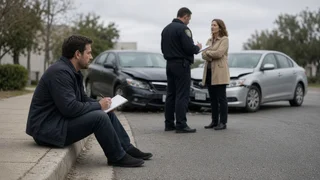
A short description of an accident is a brief, factual account of a collision written in the order events happened. It states when and where the crash occurred, who was involved, what each vehicle was doing, where the vehicles made contact and what happened immediately afterward. It should contain only what you directly observed or know, without guessing, assigning blame or apologizing. The same basic account works for a police report, your own insurance claim or a state accident form. The answer changes if someone was injured, fault is disputed or the other driver's insurer asks you for a statement. In those situations, consider speaking with your own insurer or an attorney before you submit anything in writing.
Key Terms
Accident statement: your written or recorded account of the collision, given to police, an insurer or another party. Claim: a formal request to an insurance company for payment under a policy. Adjuster: the insurance company employee who investigates a claim and decides how it is paid. Point of impact: the part of each vehicle that made contact, such as the front bumper or the rear passenger door. Right-of-way: the legal priority one road user has over another at a given moment, such as at a stop sign or a crosswalk.
What to Include
Date and approximate time of the collision. Exact location: road names, nearest intersection, direction of travel and lane. Vehicles involved: make, model, color and license plate, if known. People involved: drivers, passengers and witnesses, identified by name if you have it. What you were doing just before the crash: your speed if you know it, your lane, and whether you were stopped, turning, merging or going straight. What the other vehicle did, as you saw it. Point of impact on each vehicle. Conditions: weather, lighting, road surface, traffic signals and visible signs. What happened afterward: where the vehicles came to rest, whether police came, whether anyone reported injuries, and whether a vehicle was towed. Reference details: police report number and the other driver's insurance information, if exchanged.
What to Leave Out
Admissions or apologies, such as "It was my fault" or "I'm sorry, I didn't see them." Fault is decided by insurers, police or courts based on the evidence. Guesses written as facts. If you do not know a speed or distance, write "approximately" or say you are unsure. Opinions about the other driver's character, attitude or sobriety, unless you directly observed something specific, such as a stated fact the driver said aloud. Statements about your injuries that go beyond what you know. Some injuries appear later, so avoid writing "I was not hurt" if you have not been examined. "I did not notice injuries at the scene" is more accurate. Emotional language and long background stories unrelated to the collision.
How to Write the Statement Step by Step
1) Write it as soon as possible, while details are fresh. Use any notes, photos or dashcam footage you have to confirm the facts. 2) Start with the basics: date, time, location, weather and lighting. 3) Describe your vehicle's position and movement just before the collision. 4) Describe the other vehicle's position and movement, using plain directional terms such as northbound, left lane or turning right. 5) State the point of impact on each vehicle. 6) Describe what happened immediately afterward, including police response, tows and anyone who said they were hurt. 7) List witnesses and their contact details, if collected. 8) Write in short, past-tense sentences. Use first person, for example "I was stopped at the red light."; 9) Add a sketch if the form allows it, showing lanes, signals, the direction of travel and the point of impact. 10) Sign and date the statement if required, and keep a copy.
A Simple Template
Date and time: [date], approximately [time]; Location: [street] at [cross street], [city, state]; Conditions: [weather], [daylight/dark], [road surface]; My vehicle: [year, make, model, color, plate]; Other vehicle: [make, model, color, plate]; Description: I was traveling [direction] on [street] in the [lane]. [What I was doing.]; The other vehicle was [position and movement]. The [part] of the other vehicle struck the [part] of my vehicle. After the collision, [where vehicles stopped, police response, injuries reported, tow]. Witnesses: [names and contact details, or "none identified"]; Police report number: [number, if issued]; Signed: [name] Date: [date]
Example of a Short Description
The following example is fictional and only illustrates tone and structure:
I was stopped at a red light, traveling north on Main Street in the right lane at its intersection with Oak Avenue. It was daytime, dry and clear. The vehicle behind me, a gray sedan, struck the rear bumper of my car. Both vehicles stayed in the lane. Police responded and issued a report number. I did not notice injuries at the scene. My car was driven home.
Who May Ask for a Statement
Recipient | Purpose | Points to note; Police | Official crash report | Give facts calmly. Ask how to get a copy of the report. Your insurer | Processing your claim | Most policies require you to cooperate and report promptly. Check your policy for deadlines. Other driver's insurer | Evaluating its own driver's liability | You may not be obligated to give a recorded or written statement. Check with your insurer or an attorney first, especially if there are injuries. State motor vehicle agency | Required crash reporting form | Whether a report is required, and the deadline, depends on the state and the circumstances, such as injuries or damage above a set amount.
Check Your Statement Before Submitting
Date, time and location match your photos, the police report and any receipts, such as a tow invoice. Directions, lanes and points of impact are consistent throughout the statement and with any sketch. Every sentence describes something you observed or know. Uncertain details are marked as approximate. The statement contains no admissions of fault, apologies or speculation. Names, plate numbers and policy numbers are spelled correctly. The statement is signed and dated if required, and you have kept a copy along with your photos and notes.
Limits of This Guide
This guide covers general principles for writing a factual accident description in the US. It does not cover state-specific reporting thresholds, filing deadlines or official form layouts, because these differ by state and no state-specific details were available here. Before filing, check your state motor vehicle agency's requirements and your insurance policy's notice provisions. If the crash involved injuries, a disputed fault question or a commercial vehicle, a licensed attorney in your state can tell you how your statement may be used.