Safest Cars for Families
The short answer
No single car is the safest for every family. The safest choice is a vehicle that has strong current crash-test results for the exact model year and configuration you're buying, includes effective crash-avoidance technology, and fits your car seats and passengers correctly. A model that scores well in one year or trim can score differently in another, so check ratings against the specific vehicle rather than the model name alone.
This guide does not rank or name specific models because no confirmed, current test results were available to support those claims. Use it as a checklist for verifying any vehicle on your shortlist.
Conditions that change the answer
Model year: Test procedures and award criteria are revised periodically, so a rating from one year isn't directly comparable with a rating from another. A redesign can also change results. Trim and equipment: Some safety features, including headlight types and certain driver-assistance systems, may be standard on one trim and optional or missing on another. Body style and powertrain: Different body styles or powertrain versions of the same nameplate may be tested and rated separately. Vehicle size and weight: Under the same physics, a larger, heavier vehicle generally gives its occupants more protection in a collision with a smaller, lighter one. A small car with top ratings is not equivalent to a large vehicle with top ratings. New versus used: Older vehicles were tested under earlier criteria and may lack features that are now common.
Where to check crash-test ratings in the US
Two organizations publish crash-test results for vehicles sold in the US. The National Highway Traffic Safety Administration (NHTSA), a federal agency, runs the 5-Star Safety Ratings program, which covers frontal crash, side crash and rollover resistance. The Insurance Institute for Highway Safety (IIHS), an independent research organization funded by insurers, runs its own crash tests and evaluates headlights, crash-avoidance systems and child-seat hardware. IIHS gives its best-performing vehicles Top Safety Pick and Top Safety Pick+ awards.
The two programs test differently, so a vehicle that has been evaluated by both and does well in each gives you broader evidence. Confirm that each rating you read applies to your model year and body style, and note any rating that is missing because the vehicle wasn't tested.
What to check when choosing
Item | What to look for | Why it matters; Crash-test results | Top results in current NHTSA and IIHS evaluations for the exact model year and body style | Shows how well the structure and restraints protect occupants; Rear-seat protection | Results from any test that measures protection for rear passengers, where available | Children usually ride in the back, and older tests focused mostly on front occupants; Automatic emergency braking | Whether it is standard, and whether it is rated for pedestrian detection | Can prevent some crashes or reduce their severity; Headlights | The headlight rating for the trim you plan to buy | Headlight performance can vary by trim and package; Child-seat hardware | Easy-to-use lower anchors and tether anchors in the seating positions you need | Correct installation is critical to car-seat protection; Rear seat belt reminders | Whether reminders cover the rear seats | Helps ensure older children and adults buckle up; Recalls | Any open recalls on the specific vehicle | Unrepaired defects can undermine safety
Make sure your car seats fit
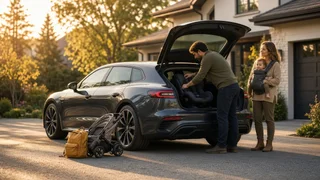
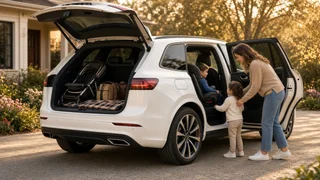
A high crash rating only helps if every passenger is restrained correctly. Most vehicles in the US have LATCH (Lower Anchors and Tethers for Children), a set of attachment points for child seats. How easy those anchors are to reach and use varies between vehicles. Before you buy, install your actual car seats in the seating positions you plan to use. Check that each one installs tightly, that rear-facing seats leave enough room for front occupants, and that older children can buckle themselves if you will need three seats across or a third row.
Steps before you buy
Confirm the exact model year, body style, trim and powertrain of the vehicle you're considering. Look up NHTSA and IIHS results for that configuration and note any untested areas. Check which safety features are standard on that trim and which require an option package. Use the vehicle identification number (VIN) to check for open recalls, especially on a used vehicle. Install your car seats during the test drive. For a used vehicle, have a qualified mechanic inspect it and request its accident and repair history, since earlier crash damage or poor repairs can affect how it performs in a future collision.
Information gaps
This guide contains no model names, ratings, prices or award lists, because no verified current data was available. Ratings, award criteria and standard equipment change between model years, so check current results for any vehicle on your shortlist before you decide.