Rebuild a brake wheel cylinder
The short answer
You can rebuild a brake wheel cylinder by taking it apart, cleaning and lightly honing the bore, and fitting a kit of new rubber cups, dust boots and usually a new spring. This only works if the bore is still smooth after a light hone. If honing does not remove pitting, scoring or corrosion, or if the bore is worn beyond the vehicle manufacturer's limit, replace the cylinder. Because new wheel cylinders are widely available for many vehicles, replacement is often the more practical choice. A rebuild makes the most sense when a new part is hard to find, as with some older or low-volume vehicles.
What a wheel cylinder is and where this applies
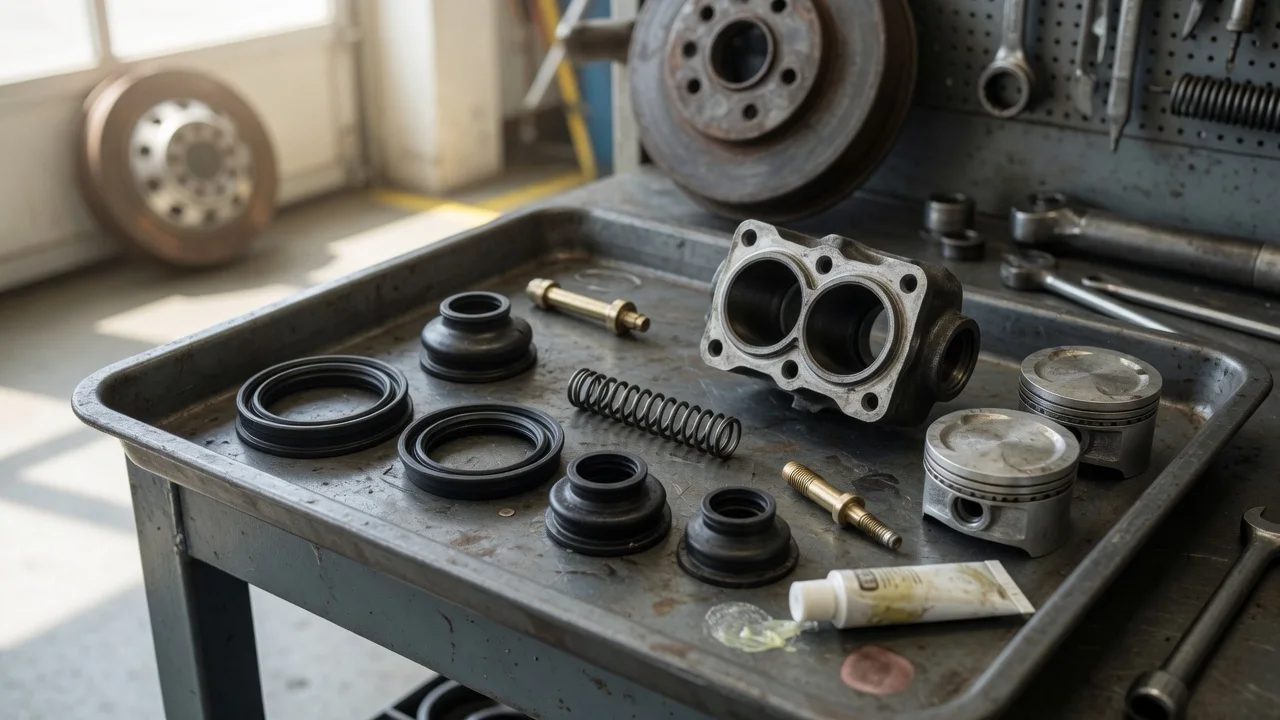
A wheel cylinder is the hydraulic component in a drum brake. When you press the pedal, fluid pressure from the master cylinder pushes the wheel cylinder's pistons outward, and the pistons force the brake shoes against the drum. A typical cylinder has a cast body with a smooth internal bore, one or two pistons, a rubber cup seal behind each piston, a light spring between the cups, rubber dust boots at each end, and a bleeder screw. Designs vary by vehicle, so match the rebuild kit to the exact model, year and axle position.
This guide covers drum brake wheel cylinders only. A disc brake caliper is a different part, and so is the master cylinder, even though both are sometimes loosely called a brake cylinder. Each has its own rebuild procedure and parts.
Rebuild or replace?
Rebuild may be reasonable if the bore cleans up to a smooth, even finish with a light hone, the body and bleeder threads are sound, the bleeder screw is not seized, and a correct seal kit is available. Replace if pitting or scoring remains after light honing, if the bore exceeds the manufacturer's wear or clearance limit, if the bleeder screw is seized or snaps, if the body is cracked, or if a new cylinder costs about the same as a kit and is easy to get. Treat both sides of an axle the same. If one cylinder is leaking, the other is often near the same condition.
Honing a brake cylinder bore
A brake cylinder hone is a small spring-loaded tool, usually with three stones, that runs in a drill. Its job is to remove light varnish, glaze and surface corrosion and leave a clean finish for the new cups to seal against. It is not meant to enlarge the bore or remove deep damage.
Use a hone sized for small brake bores, and lubricate it with clean brake fluid of the type the vehicle specifies. Run the drill at low speed and stroke the hone steadily through the full length of the bore. Keep it moving so you don't cut a step or taper. Hone only briefly, then stop and inspect. If pits or scratches remain after a light pass, the cylinder needs replacing. Do not keep honing to chase them out. Clean out all abrasive residue before assembly. Grit left in the bore will damage the new seals. If the service information gives a maximum bore size or a piston-to-bore clearance, measure against it. Exceeding the limit means replacement. Check the manufacturer's guidance before honing aluminum bodies or bores with a special surface treatment. Some are not meant to be honed.
Rebuild steps
Raise and support the vehicle safely, remove the wheel and drum, and inspect the shoes and hardware. Disconnect the brake line with a flare-nut wrench to avoid rounding the fitting, then cap or plug the line to limit fluid loss and keep contamination out. Removing the cylinder from the backing plate makes cleaning and honing much easier, although some people rebuild it in place. Remove the dust boots, pistons, cups and spring. Note the order and orientation of the parts. Clean the body and passages, then inspect the bore under good light. Hone as described above, clean thoroughly, and inspect again. Coat the new cups and the bore with fresh brake fluid or the assembly lubricant supplied in the kit. Fit the cups with the sealing lip facing the fluid side, then install the spring, pistons and boots. Reinstall the cylinder and line, refit the shoes and drum, and adjust the brakes according to the vehicle's procedure. Bleed the hydraulic system until no air remains, check for leaks, and confirm a firm pedal before driving.
Mistakes that cause early failure
Petroleum products such as oil, grease, solvent or penetrating spray can swell and destroy the rubber seals. Keep them off all internal parts. Glycol-based brake fluids and silicone-based DOT 5 fluid must not be mixed. Use only the fluid the vehicle specifies. Shoes soaked with brake fluid cannot be cleaned reliably. Replace them as an axle set. A cylinder that is reinstalled with grit inside, or with cups fitted backwards, will leak or fail to apply properly.
What this guide does not cover
This guide does not give bore sizes, wear limits, piston-to-bore clearances, bleeder or line torque values, or bleeding sequences. These vary by vehicle, so take them from the factory service information for your model and year. Brakes are safety-critical. If you are unsure about the bore condition or the procedure, have a qualified technician inspect the work before the vehicle goes back on the road.