Porsche Steering Angle Sensor Reset and Calibration
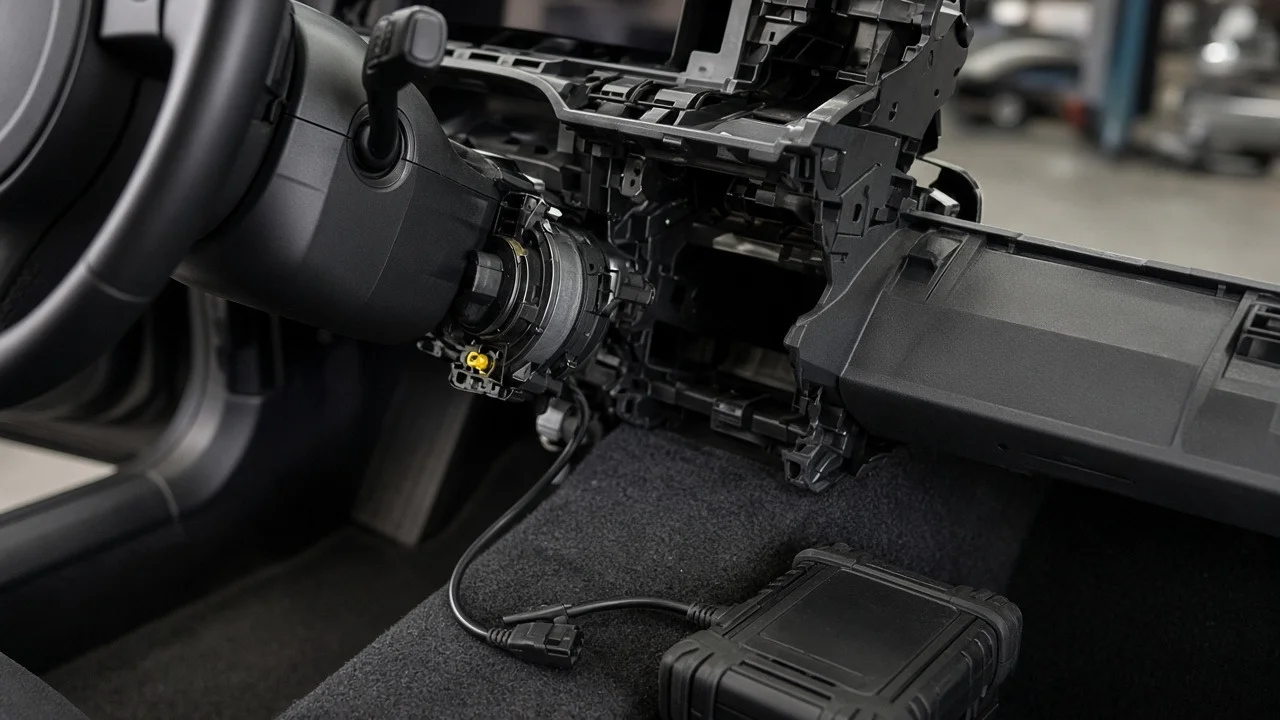
A Porsche steering angle sensor calibration or reset addresses the electronic reference point that tells stability, traction, and suspension systems where the driver is pointing the front wheels. When this reference drifts after alignment, suspension work, or battery disconnection, the vehicle may log chassis faults or disable driver aids. The process is not a repair for worn parts; it re-teaches the control module a straight-ahead position and the sensor's linear output so that steering effort, PSM, and PASM react predictably during normal driving.
Essential answer
A steering angle sensor reset and calibration is the procedure that clears an old zero reference and records the current steering wheel angle as the vehicle's centered, straight-ahead state. On Porsche models the task is typically performed with a compatible diagnostic interface rather than by turning the wheel lock-to-lock and hoping the module learns. The sensor itself measures rotation, but the calibration teaches the control unit how that rotation corresponds to the front wheels after changes in wheel alignment, ride height, or steering component replacement.
The scope of the job depends on why the reference was lost. A simple reset may restore the stored center after a temporary communication fault, while a full calibration requires driving the wheels onto an alignment rack, confirming the steering rack is centered, and running a guided routine. Because the sensor signal feeds PSM stability logic and steering effort maps, an inaccurate zero point can cause a steering wheel that appears crooked, a PSM light, or a fault code that returns after clearing. The code indicates a mismatch; it does not prove the sensor is broken.