Diagnose no-crank no-start when lights still work
The short answer
When the dashboard and headlights come on but the engine does not turn over, the battery is not proven healthy. Lights draw a small current, while a starter motor draws a very large one. A battery that is partly discharged, or a cable connection that is corroded or loose, can often still power the lights but cannot deliver enough current to crank the engine. The most common causes are a weak battery, poor battery or ground connections, a safety interlock that is not being satisfied (gear selector or clutch pedal), an immobilizer that does not recognize the key, a failed starter relay or fuse, or a faulty starter motor or solenoid. Less often, the engine itself cannot turn because of mechanical damage.
This guide applies to conventional gasoline and diesel vehicles with a 12-volt starter motor. Hybrids and electric vehicles do not crank in the same way. In those vehicles, a no-start with working lights usually points first to the 12-volt auxiliary battery or the vehicle's ready-mode system, and the specific procedure depends on the model. Check the owner's manual for those vehicles.
Why lights can work when the starter does not
Turning the key or pressing the start button sends a low-current signal through the ignition switch and safety interlocks to a starter relay or the starter solenoid. The solenoid is an electromagnetic switch mounted on or near the starter. It closes a heavy-current circuit from the battery to the starter motor and engages the starter gear with the engine's flywheel. A fault anywhere along that signal path, or in the heavy cables, can stop cranking while the lower-demand lighting circuits keep working. On many modern vehicles, the engine control module or body control module also decides whether to allow cranking. Security or interlock conditions can therefore block the start even when the wiring is intact.
Before you start checking
Park on level ground with the parking brake firmly applied. Wear eye protection near the battery. Lead-acid batteries can release flammable hydrogen gas, so keep sparks and flames away. Keep hands, clothing and tools clear of belts and the cooling fan, which can start without warning on some vehicles. If you disconnect the battery, follow the manufacturer's order. The usual convention is negative first when disconnecting and negative last when reconnecting. Disconnecting may reset radio codes or learned settings on some models. Avoid bridging starter terminals with a screwdriver or jumper wire. This can crank the vehicle while it is in gear, cause burns, or damage electronics. Leave this kind of bypass to a professional.
Use what you hear and see to narrow it down
Turn the key to start, or press the start button with the brake or clutch applied as required, and watch the dashboard lights while you listen. Ask a helper to watch the headlights if possible. Each pattern below points toward a different group of causes. None of them proves a specific part has failed.
What happens | What it usually suggests | Next check; Rapid clicking, lights dim or flicker | Not enough current reaching the starter: low battery charge or a poor connection | Battery terminals, cables, battery charge, jump-start test; One loud click, lights stay bright, no cranking | The solenoid is being energized but the motor is not turning: possible starter or solenoid fault, or a poor high-current connection at the starter | Starter cable and ground connections, then starter diagnosis; One click, lights dim heavily | Heavy current draw with no rotation: weak battery, bad connection, or an engine that cannot turn | Battery and cables first; if those check out, consider a mechanical problem; No click and no sound, lights stay bright | The start signal is not reaching the solenoid: interlock, immobilizer, relay, fuse, ignition switch or wiring | Gear selector or clutch switch, security light, fuses and relay; Lights go out completely when you try to start | A severe connection fault or a battery near failure | Battery terminals and main cables; Whirring or spinning noise but the engine does not turn | The starter motor is running but not engaging the engine | Starter drive or flywheel teeth, which usually needs professional inspection
Step-by-step checks
1) Inspect the battery terminals and cables
Look for white, green or bluish corrosion, cracked clamps, or terminals that move by hand. Follow the negative cable to where it bolts to the engine or body, and check the ground strap between engine and chassis. A loose or corroded connection can pass enough current for lights but not for the starter. If you clean the terminals, disconnect them first, clean both the post and the clamp, then refit and tighten them. If cranking returns after a cable is wiggled or cleaned, the connection was the likely cause, although the battery may still need testing.
2) Check the battery's state of charge
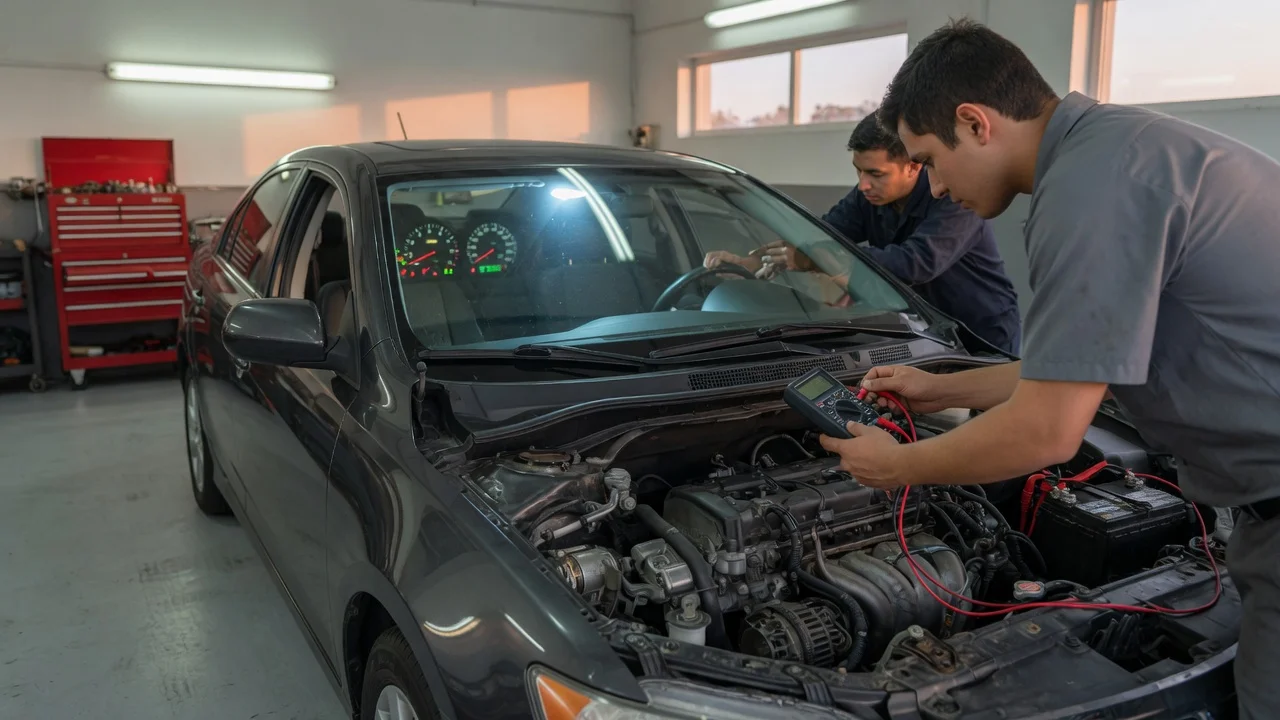
Use a multimeter across the battery posts with the engine and accessories off. A fully charged 12-volt lead-acid battery is commonly quoted at about 12.6 volts at rest, but exact thresholds vary by battery type (flooded, AGM or lithium auxiliary) and by manufacturer. Use the battery maker's figures where possible. A resting voltage alone does not show whether the battery can deliver cranking current. A load test, which many parts stores and workshops can perform, is a more reliable check. If the vehicle cranks normally with a jump start or a charged booster pack, the battery or charging system is the likely cause. Have the alternator checked as well, so you do not end up with the same problem again.
3) Confirm the safety interlocks
Automatic transmissions normally allow cranking only in Park or Neutral. Firmly reselect Park, or try starting in Neutral with the brake held. If the engine cranks in Neutral but not in Park, a misadjusted or failing transmission range sensor (often called a neutral safety switch) is a plausible cause. Manual-transmission vehicles usually need the clutch pedal fully pressed, and a faulty clutch pedal switch can stop cranking. Push-button vehicles commonly require the brake pedal to be pressed. A failed brake light switch can sometimes prevent starting, and it may also affect the brake lights, which a helper can check.
4) Look for immobilizer or key recognition problems
Watch for a flashing key, lock or security symbol on the dashboard, or a message saying the key is not detected. On keyless vehicles, a weak key fob battery is a common cause. Many models allow starting by holding the fob against a marked spot or the start button, but the method is model-specific and is described in the owner's manual. Try a spare key if one is available. If the spare works, the original key or its battery is the likely problem. Persistent immobilizer faults usually need dealer or specialist equipment to diagnose.
5) Check starter fuses and relay
Use the owner's manual or the fuse box lid diagram to find the starter or ignition fuse and the starter relay, if fitted. Inspect the fuse for a broken element, or test it with a meter. Where the manual identifies an identical relay used for a non-critical circuit, swapping the two is a common test, but confirm the part numbers match first. Replace a blown fuse only with one of the same rating. A fuse that blows again points to a short circuit that needs further diagnosis.
6) Consider the starter motor and solenoid
If the battery and connections test good, the interlocks are satisfied and the start signal is present, the starter or solenoid becomes the main suspect. A single click with bright lights, or a starter that works intermittently, fits this pattern. Gently tapping the starter body while a helper turns the key is a widely described stopgap that can free worn internal contacts. It is not a repair, and it requires working near the exhaust, wheels and moving parts, so do it only if the vehicle is secure and the starter is safely reachable. Confirming a starter fault properly involves checking voltage at the solenoid terminals during a start attempt. That is a reasonable task for someone comfortable with a multimeter and the vehicle's wiring diagram. Otherwise, it is a job for a technician.
7) Rule out an engine that cannot turn
If there is a heavy clunk with no rotation, the battery and starter test good, and especially if the vehicle was recently driven through deep water, ran low on oil or made unusual noises before stopping, the engine may be mechanically locked. Water drawn into the cylinders (hydrolock) or internal damage are possibilities. Stop trying to start the vehicle, because repeated attempts can cause further damage, and arrange professional diagnosis.
Using fault codes
An OBD-II scan tool can read stored diagnostic trouble codes and, on many vehicles, live data such as transmission range position or immobilizer status. Codes related to the immobilizer, transmission range sensor, brake switch or communication between modules can point you toward the right circuit. A code tells you what to investigate, not which part to replace. Confirm the fault with the checks above or the manufacturer's diagnostic procedure before buying parts. Basic generic scanners may not read body or security module codes on every vehicle.
When to stop and get professional help
You smell burning, see smoke, or notice melted insulation or hot cables. A fuse blows again after replacement. The engine appears mechanically locked, or water ingestion is possible. Immobilizer or key programming faults persist after trying the spare key and a new fob battery. The starter is hard to reach safely, or testing requires working under the vehicle without proper support. The vehicle is a hybrid or electric model and the problem is not resolved by charging or replacing the 12-volt battery.
Limits of this guide
Interlock logic, fuse and relay locations, key fob backup-start methods, battery specifications and starting circuit design all vary by manufacturer, model year, powertrain and market. This guide does not give model-specific voltage limits, wiring details or tightening values. Confirm those details in the owner's manual, service information or with a qualified technician for your vehicle.
How to know the problem is fixed
The engine should crank at a steady, normal speed and start on several attempts in a row, including after the vehicle has sat overnight. Warning lights should clear after starting. If the battery was the cause, a charging-system check confirms whether the alternator is keeping it charged. If cranking stays slow or the fault returns intermittently, the underlying cause has not been fully resolved.