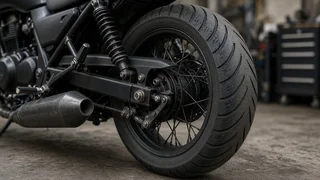
Motorcycle racing slick tires

Motorcycle racing slick tires are purpose-built track tires whose smooth, treadless contact patch maximizes dry-pavement grip. Unlike street tires, they trade water evacuation and longevity for the highest possible cornering and braking traction once warmed. This distinction matters for riders considering track days or competition, because using a slick changes warm-up behavior, suspension demands, and safety margins. Understanding how these tires work helps clarify why racers select them and what conditions make them suitable. The following overview explains the essential role of a slick, its operating requirements, and how related tire fundamentals such as sizing, inflation, and speed rating affect performance.
Essential answer
A motorcycle racing slick tire is designed for closed-course use in dry conditions. Its defining feature is the absence of tread grooves, which creates an uninterrupted rubber contact patch. At proper operating temperature, that smooth surface conforms closely to pavement texture and generates more mechanical grip than a grooved tire of similar compound. The benefit is most evident under hard acceleration, deep lean angles, and threshold braking, where consistent footprint stability directly influences rider confidence and lap time.
The scope is narrower than a general sport tire. A slick is not intended for public roads, standing water, or cold starts. Riders researching motorcycle racing slick tires should view them as one part of a track-oriented system: tire size must match rim width and swingarm clearance, load index and speed rating must suit the machine, and inflation pressure becomes a fine adjustment rather than a fixed street setting. Drivetrain compatibility also matters, because aggressive power delivery can overwhelm a cold or incorrectly sized slick.