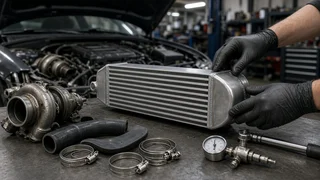
Mazda 3 turbo intercooler

Choosing a replacement Mazda 3 turbo intercooler means looking beyond the part shape and focusing on how the heat exchanger preserves charge-air temperature under sustained boost. A well-matched unit reduces compressor outlet heat while maintaining the hose connection integrity the turbocharged engine relies on. The right evaluation covers core condition, mounting fit, fin density, and leakage signs such as oil contamination. This frames the purchase decision around real thermal and pressure-loss behavior rather than appearance alone.
The direct answer
The direct answer is to select a direct-fit or correctly sized Mazda 3 turbo intercooler that maintains consistent boost pressure without adding excessive pressure loss across the core. An undersized core may fit but still allow charge-air temperature to climb during repeated acceleration. A larger unit can help on a tuned or heavily loaded car, yet it should not force questionable hose connection angles or block airflow to the radiator and condenser.
Check the end tanks and inlet/outlet stubs first. Cracks, deformed clamping surfaces, or oil contamination inside the passages indicate the old intercooler was already working beyond its limits or sealing poorly. Oil film can come from normal crankcase vapor, but pooled oil deserves closer inspection of the turbocharger and plumbing before installing a new part. Confirm that the mounting tabs and bracket positions match the original so the replacement does not strain the couplings or rub against nearby components.