Maserati Oil Change Service: What It Involves and How It Differs
A Maserati oil change service replaces the engine oil and oil filter using a lubricant that meets the specification Maserati sets for that specific engine, fills it to the correct level, and resets the service reminder. The basic job is the same as on any car. What sets it apart is that Maserati has used several very different engines across its range, and each has its own oil approval, fill quantity, level-check method and service interval. The right procedure for your car depends on its model, model year, engine and market, so the owner's manual and maintenance schedule for that exact vehicle come first.
The Short Answer
An oil change on a Maserati involves draining the old oil, replacing the filter, refilling with the approved oil, checking the level by the method specified for that engine, and resetting the service indicator. The correct oil, quantity and interval vary by engine family, so there is no single Maserati oil change specification. Any qualified shop can physically do the work, but using the wrong oil grade or approval, or skipping the correct level-check procedure, can harm the engine and may affect warranty coverage. Fully electric Maserati models do not use engine oil, so they have no engine oil change, although they still have a maintenance schedule.
Why the Engine Matters More Than the Badge
The Maserati name covers a broad range of powertrains. Older models used naturally aspirated V8 engines developed with Ferrari. Many Ghibli, Quattroporte and Levante models from the mid-2010s onward use a twin-turbocharged V6, with V8 versions in some trims. More recent models introduced the Nettuno V6 and a turbocharged four-cylinder mild-hybrid engine, and the Folgore line is fully electric. These engines differ in design, operating temperatures, turbocharging and lubrication systems, which is why their oil requirements differ.
Powertrain type | What it means for an oil change; Naturally aspirated V8 (older models) | Some use dry-sump lubrication, which changes how the oil level is checked and how the system is drained and filled; Twin-turbo V6 and V8 (Ghibli, Quattroporte, Levante era) | Turbochargers place extra demands on oil, so following the approved specification and interval matters; Nettuno V6 (newer performance models) | A distinct, more recent engine with its own oil requirements; treat it as separate from earlier V6 engines; Four-cylinder mild hybrid | A different engine family again, with its own specification despite sharing model names with V6 versions; Folgore electric | No engine oil; maintenance covers other fluids and components
Two cars with the same model name can need different oil if they have different engines. Identifying the engine is therefore the first step in any Maserati oil change.
Equipment Identification: Confirming Your Exact Engine
Before buying oil or booking a service, confirm which engine your car has. Useful ways to identify it include:
The vehicle identification number (VIN), which a dealer or parts supplier can decode to the exact engine and build. The owner's manual and maintenance booklet supplied with the car, which list the oil specification and capacity for that vehicle. The original window sticker or purchase documents, which usually name the engine and trim. Badging and trim names, used as a hint only, since names alone do not always reveal the engine.
Lubricant Specification and Manufacturer Approval
Engine oil is defined by more than its viscosity grade, such as the familiar two-number rating describing cold and hot flow. Manufacturers also set performance requirements covering how the oil protects against wear, deposits and breakdown at high temperatures. An oil that matches the viscosity number but lacks the required approval or performance standard is not a correct substitute.
For a Maserati, the safest approach is to use an oil that the owner's manual names or that explicitly meets the specification Maserati lists for that engine. Oil containers usually state which manufacturer approvals or standards the product meets. If the label does not clearly match the requirement in the manual, choose a different oil. This matters most on turbocharged engines, which run their oil hotter and depend on it to lubricate and cool the turbocharger bearings.
Fill Quantity and Level Check
Fill quantity, meaning how much oil the engine takes during a change with a new filter, varies by engine and is listed in the owner's manual. Rather than pouring in a fixed amount and assuming it is right, a careful technician adds most of the specified quantity, runs the engine as directed, and then confirms the level using the method Maserati specifies for that engine.
The level check is where Maserati engines can differ from typical cars:
Some models use a traditional dipstick, while others display the oil level electronically through the instrument cluster or infotainment system. Dry-sump engines store most of their oil in a separate reservoir rather than in a pan under the engine. Their level is often checked under specific conditions, such as with the engine warm or running, and checking it like a conventional engine can give a misleading reading. Both overfilling and underfilling are harmful. Too little oil risks inadequate lubrication, while too much can cause foaming, pressure problems and oil being drawn into places it should not go.
Service Interval
The service interval is the distance or time allowed between oil changes, whichever comes first. Maserati's recommended intervals differ by model, engine, model year and market, and many recent models display a service reminder in the instrument cluster. Check the maintenance schedule for your specific car rather than relying on general figures or on intervals quoted for a different Maserati.
Driving conditions can justify changing oil sooner than the standard schedule. Frequent short trips that never fully warm the engine, sustained high-performance or track driving, very hot or dusty climates, and long periods of storage are all conditions under which many manufacturers recommend shorter intervals. If your manual includes a severe-service schedule, consider whether your use fits it. Because oil also ages over time, a low-mileage car still needs changes on a time basis.
What a Proper Maserati Oil Change Includes
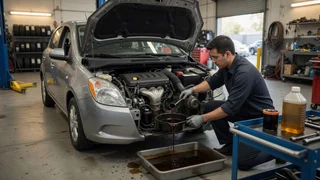
Confirming the engine and the required oil specification and quantity. Draining the old oil fully, using the correct drain points for the engine. Dry-sump systems may have more than one. Replacing the oil filter with a correct-fit part and lubricating the new filter seal as specified. Replacing drain plug washers or seals where the manufacturer calls for it. Refilling with approved oil and running the engine to circulate it. Checking the level by the specified method and correcting it if needed. Inspecting for leaks around the filter and drain points. Resetting the service reminder so the next service is tracked correctly. Recording the date, mileage, oil product and filter used for the service history.
Many shops also perform a basic inspection during the visit, such as checking other fluid levels, tires and visible components. This can be useful, but it is separate from the oil change and can vary between providers.
Dealer, Independent Specialist or DIY
In the US, owners generally choose among three options, each with tradeoffs:
Option | Strengths | Points to consider; Maserati dealer | Factory-trained technicians, access to brand diagnostic tools, familiarity with model-specific procedures, dealer-stamped service records | Often the most expensive option; availability depends on how close you live to a dealer; Independent Maserati or exotic-car specialist | Brand experience, often lower labor costs, sometimes more personal service | Confirm they use the correct oil approval and filter and can reset the service indicator; ask about their experience with your engine; General quick-lube shop | Convenient and widely available | Risk of using a generic oil that does not meet the required approval, or of an incorrect level check on dry-sump engines; not ideal for most Maseratis; DIY | Full control over parts and procedure | Requires the correct oil, filter, tools, a way to reset the service reminder and knowledge of the level-check method; keep receipts and records
Regarding warranty, US federal law generally prevents a manufacturer from voiding a warranty simply because maintenance was done somewhere other than a dealer. The owner may still need to show that the work was performed on schedule with parts and fluids meeting the required specification. Keeping receipts that show the oil product, filter, date and mileage is the practical way to protect yourself, whoever does the work.
Questions to Ask When Booking
Which oil product will you use, and does it meet the specification listed for my engine? Will you use a genuine or equivalent-quality filter? How will you check the oil level on my engine, especially if it is dry-sump or has an electronic level reading? Will you reset the service reminder? Will the receipt list the oil, filter, date and mileage? Is the price for the oil change alone, or does it include inspections or other items?
Bottom Line
A Maserati oil change follows the same basic steps as on any car, but the details depend on which engine the car has. Identify your engine, use an oil that meets Maserati's stated specification for it, fill to the specified quantity, check the level by the correct method, and follow the service interval for your model year and driving conditions. Whether you choose a dealer, an experienced independent specialist or do the work yourself, accurate parts, a correct procedure and complete records matter more than where the service is performed.