Made in USA Tire Pressure Gauges: What to Know Before You Buy
Direct answer
A made in USA tire pressure gauge is not a single standard product. It generally means a dial, digital, pencil or industrial gauge assembled in the United States from mostly domestic components, but the practical choice depends on how you use it. For routine passenger vehicle checks, a quality USA-assembled pencil or dial gauge is usually enough. For frequent shop, track or fleet use, a rebuildable dial gauge with a protective case is more relevant. The key condition is that USA assembly does not by itself guarantee accuracy or long-term calibration; you still need to check the scale range, build quality and whether replacement parts are available.
How to interpret the made in USA claim
Tire pressure gauges fall into an area where country-of-origin wording can vary. Some manufacturers assemble the complete gauge in the USA and mark it clearly. Others use USA-made movements or brass bodies but attach a hose, chuck or lens cover sourced elsewhere. When a gauge is labeled “Made in USA,” check whether the manufacturer states that the metal case, bourdon tube, dial face and calibration are produced domestically. If the packaging only says “assembled in USA” or “USA design,” the gauge may contain imported components. This matters less for casual use, but it can affect warranty support and the availability of repair kits.
Gauge types and where USA production fits
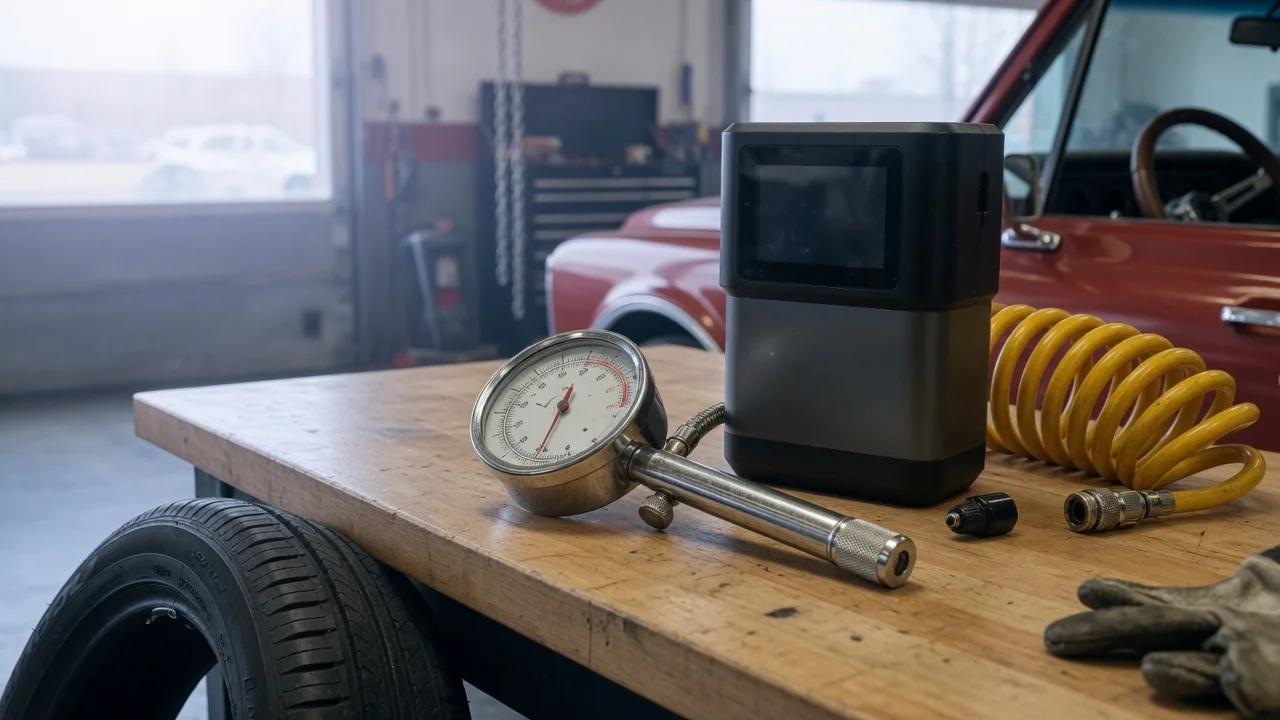
Pencil or stick gauges: simple, compact and often made with a metal barrel and a sliding indicator; good for glovebox use but harder to read in low light. Dial gauges: show pressure on an analog face; more legible and often available with a flexible hose; the type most often sold as a USA-made service gauge. Digital gauges: easy to read and often precise, but fewer are assembled in the USA and they depend on batteries. Industrial or liquid-filled gauges: built for repeated shop or race use; more likely to be USA-assembled and rebuildable, but overkill for a standard passenger car.
What to look for in a USA-made dial gauge
If you choose a dial gauge, match the gauge’s common working range to your vehicle. Passenger car tires generally operate around 30 to 40 psi, but light truck and heavy-duty tires can sit between 50 and 80 psi or higher. A gauge with a 0–60 psi dial will give a more readable mid-scale reading for a sedan, while a 0–100 psi or wider dial suits trucks but may sacrifice fine resolution at lower pressures. A bourdon tube is the coiled metal tube that moves the needle. In a service-grade USA gauge, the tube, socket and gear mechanism are usually brass, which resists corrosion better than plastic internals.
Accuracy, calibration and use
No gauge is perfectly accurate across its entire range. A practical expectation for a quality analog tire gauge is within about 2 psi of a reference reading in the middle of the scale. Digital gauges may state tighter tolerance, but that claim still depends on battery condition and temperature. Preserve consistency by checking tires cold, before the vehicle has been driven far. Sun, heat and residual air from a compressor can change the reading. Do not drop a dial gauge. A hard impact can shift the pointer or damage the bourdon tube, which is why many USA-made professional gauges include a rubber boot or protective gauge guard.
Repairability and ownership trade-offs
A rebuildable USA-made gauge is an ownership tool rather than a disposable accessory. Some service gauges let you replace the lens, chuck, hose or gauge movement. This reduces waste and keeps the same housing in use for years, but it also means a higher initial cost and the need to order compatible parts. For a daily driver, a fixed gauge may be simpler. For someone who works on multiple vehicles or checks pressure constantly, a repairable dial gauge is more likely to justify its price. The main gap is manufacturer-specific compatibility: repair parts from one brand generally do not fit another, so confirm part support before treating a gauge as rebuildable.
Bottom line
A made in USA tire pressure gauge is a reasonable choice when you want domestic assembly, serviceable metal construction and long-term use. The specific type should match your vehicle and routine. A pencil gauge is fine for occasional checks. A dial gauge with a comfortable operating range is better for regular use. A rebuildable service gauge makes sense if you need repeatable readings and expect to maintain the tool over time. Verify the exact origin wording and the psi range before choosing, because those two details affect the gauge’s usefulness more than the country label alone.