Best Tire Pressure Gauges: How to Choose One
How this list is organized
A tire pressure gauge measures the air pressure inside a tire. The result is usually expressed in pounds per square inch, abbreviated psi, although many gauges can also display kilopascals or bar. This list is not an exhaustive inventory of every model on sale. It groups gauges by the measurement technology and physical form that affect how consistently they work, how well they fit a valve stem, and how easy the reading is to use in a driveway or garage.
The entries are ordered from the most traditional and self-contained design to the more specialized or accessory-dependent types. Each entry explains what the gauge does well and where its compromises show. Because no single gauge is universally superior for every vehicle or every owner, the comparison section separates accuracy, ease of use, and reliability so you can match a type to your intended use.
1) Pencil or stick gauge
A pencil gauge is a simple sliding-rod instrument. The chuck is pressed onto the valve stem, and air pressure pushes a calibrated rod out of the barrel. The pressure is read where the rod stops, usually against a printed scale. This design has no battery and few moving parts, which makes it compact and dependable as an emergency or glovebox tool.
The main limitation is the small scale. Markings can be close together, especially on a gauge rated for a wide pressure range, so the reading depends on holding the gauge straight and viewing the rod from the correct position. A pencil gauge is most useful as a backup for occasional checks rather than as the primary tool for owners who need precise cold-pressure readings.
2) Analog dial gauge
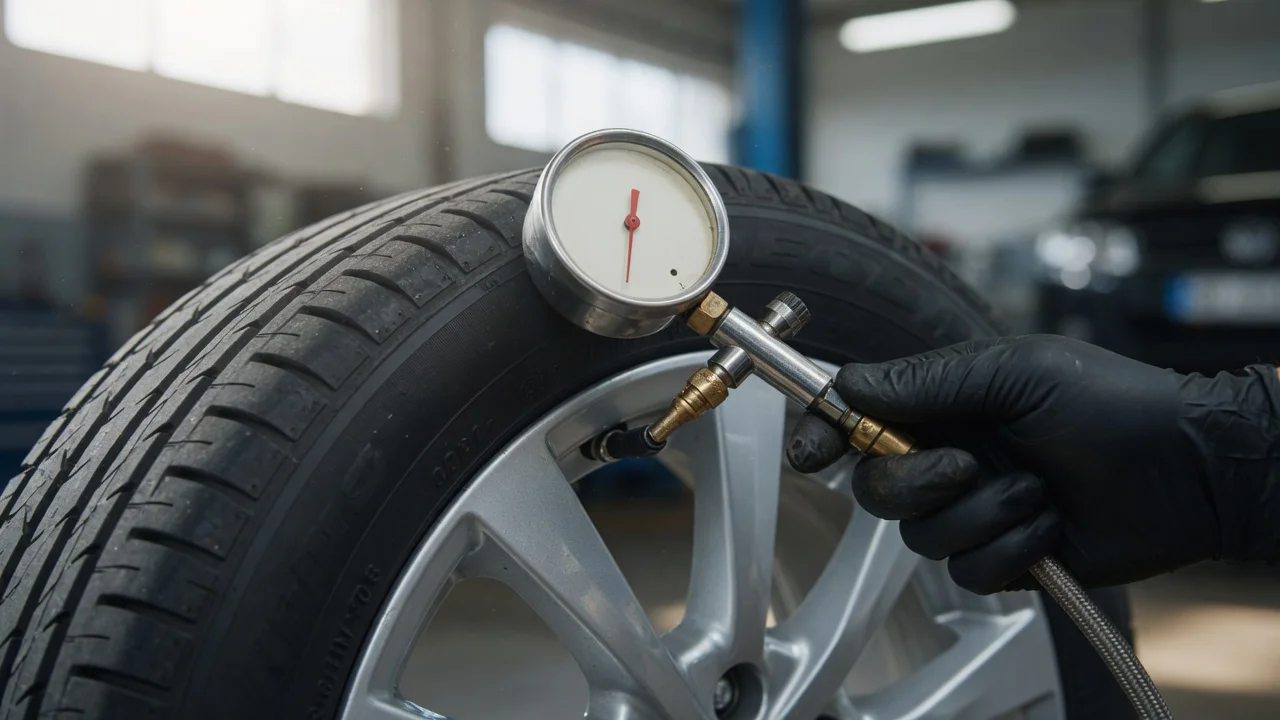
An analog dial gauge uses a mechanical bourdon tube or similar sensing element connected to a needle on a circular face. The larger dial spreads the scale over more distance than a pencil gauge, which usually makes intermediate values easier to distinguish. Many dial designs include a bleed button, allowing the user to release small amounts of air while the chuck remains attached.
Durability depends heavily on construction. A gauge with a flexible hose between the chuck and the dial is easier to align on a recessed valve stem, but the added hose and fittings create more places for leaks or damage. A rigid dial gauge is simpler, though it can be awkward on wheels with limited clearance. Drops and hard impacts can shift calibration on any mechanical gauge, so this type rewards careful storage.
3) Digital gauge
A digital gauge converts pressure into a numeric reading on a small display. This removes much of the interpretation required by a needle or sliding scale. The display format also makes it easy to note exact values when comparing all four tires. Many digital gauges retain the last reading briefly after the chuck is removed, which helps when the display is at an awkward angle.
The tradeoff is the battery. A digital gauge requires a functioning power source, and battery life can be shortened by cold weather or by leaving the unit switched on. Some digital models may also be more sensitive to moisture than a purely mechanical gauge. If the gauge is kept in a vehicle year-round, the owner should accept that the battery is a maintenance item alongside the gauge itself.
4) Inflator gauge or gauge with air chuck
This type combines pressure measurement with an air supply connection, often as a gauge mounted on an inflator body or integrated into a compressor hose. It allows the user to check pressure and add air through the same valve connection. For owners who adjust pressure frequently or manage several vehicles, an inflator gauge can speed up the work considerably.
The gauge on an inflator is exposed to the same pulses, vibration and moisture as the air line. Accuracy and long-term stability can therefore vary more than a dedicated handheld gauge kept away from the compressor. When using this type, the most reliable check is to inflate slightly above the target, then use a separate reference gauge to confirm the result after the chuck is removed.
Which differences matter for your use
The practical choice depends on where and how often the gauge will be used, not on an abstract ranking. A low-cost pencil or basic dial gauge is light and easy to keep in a vehicle, making it a reasonable backup for occasional checks. A larger analog dial or digital gauge is easier to read when the owner wants repeatable cold-pressure values for a specific vehicle.
For regular inflation work, a gauge that connects to an air supply reduces the number of times the valve must be reseated. In exchange, it may be less suitable as the sole reference tool unless it is checked against a known-good handheld gauge. The important comparison is not a single overall winner, but which combination of readability, sturdiness and convenience best matches the intended role.
Key accuracy and readability features
Accuracy in a consumer tire gauge is best understood as repeatability under consistent use. A gauge does not need laboratory certification for routine tire checks, but it should return nearly the same value when checked repeatedly against a stable reference. If a gauge varies by several psi between consecutive readings, it is not providing a useful basis for adjustment.
Resolution: A dial or digital gauge with a scale that shows smaller increments is easier to read, but fine markings do not by themselves prove that the gauge is accurate. Range: The gauge should place the target pressure in the middle portion of its working range where the mechanism is typically most predictable. Valve fit: A secure, straight seating on the valve stem prevents a noisy reading caused by air escaping during the measurement. Display stability: A digital display that holds the value after release reduces parallax and hurried reading errors.
Tire pressure specifications are vehicle-dependent. The correct value comes from the tire information label on the vehicle, usually located on the driver-side door jamb, or from the owner’s manual. A gauge cannot choose the target pressure for a given make, model, year, trim or load condition. It only reports the pressure that the user then compares with that specification.
How to check tire pressure accurately
The most consistent procedure measures cold tires before the vehicle has been driven more than a short distance. Heat from driving raises internal tire pressure, so a reading taken after a long trip will not correspond reliably to the cold inflation specification.
Locate the vehicle’s recommended tire pressure on the tire information label or in the owner’s manual. Gather the gauge and, if needed, an air source such as a portable inflator or service-station air pump. Measure the tires before substantial driving, preferably after the vehicle has been stationary for several hours. Remove the valve cap and keep it clean and dry. Press the gauge chuck firmly and squarely onto the valve stem until the flow of escaping air stops. Read the value and note it before moving to the next tire. Replace the valve cap snugly after each measurement. Inflate or deflate as required, then re-measure to confirm that the final pressure matches the target.
A common completion check is to measure all four tires again after any adjustment and compare each result with the same specification. Include the spare only if the vehicle uses a matching full-size spare that is intended to be driven at the same pressure. If you are unsure of the required value or the applicable load condition, consult the owner’s manual or a qualified service provider.
Maintenance and limitations
Store a gauge where it is protected from hard impacts, extreme heat and prolonged moisture. If a gauge has been dropped or exposed to freezing conditions, compare it with another known-good gauge before relying on its reading. Valve caps also matter: they help keep dirt and moisture out of the valve core, reducing the chance that debris will interfere with future measurements.
A tire pressure gauge measures pressure only. It does not measure tire temperature, tread condition, load capacity or the condition of the valve stem. A normal pressure reading does not rule out a damaged tire, a leaking valve or an incorrect tire for the vehicle. Any suspected leak, vibration, handling change or persistent pressure loss should be inspected by a qualified tire service provider rather than managed by repeated inflation alone.