Choose Lotus Elise transmission fluid
The short answer
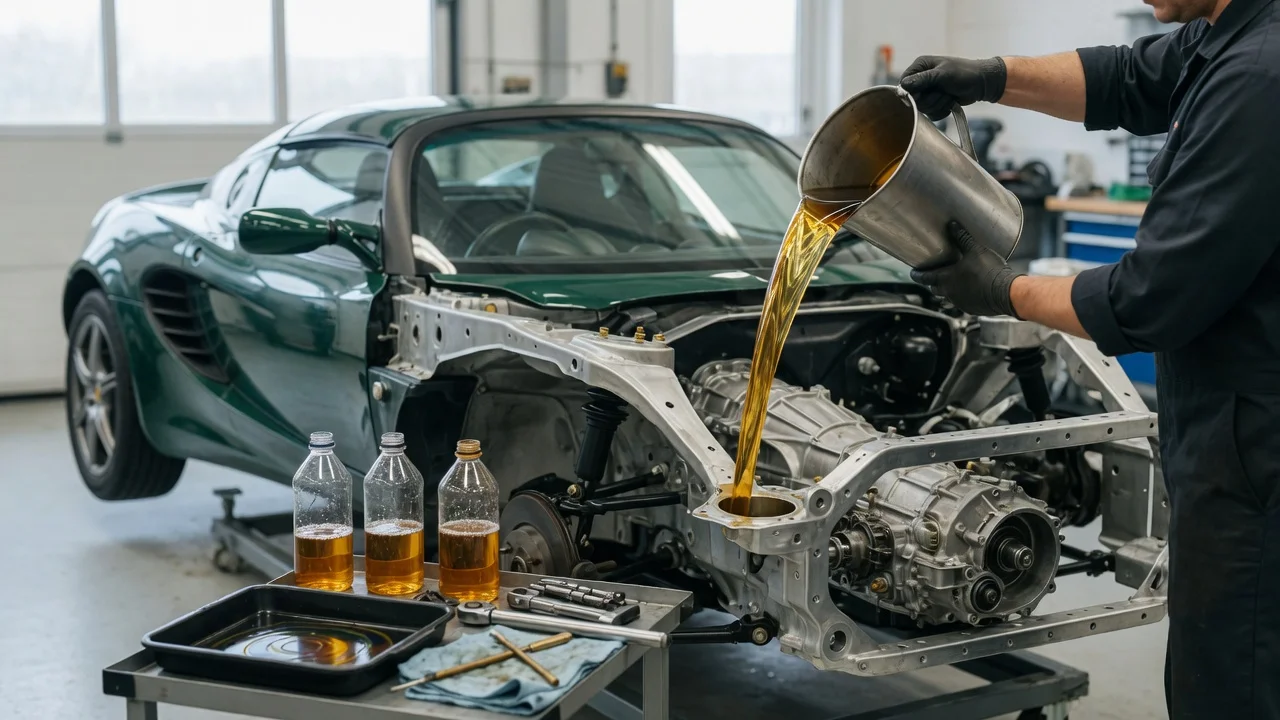
There is no single correct transmission fluid for every Lotus Elise. The right oil depends on which gearbox your car has, and that changed across the model's life. Start by identifying your car's generation and engine, then use the fluid specification (performance rating and viscosity grade) listed in the owner's handbook or service manual for that gearbox. An oil that meets that specification is the correct choice. A brand name alone is not enough to decide.
This guide covers how to choose gear oil for the Elise's manual gearbox. No manufacturer service data, fluid capacities or product test results were supplied for this article, so it does not give a fill quantity or name a specific product. Confirm those details against Lotus documentation for your exact car before buying.
Why the generation and engine matter
The Elise was built from 1996 to 2021 across Series 1, Series 2 and Series 3 cars. Lotus used engines from different suppliers over that period. Each engine was paired with a gearbox from the same supplier.
Rover K-series cars (Series 1 and early Series 2): generally paired with a Rover-sourced five-speed manual gearbox. Toyota-engined cars (later Series 2 and Series 3): generally paired with a Toyota-sourced six-speed manual gearbox. The changeover date and the engine and gearbox combinations differed by market. A car's registration year alone may not tell you which unit it has.
These gearbox families came from different manufacturers, so their fluid specifications are not interchangeable by default. Imports, engine swaps and gearbox replacements are known among modified Elises. On a used car, check the gearbox itself, not just the model year.
How to identify your gearbox
Check the vehicle identification number (VIN) and build date against the model year and market. Confirm the engine type. Engine codes are stamped on the block and recorded in service paperwork. Count the forward gears. Five suggests the earlier Rover-sourced unit, and six suggests the Toyota-sourced unit. Confirm this rather than relying on it alone. Look for a gearbox identification plate or casting code, and review service history for any replacement.
What to read on the specification
A gear oil specification usually has two parts. The performance rating, commonly given as an API GL category, describes the additive package and load-carrying ability. The viscosity grade, such as a 75W-figure rating, describes how thick the oil is when cold and at operating temperature. Some manufacturers specify a proprietary fluid instead of, or as well as, these generic ratings. In that case, a substitute should state that it meets that proprietary specification.
The performance rating needs particular care. Manual gearboxes with brass or bronze synchronizer rings are often specified for GL-4 oil. Oils rated only GL-5 contain higher levels of extreme-pressure additives, which are widely regarded as potentially harmful to those yellow-metal parts and can change shift feel. Do not assume a higher number is better. Use the rating the gearbox calls for. Some oils are labelled as meeting both GL-4 and GL-5, which can be acceptable when the specified rating is listed.
Choosing between fluid options
Once you know the specification, the practical choice is usually between the manufacturer-branded fluid and an aftermarket oil that states it meets the same specification. No comparative test data was supplied for any specific product. The table below therefore compares the options on decision criteria, not on measured performance.
Criterion | Manufacturer-specified or branded fluid | Aftermarket oil stating the same specification; Certainty of match | Highest, as it is the documented fluid | Depends on the label explicitly listing the required rating or approval; Availability | May be harder to source for older or discontinued gearboxes | Often easier to find; Cost | Varies by market. No pricing was supplied | Varies by market. No pricing was supplied; Shift feel | Matches the original design intent | May differ. Owner reports vary and are not controlled tests; Best suited to | Owners who want a documented match, or cars under any remaining warranty | Owners who have confirmed the specification and need a practical alternative
Editorial judgment: for a road car used normally, choose the specified fluid or a clearly labelled equivalent. Track use or heavy modification may justify asking a Lotus specialist whether a different grade suits the car. That decision is specific to the car and its use, not a general upgrade.
Gaps to close before you buy
Exact fluid specification for your gearbox: confirm in the owner's handbook or Lotus service manual for your model year and market. Fill capacity: not supplied here. Check the service manual, and fill to the level the procedure specifies rather than to a fixed volume. Change interval: not supplied here. Follow the service schedule for your car. Fill and drain plug locations, sealing washers and tightening torques: check the service manual before starting the job.
Bottom line
Identify whether your Elise uses the earlier Rover-sourced five-speed or the later Toyota-sourced six-speed gearbox, and confirm this on the car itself. Then buy an oil that explicitly meets the rating and viscosity Lotus specifies for that unit. Treat the performance rating as important as the viscosity, and verify capacity and service intervals from official documentation.