LegUp Motorcycle Landing Gear: What to Check Before You Buy
LegUp motorcycle landing gear is an aftermarket system that lowers a pair of small wheeled legs when a motorcycle slows to a stop, so the bike stays upright without the rider holding it up with their feet. It is aimed mainly at riders of heavy touring motorcycles who struggle with the weight at a standstill because of height, inseam, strength, injury, age or a heavy passenger and luggage load. Whether it is a sensible purchase depends on three things: an exact fitment match for your motorcycle, an electrical system that can support it, and your willingness to adapt how you stop and pull away.
The Short Answer
If you ride a large touring bike that appears on the current fitment list for your exact model year, and your main problem is supporting the bike at stops, landing gear can be a reasonable alternative to lowering the suspension or converting to a trike. If your bike is not explicitly listed, has significant aftermarket exhaust, floorboard or crash bar changes, or you are mainly worried about low-speed balance while moving rather than at a full stop, check those points carefully first, because they can change the answer.
How Motorcycle Landing Gear Works
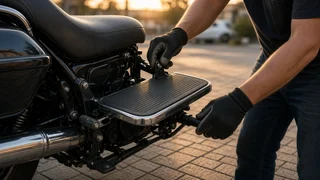
Systems of this type mount a pair of retractable legs, each with a small wheel at the end, to the motorcycle's frame on either side. An electric actuator moves the legs down as the bike approaches a stop and lifts them back up when the rider is ready to ride on. Depending on the version and setup, deployment and retraction may be triggered by a handlebar switch, by speed sensing, or by a combination of the two. While deployed, the bike rests on the wheels instead of on the rider's legs.
The gear supports the bike when it is stopped or rolling very slowly in a straight line. It is not a substitute for balance while the motorcycle is leaning or turning, and it does not replace the side stand for parking. Confirm with the seller how the specific version you are considering behaves at walking pace, on uneven ground and on slopes.
Who It Suits and Who It May Not
Likely good candidates: riders who cannot comfortably flat-foot a heavy touring bike at stops. Riders recovering from or living with knee, hip or back problems who want to keep riding a full-size motorcycle. Riders who often carry a passenger and full luggage, which raises the weight they must hold at a stop. Riders who want to keep their bike's original ride height and suspension travel rather than lowering it. Less likely to suit: riders whose motorcycle is not on the fitment list. Riders who frequently stop on steep cambers, gravel or rough surfaces, where any wheeled support is less predictable. Riders whose difficulty is mainly slow-speed maneuvering and tight turns, which landing gear does not solve.
Model Identification and Fitment
Landing gear kits use model-specific brackets that attach to particular points on the frame, so fitment is the first and most important check. The system has been marketed primarily for large touring motorcycles, but the list of supported bikes can change over time and between versions. Do not rely on a general model family name alone.
Make, model and exact model year. Frame and mounting points can change between generations of the same model name. Trim or variant, such as a standard touring model, a low-seat version or a factory trike-ready configuration. Market. A bike sold in the US may differ in exhaust, lighting or wiring from the same model sold elsewhere. VIN, if the seller asks for it to confirm the frame version. Whether the bike has already been converted, lowered or modified in ways that move mounting points or reduce clearance.
Equipment Compatibility With Your Existing Accessories
Touring bikes rarely stay stock, and accessories are where many fitment surprises happen. The legs need room to move between their raised and lowered positions without contacting anything.
Exhaust: aftermarket headers, mufflers or crossover pipes may sit in a different position from the factory system. Ask whether your exhaust is known to work. Floorboards and highway pegs: extended boards, relocated pegs and passenger boards can sit in the path of the legs or the rider's feet. Engine guards and crash bars: aftermarket bars may share mounting points or occupy the same space. Saddlebags, bag guards and lower fairings: check clearance around the lower sections. Lowering kits or suspension changes: altering ride height affects how far the legs must travel to reach the ground. Trailer hitches and wiring: these can compete for space and electrical connections.
Engine Configuration, Drive System and Clearance
The engine configuration and drive system of your motorcycle matter mainly because they determine where heat sources and moving parts sit. On a typical large V-twin touring bike, the exhaust, primary cover and final drive (usually a belt on many touring models) are close to the area where landing gear mounts. A well-designed kit for your exact model should route around these, but modifications can reduce the margins. Ask the seller or installer to confirm clearance from hot exhaust parts and from the belt or chain and its guard.
Also consider cornering clearance. Anything mounted low on a motorcycle can reduce lean angle. Ask whether the retracted gear sits higher or lower than parts that already touch down first, such as floorboards, and whether that changes how far the bike can lean before something scrapes.
Electrical Requirements
Because the legs are powered by an electric actuator, the system draws on the motorcycle's battery and charging system. Before buying, look at how much electrical equipment your bike already runs, such as heated gear, auxiliary lights, audio amplifiers and GPS units.
Battery condition and age: a weak battery can affect actuator performance and starting. Charging system capacity relative to your existing accessory load. How the kit connects to the wiring harness, and whether it uses a dedicated fused circuit or relay. What happens if power is lost while the legs are down or up, and whether there is a manual way to raise or lower them. Whether connecting to the bike's wiring could interfere with factory electronics on models with complex control modules.
Riding Controls and Rider Habits
Landing gear adds a control to your riding routine, even when deployment is partly automatic. Find out where the switch mounts, whether it can be reached without moving your hand away from the clutch or throttle in an awkward way, and whether it may crowd existing switchgear or accessory controls.
The biggest adjustment is habit. Many riders put a foot down at every stop by reflex, and some will continue to do so for a while. You will also need to get used to timing deployment as you slow and retraction as you pull away, and to keeping the bike upright and straight while the legs are down. Practice in an empty parking lot before using the system in traffic is sensible, ideally with someone experienced in the system present.
Passenger and Load Considerations
Passenger accommodation is a common reason riders consider landing gear, because a passenger shifting their weight at a stop is one of the most likely moments for a heavy bike to tip. Check with the seller whether the system is rated for your typical combined load of motorcycle, rider, passenger and luggage. Also check whether the legs or their movement could interfere with passenger floorboards or the passenger's feet, and brief your passenger on how the bike behaves when the gear is deployed so they do not put their own feet down unexpectedly.
Installation and Service Specification
Installation involves mounting load-bearing brackets to the frame and integrating the system with the bike's electrics. Even mechanically capable owners should weigh whether a dealer or experienced installer is the better choice. Ask the following before you commit.
Whether installation by an approved or experienced installer is recommended or required to keep the warranty valid. Whether the kit comes with the correct service specification for fasteners, such as torque values and any thread-locking requirements, and whether those must be checked again after an initial period of use. What routine maintenance the system needs, such as checking wheels, pivots, fasteners and wiring connections. How the gear affects access for routine motorcycle service, such as oil changes, exhaust work or tire changes. Whether fitting the kit could affect your motorcycle's factory warranty, and how your dealer views it.
Questions to Ask Before Buying
Is my exact make, model, model year and trim confirmed as compatible? Are my exhaust, floorboards, crash bars and other accessories known to clear the system? What are the combined weight limits, and does my two-up touring load fit within them? How is the system triggered, and what is the manual backup if power fails? What is the warranty, what does it cover, and does it depend on who installs it? Are replacement parts such as wheels and actuators available, and how is service handled? Can the system be removed later, and what is left behind if I sell the bike without it? Have I told my insurer about the modification?
Alternatives Worth Comparing
Landing gear is one of several ways to make a heavy motorcycle easier to manage. A lowering kit or reduced-height seat can bring your feet closer to the ground but may reduce suspension travel, ground clearance or comfort. A narrower seat can help reach without changing ride height. A trike conversion or a factory three-wheeler removes the balance issue entirely but changes how the vehicle handles, costs and is licensed in some states. A lighter or lower motorcycle may be the simplest answer if you are open to changing bikes. Landing gear is most attractive when you want to keep your current touring bike, its ride height and its two-wheel handling.
Bottom Line
LegUp landing gear can make stops far less demanding on a heavy touring motorcycle, especially when riding two-up or with a full load. Treat it as a model-specific, electrically powered modification rather than a universal accessory. Confirm exact fitment and accessory clearance, check that your electrical system can support it, clarify installation and warranty terms, and plan time to retrain your stopping habits before relying on it in everyday traffic.