Last Year of the Dodge Viper: Final Model Year, First Year and Every Generation
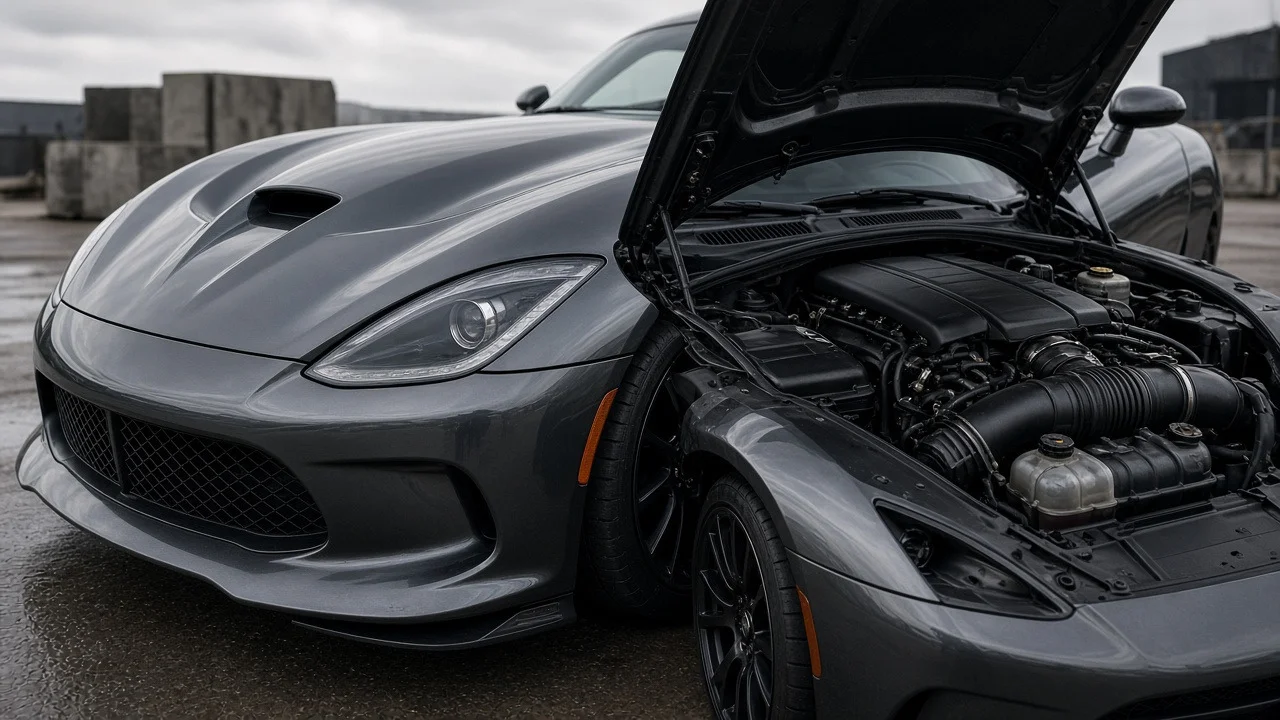
The last year of the Dodge Viper was the 2017 model year. Production ended in 2017 at the Conner Avenue assembly plant in Detroit, where the car had been hand-assembled for most of its life. No Viper has been built since. Some new 2017 cars sat on dealer lots for a long time and were sold and registered well after production stopped, so a later sale or title date does not mean the car is a later model year. Anyone looking up a Dodge Viper year should know that the run was not continuous. The car spans five generations from the 1992 to the 2017 model year, with gaps in between. It also changed its name, body styles and engine displacement along the way. The sections below cover the first and last years, each generation by year, and the gaps that confuse many buyers.
Short Answer: First and Last Viper Model Years
Milestone | Model year | Notes; First year | 1992 | RT/10 open roadster, the only body style at launch; Last year | 2017 | Final model year of the fifth generation; production ended in 2017; Skipped years | 2007, 2011, 2012 | No Viper was sold as these model years; Name change | 2013–2014 | Sold as the SRT Viper; Dodge branding returned for 2015
The First Year Dodge Viper: 1992
The Viper first appeared as a concept car in 1989. Production began for the 1992 model year. The first-year Viper was the RT/10 roadster, a bare-bones two-seater built around a large-displacement V10. Early cars had no exterior door handles, no roll-up side windows and side-exit exhaust. Those choices showed that the car was designed for raw performance, not comfort. The 1992 model year had a short production run, which is why first-year cars get attention from collectors.
Dodge Viper Generations by Year
Enthusiasts often use internal shorthand for the generations: SR for the first two, ZB for the third and fourth, and VX for the fifth. Each generation is a distinct engineering period. Body style, trim level, powertrain variant and branding all shift depending on the model year.
Generation | Model years | Body styles | Engine | Key notes; First (SR I) | 1992–1995 | RT/10 roadster | 8.0-liter V10 | Original minimalist design; roadster only; Second (SR II) | 1996–2002 | RT/10 roadster, GTS coupe | 8.0-liter V10 | GTS coupe added; more refinement and higher output; Third (ZB I) | 2003–2006 | SRT-10 roadster, SRT-10 coupe (2006) | 8.3-liter V10 | Full redesign; renamed SRT-10; coupe returned for 2006; Fourth (ZB II) | 2008–2010 | SRT-10 roadster and coupe | 8.4-liter V10 | Major engine update; ACR track variant offered; Fifth (VX I) | 2013–2017 | Coupe | 8.4-liter V10 | Branded SRT Viper for 2013–2014; Dodge Viper 2015–2017; final generation
First Generation (1992–1995)
The original Viper was sold only as the RT/10 roadster. It had a removable soft top and minimal driver aids. Its 8.0-liter V10 was paired with a manual transmission, and every Viper kept a manual through the end of production.
Second Generation (1996–2002)
The second generation added the GTS coupe, with a fixed roof and the 'double bubble' roofline that became a Viper trademark. The RT/10 roadster continued alongside it. This era also brought refinements such as a revised chassis, and the roadster gained proper side windows. The GT2-inspired special edition and the end-of-run Final Edition cars from this period are well known among collectors.
Third Generation (2003–2006)
A full redesign arrived for 2003, and the car was renamed the Viper SRT-10. It launched as a convertible with a folding top. Displacement grew to 8.3 liters. A coupe version was added for the 2006 model year.
Fourth Generation (2008–2010)
There was no 2007 model year. Production of the 2006 cars was extended, and the updated car arrived as a 2008 model. Its main change was a heavily revised 8.4-liter V10. The track-focused ACR (American Club Racer) variant was offered in this period. Production paused after the 2010 model year.
Fifth Generation (2013–2017)
After skipping the 2011 and 2012 model years, the Viper returned for 2013 as a coupe. For its first two years it carried SRT branding, sold as the SRT Viper and SRT Viper GTS, rather than the Dodge name. The Dodge Viper name came back for the 2015 model year. Trim levels in this era included the base SRT, GTS, TA (Time Attack) and a new ACR with an aggressive aerodynamic package. The 2017 model year was the last, and several limited-run final editions were produced to mark the end.
Why the Viper Ended After 2017
The Viper was a low-volume, hand-built car, and sales of the fifth generation were weak. Dodge cut the price to try to boost demand. The decision to end production was widely reported as being tied to a federal safety rule requiring side-curtain airbags, which the existing Viper design did not have. Re-engineering the car to comply was not considered worthwhile for its small sales volume, so the 2017 model year closed out the nameplate.
How to Confirm a Viper's Model Year
Because of the gaps and the rebranding, listings sometimes misstate a car's year or name. A few checks help:
Read the 10th character of the VIN, which encodes the model year on all US-market vehicles from this period. Compare the build date on the door-jamb label with the model year; a car built late in a calendar year can carry the next model year. Treat any listing claiming a 2007, 2011 or 2012 Viper as an error, or as a leftover car titled in a later calendar year. Expect 2013–2014 cars to be badged and titled as SRT Viper rather than Dodge Viper. Check that the body style matches the generation; for example, a coupe labeled 1993 does not match the roadster-only first generation.
Key Takeaways
The Dodge Viper ran from the 1992 model year to the 2017 model year across five generations, with no cars sold as 2007, 2011 or 2012 models. The first year was a roadster-only design. The final years were coupes with an 8.4-liter V10 and track-focused trims such as the ACR. For buyers, the generation and model year shape a car's body style, powertrain variant and badging, so the VIN and door-jamb label are the most reliable ways to confirm what a given Viper actually is.