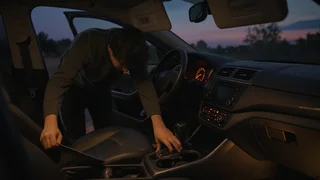
Key Lost in the Car: How to Find It and What to Do Next
A key lost in the car is usually still in the car. Keys slide into gaps between seats, drop under floor mats, fall into door pockets, or get buried in bags and cup holders. A slow, systematic search finds most of them. This guide covers where to look, how to tell the parts of a modern key apart, how the vehicle's own warnings can help, and what to do if the key is locked inside or truly gone.
The Short Answer
Search the cabin zone by zone, starting with the places a key can fall out of sight: the gaps beside and between the front seats, under the seats, beneath the floor mats, and inside the center console. If the car has keyless entry and push-button start, its key-detection warnings may help confirm whether the fob is still inside. The right next step depends on which situation you are in:
The key is somewhere in the cabin and you can get in: do a structured search, then use any key-detection feature the vehicle offers. The key is visible or presumed inside, but the doors are locked: use a spare key, a manufacturer app with remote unlock if your vehicle has one, roadside assistance, or a licensed locksmith. The key cannot be found after a thorough search: treat it as lost and arrange a replacement, which on most modern vehicles requires key programming.
Know What You Are Looking For
Modern car keys come in several forms, and some combine more than one part in a single housing. Knowing the type helps you judge its size and appearance, and whether part of it may have come loose. Key designs vary by manufacturer, model year and trim, so your owner's manual is the reference for your exact configuration.
Key type | What it looks like | What to keep in mind; Mechanical key | A traditional metal blade, sometimes with a plastic head | It may contain a transponder chip that communicates with the engine immobilizer. A worn blade alone may not start the car. Remote transmitter with blade | A fob with lock and unlock buttons and either a fixed blade or a flip-out blade | The buttons control the locks. The blade or a hidden chip handles starting, depending on the vehicle. Smart key or proximity fob | A buttoned fob with no exposed blade, used with keyless entry and push-button start | Many include a removable emergency mechanical key inside the housing. Check that it is still attached. Key card or phone-as-key | A flat card, or a smartphone app or digital key | These are offered on some vehicles only. A card can slip into gaps a fob would not fit.
Immobilizer in this context means the electronic system that stops the engine from running unless it recognizes an authorized key. That is why a copied metal blade or a generic fob usually cannot replace a lost key without programming.
Where Keys Hide Inside a Car
Search in a fixed order so you do not check the same spot twice and miss another. A flashlight helps, even in daylight, because many of these gaps are dark and narrow.
Between the front seats and the center console: this is the most common hiding place. Slide each seat fully forward and then fully back to open the gap from both ends. Under the front seats: look around the seat rails and wiring. Keys can lodge against the seat frame. Under and beneath the floor mats: lift the mats out completely instead of only peeking under the edges. Center console, armrest bin and cup holders: check any removable trays and the space beneath them. Door pockets and the door sill area: keys can drop as you exit and land on the sill or in the bottom of the pocket. Seatback pockets and the rear seat: check the creases where the cushion meets the backrest, and fold the rear seats if they fold. Glovebox, sun visors and overhead storage: check them if you may have set the key down while handling papers or sunglasses. Cargo area or trunk: look under the load floor cover, in side storage bins, and inside bags or groceries that were loaded recently. Bags, jackets and child seats: empty them fully. A key in a coat pocket or under a car seat cushion is easy to overlook.
Avoid forcing your hand deep into seat mechanisms or under seats while the seats are moving. Power seat tracks and folding mechanisms can pinch fingers. If you need to reach far in, stop the seat first.
Using the Vehicle to Help Locate a Smart Key
Vehicles with keyless entry and push-button start use antennas to detect whether the fob is inside the cabin. They cannot point to the fob's exact position, but they can help narrow the search. How they behave depends on the manufacturer and model year, so check your owner's manual for specifics.
Key-detection messages: many such vehicles show a warning such as "key not detected" when you try to start the engine without the fob inside. If the car starts or shows no warning, the fob is probably somewhere in the cabin. Moving the fob search: if the car detects the key from the driver's seat but not after you move certain items, the fob is likely near where those items were. Weak battery warnings: a low fob battery can reduce detection range. A missing key with a weak battery may not trigger detection even when it is inside. Backup start position: many push-button vehicles have a designated spot, often near the start button or in the console, where a fob with a weak battery can still be read. The manual identifies the location for your car.
Pressing buttons on a spare remote will not make a lost fob beep. Most car keys have no speaker. The panic button sounds the vehicle's horn, not the key. If you attached a Bluetooth tracker to your key ring, use its app. Otherwise, the key itself has no locating signal.
If the Key Is Locked Inside the Car
Many smart-key vehicles try to prevent locking the fob inside, but these safeguards do not cover every situation. A weak fob battery, a fob inside a metal container, or a key left in the cargo area can defeat them, and older vehicles with a mechanical key may have no such protection at all. If you can see or suspect the key is inside a locked car, try these options in roughly this order:
Spare key: the quickest and cheapest fix if a household member or a safe location can bring one. Manufacturer or connected-vehicle app: some vehicles support remote unlock through an app, usually only if the service was activated and any subscription is current. Roadside assistance: auto insurance policies, auto club memberships, some credit cards and new-vehicle warranties often include lockout service. Check what your coverage includes before paying separately. Licensed locksmith: an automotive locksmith can open the vehicle with methods designed to avoid damage to the door, seals and wiring.
Avoid improvised entry methods. Modern doors contain airbag sensors, wiring and window mechanisms that are easy to damage, and repairs can cost far more than a lockout call. If a child or pet is locked inside a car in heat or cold, call emergency services right away rather than waiting for a locksmith.
Proof of Ownership
Locksmiths, dealers and roadside providers commonly ask for proof of ownership before they open a vehicle or make a key. This protects owners against theft. Requirements vary by provider and state, but the documents typically requested include:
A government-issued photo ID matching the registered owner or an authorized driver. The vehicle registration or title. The vehicle identification number (VIN), which is often visible through the windshield at the base of the driver's side. A lease or financing agreement, if the vehicle is not owned outright.
If your registration is locked inside the car with the key, tell the provider. Some can verify ownership once the vehicle is open and the documents can be retrieved, while others may need alternative verification. Policies differ, so ask when you call.
When the Key Is Truly Lost
If a thorough search turns up nothing, plan for a replacement. For most vehicles built in roughly the last two decades, this is more than cutting a blade. The new key or fob must be programmed so the immobilizer accepts it. The remote functions may also need separate pairing.
Dealer service department: can supply a key matched to the VIN and program it, but usually needs proof of ownership and may need to order parts. Automotive locksmith: many can cut and program keys for a wide range of vehicles, sometimes on site. Capability varies by make and model year. Remaining spare: if you still have one working key, programming a new one is often simpler than if all keys are lost. Some vehicles also let the old key be removed from the system so it no longer starts the car.
If you believe the key was lost outside the vehicle, ask whether the missing key can be deleted from the vehicle's memory during programming. This keeps a found key from being used to start the car.
Preventing a Repeat
Keep a spare key somewhere secure outside the vehicle, not hidden on the car itself. Give the key one consistent spot in the cabin, such as a specific console tray, every time you drive. Replace the fob battery when the vehicle or fob signals that it is low, so key detection keeps working reliably. Consider a Bluetooth tracker on the key ring if you misplace keys often. Note your roadside assistance details and VIN somewhere you can reach without the car, such as your phone.