Japanese Gentlemen's Agreement Cars: What the 280 PS Limit Was and Which Cars It Shaped
The short answer
Gentlemen's agreement cars are Japanese performance cars sold in Japan's home market during roughly the 1989 to 2004 period. During this time, carmakers voluntarily agreed not to advertise any model as producing more than 280 PS (about 276 hp). The arrangement was informal. There was no law and no engineering ceiling. Many cars from this era carried an official 280 PS rating even when their engines were widely believed to make more.
One qualification matters. The agreement applied to Japanese domestic market (JDM) ratings. The same or similar models sold abroad, including in the United States, were not bound by it and were sometimes advertised with higher outputs. So whether a car counts as a gentlemen's agreement car depends on the market version, not just the model name.
What the agreement was
In the late 1980s, Japanese manufacturers were competing hard on horsepower figures. Road safety was also drawing growing public and government concern. Under the umbrella of the industry's trade association, the manufacturers settled on a voluntary self-restraint policy. No domestic-market car would be marketed above 280 PS. The figure is commonly linked to the Nissan 300ZX (Z32 generation), whose 280 PS rating became the de facto ceiling.
Similar self-restraint covered other areas. JDM cars of the period typically had a speed limiter set around 180 km/h. Kei cars, Japan's small-displacement microcar class, had their own separate advertised power cap of 64 PS. The kei limit is a distinct arrangement and should not be confused with the 280 PS performance-car agreement.
How it worked in practice
Because the limit applied to advertised output, it affected how cars were marketed more than how they were built. Manufacturers could still compete in other ways:
Torque and power delivery: torque figures were not capped in the same way, so manufacturers could promote torque increases between model updates while the power rating stayed at 280 PS. Chassis and drivetrain technology: all-wheel-drive systems, active differentials, four-wheel steering and advanced suspension became key selling points. Weight and handling: lighter construction and sharper handling offered a way to improve performance without changing the headline number. Conservative ratings: enthusiasts and testers often reported that certain engines produced more than their official figure. Results varied by model, condition and test method, so the extent of any underrating is not consistent across the era.
The practical result was a generation of cars that look nearly identical on paper but differ greatly in character, layout and real-world performance. The shared 280 PS figure says very little about how two of these cars compare on the road.
Well-known cars from the era
The models below are widely associated with the gentlemen's agreement in their JDM forms. Not every version or trim of each model was rated at 280 PS. Some lower trims were rated below the cap, and later special editions near the end of the period sometimes changed the picture. Check the specific generation, engine and trim.
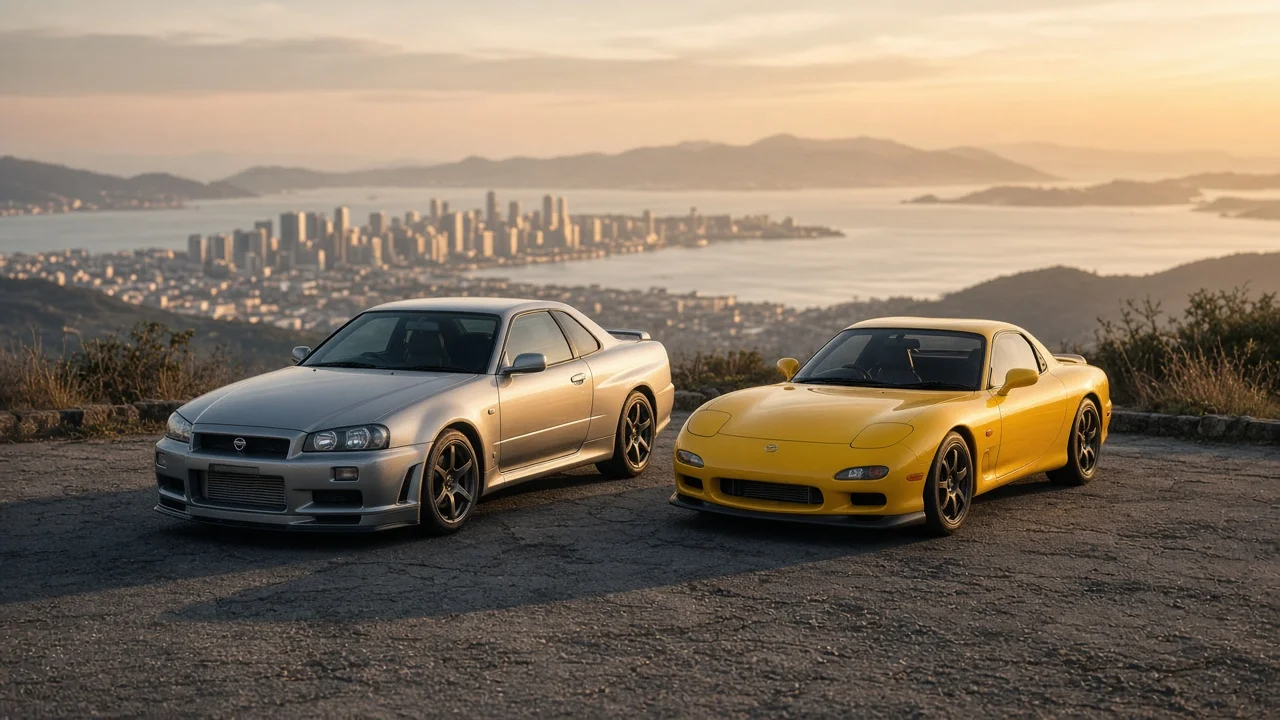
Model | Generation or engine commonly cited | Notes; Nissan Skyline GT-R | R32, R33, R34 (RB26DETT) | Twin-turbo inline-six with all-wheel drive; the defining car of the era for many enthusiasts; Nissan 300ZX / Fairlady Z | Z32 (VG30DETT twin-turbo) | Often credited with setting the 280 PS reference point; Toyota Supra | A80 / fourth generation (2JZ-GTE) | JDM twin-turbo version rated at 280 PS; export versions were rated differently; Mazda RX-7 | FD3S (13B-REW twin-turbo rotary) | Later JDM versions reached the 280 PS rating; Mitsubishi Lancer Evolution | Several generations (4G63T) | Turbocharged all-wheel-drive sedan that reached the cap in later versions; Subaru Impreza WRX STI | Several versions (EJ20 turbo) | Rally-derived all-wheel-drive sedan and coupe that reached the cap in later versions; Mitsubishi GTO | Twin-turbo V6 (sold abroad as 3000GT / Dodge Stealth) | Heavy, technology-laden all-wheel-drive grand tourer; Honda NSX | NA1 / NA2 (manual versions) | Mid-engine sports car; rating varied by transmission and year; Toyota Aristo, Chaser, Mark II and similar | 2JZ-GTE or 1JZ-GTE versions | Turbocharged sedans that shared powertrains with sports models; Subaru Legacy and Nissan Stagea | Twin-turbo and RB26-powered versions | Performance wagons and sedans that also carried the 280 PS rating
How JDM versions differ from export versions
Some of these cars were sold in the US under the same or a different name, such as the Supra, RX-7, 300ZX, NSX and the GTO sold as the 3000GT. The US-market car is not automatically the same as the JDM car. Differences can include:
Advertised power: export cars were not covered by the domestic agreement and were sometimes rated above 280 PS, although tuning, emissions equipment and fuel requirements also varied by market. Driving position: JDM cars are right-hand drive. Speed limiter and gauges: JDM cars typically have a 180 km/h limiter and metric instruments. Equipment and trims: some JDM trims, engines and special editions were never offered in the US, and the reverse is also true. Model availability: several cars from the list, including the Skyline GT-R, Lancer Evolution of that period and many turbo sedans, were never officially sold in the US at the time.
When and why the agreement ended
The arrangement weakened in the early 2000s as safety technology improved and Japanese manufacturers faced pressure to compete with higher-powered European cars. It is generally considered to have ended in 2004. The Honda Legend of that time is commonly cited as the first domestic-market car to be advertised above 280 PS. After that, Japanese manufacturers quoted outputs freely, and the 280 PS figure became a marker of an era rather than a rule.
What this means for US buyers today
Interest in these cars in the US is closely tied to federal import rules. A vehicle at least 25 years old can generally be imported without meeting the US safety and emissions standards that apply to newer cars. The age is counted from the month and year of manufacture. That rule has made most gentlemen's agreement cars legally importable, with the youngest examples from the end of the era reaching eligibility in turn.
Confirm eligibility using the car's actual build date, not its model year. Check your state's registration and emissions requirements, which can be stricter than federal import rules and differ from state to state. Treat the 280 PS rating as a label, not a measurement. Actual output depends on the individual car's condition and any modifications. Expect that many surviving examples have been modified. A documented history and an inspection by someone familiar with the specific model are especially valuable. Plan for parts and service. Some JDM-specific components can be harder to source in the US than parts for export-market versions.
Bottom line
A Japanese gentlemen's agreement car is a JDM performance model from roughly 1989 to 2004 whose advertised output was held at or below 280 PS by voluntary industry agreement. The cap shaped marketing far more than engineering. That explains why cars with the same official rating can feel very different, and why export versions of some models carried higher figures. For US enthusiasts, these cars matter today mainly because the 25-year import rule now brings them within reach, provided state rules and the specific car's condition check out.