How to Install Brembo Brakes on a Nissan 350Z
The short answer
On a Nissan 350Z (Z33 generation, sold from the 2003 to 2009 model years) that left the factory without Brembo brakes, fitting the factory Brembo system is commonly done as a parts swap rather than a fabrication job. Three conditions can change that. Your wheels must clear the larger calipers. You need a complete, matching set of parts for each axle you upgrade. The rear needs extra attention because the parking brake works inside the rear rotor. Nissan's parts lists for your exact model year and market are the authority on whether a specific part fits your car.
Check whether your car already has Brembos
Nissan fitted Brembo brakes to some 350Z trims and not others. In the US market the Track model is the best-known example. Which trims got them changed over the model run and differed between markets. The quickest check is to look through the wheel at the caliper, which carries Brembo branding on equipped cars. You can also have a Nissan dealer decode your VIN to confirm the original equipment. This guide does not include a year-by-year trim chart, because none was supplied for it.
Parts needed for each axle
Brembo calipers for the left and right side of the axle; Rotors sized for the Brembo calipers; these are larger than the non-Brembo rotors; Pads that match the Brembo calipers; Mounting hardware and bolts specified for the Brembo caliper; Brake hoses and fittings confirmed to suit the Brembo calipers on your model year; For the rear only: parking brake parts confirmed to match the Brembo rotor hat; Fresh brake fluid of the type your owner's manual specifies
Factory Brembo setups from the Infiniti G35 coupe are often described as interchangeable with the 350Z units, because the two cars share a platform. Confirm this against part numbers before buying, since some variants may differ.
Wheel clearance comes first
Brembo calipers and rotors take up more room inside the wheel than the standard brakes. Wheels that suited a non-Brembo car may hit the calipers, especially smaller-diameter wheels. Clearance depends on the wheel's diameter, its offset (how far the mounting face sits from the wheel's centreline) and the shape of its spokes, so wheel size alone does not settle it. Before buying brakes, test-fit the caliper or a manufacturer clearance template inside your wheel. Otherwise, plan to buy wheels that are confirmed to clear Brembo-equipped Z33s.
Front only or all four corners
Upgrading only the front axle is simpler and avoids the rear parking brake work. However, it changes how braking force is split between the front and rear of the car compared with the factory setup. Doing all four corners reproduces the Brembo-equipped car as Nissan built it. No test data was supplied comparing how a front-only conversion affects stability or ABS behaviour. If you are weighing the two options, treat that as an open question to raise with a qualified brake specialist.
Installation outline
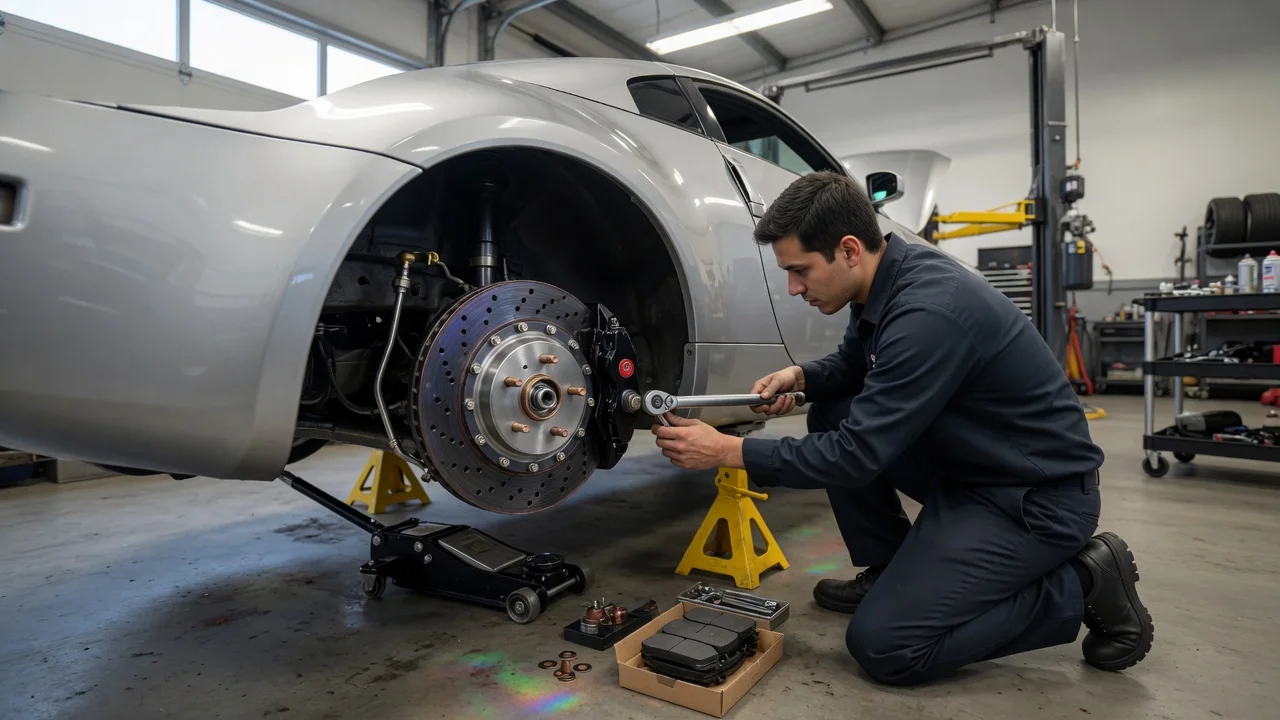
Raise and support the car on stands at the manufacturer's lift points, then remove the wheels. Remove the old caliper and plug the hose to limit fluid loss, then remove the old rotor. Clean the hub face so the new rotor sits flat, then fit the Brembo rotor. Mount the Brembo caliper and pads, then tighten all fasteners to the factory service manual torque specifications. Connect the brake hose with new sealing washers where the fitting uses them, and check that the hose does not twist or rub through full steering lock and suspension travel. At the rear, fit and adjust the parking brake shoes inside the rotor hat according to the service manual. Bleed the whole brake system with fresh fluid until no air remains, following the bleed sequence in the service manual. Refit the wheels, torque the lug nuts to specification and check pedal feel before moving the car. Bed in the new pads and rotors following the pad maker's procedure, then recheck for leaks.
Brakes are safety-critical. If you lack a service manual, a torque wrench or bleeding equipment, have a qualified shop do the installation, or at least inspect your work before the car is driven.
Open points to confirm before buying
Exact part numbers for calipers, rotors, hoses and rear parking brake parts for your model year and market; Whether a used caliper set needs a rebuild because of worn seals, corroded pistons or a sticking piston; Whether your car's master cylinder or ABS calibration differs from a Brembo-equipped car of the same year; Whether your wheels clear the calipers; Current prices and availability, which were not supplied and change frequently
Choosing your next step
Start with wheel clearance, because it can rule a swap in or out before you spend anything on brakes. Next, get a Nissan dealer or parts catalogue to confirm part numbers for your VIN. Then decide between a front-only or four-corner conversion, and whether you will install the brakes yourself or use a shop.