How to test a Club Car ignition coil
A weak or missing spark on a Club Car often points suspicion at the ignition coil, but the component must be tested before it is replaced. The coil is only one part of the starter circuit and spark path, so the diagnosis should confirm spark condition, battery state of charge, and basic wiring integrity. A no-start with normal cranking speed may also involve fuel delivery or the ignition switch. This guide explains what a coil test can show, what tools help, and how to interpret the result for an accurate repair decision.
Direct answer
The essential way to test a Club Car ignition coil is to check whether it produces a strong, consistent spark while the engine cranks and to compare its primary and secondary resistance values with the manufacturer's specification for the specific model and year. A coil that fails either test is a likely cause of ignition trouble, but a passing resistance reading does not prove the coil works under load. Confirm battery state of charge, cranking speed, and wiring connections first, because low voltage or a weak trigger signal can make a good coil appear faulty.
On most small-engine systems the coil is a transformer that steps up battery or magneto voltage to jump the spark plug gap. A spark tester gives a practical go/no-go result, while an ohmmeter reveals open or shorted windings. An intermittent misfire may occur only when the coil is hot, so a cold bench reading is not always conclusive. Treat the test as evidence about one part of the ignition path rather than a standalone verdict on the coil.
How to proceed
Begin with the battery state of charge and starter circuit before isolating the coil. A slow cranking engine reduces voltage at the coil and weakens the spark, imitating a failed component. Remove the spark plug wire, connect an inline spark tester between the plug and the high-tension lead, and crank the engine while watching for a crisp blue spark. Lack of spark can point to the coil, but it may also mean a fault at the ignition switch, a failed trigger or pickup, or a broken kill circuit.
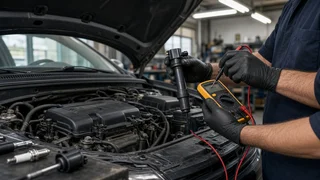
For resistance testing, disconnect the coil leads so the meter reads only the windings. Measure the primary terminals and the high-tension terminal according to the vehicle manual, since manufacturer-dependent codes and values vary. A shorted or open winding makes replacement necessary, but a reading outside the expected range should be confirmed for the specific Club Car model. If the coil passes these checks yet the engine still has no spark, diagnostic checks for fuel delivery, compression, and the ignition trigger become the next priority.