How to test a 12V car battery
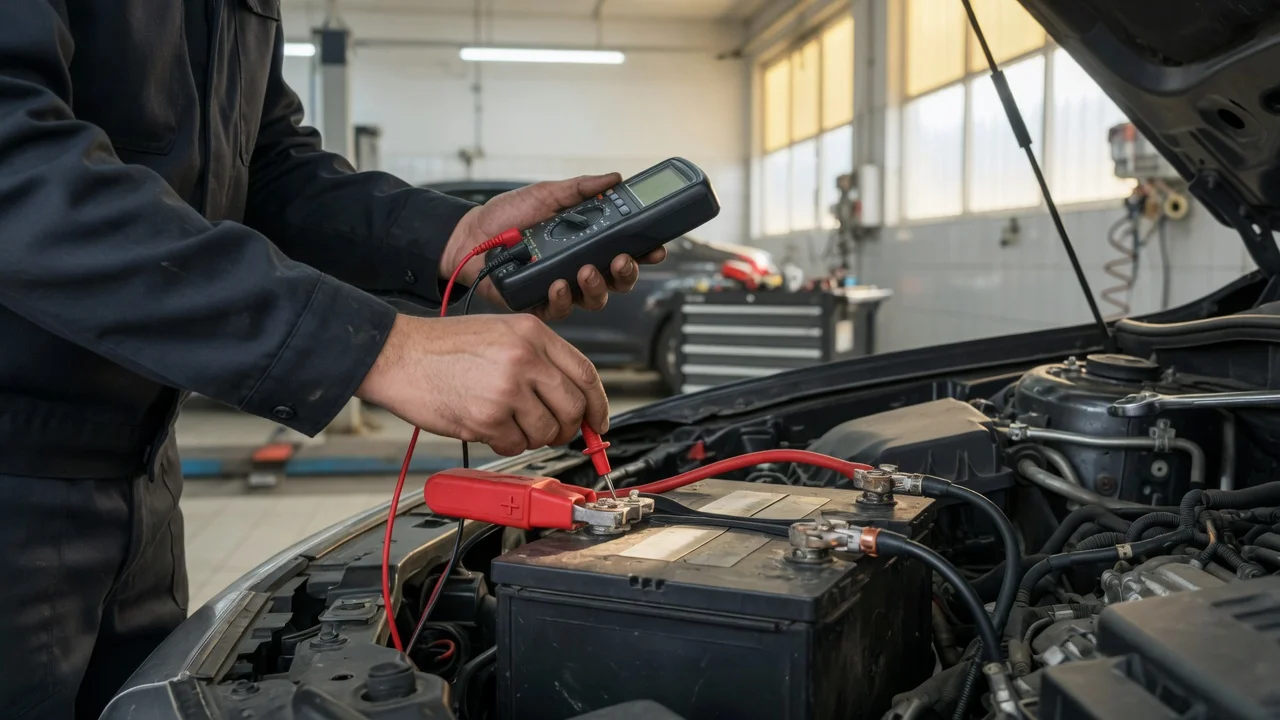
The quickest reliable way to test a 12V car battery is to have it checked with an electronic battery analyzer, the kind of test many auto parts stores, including AutoZone, offer free of charge. You can also test it at home. A digital multimeter shows the battery's state of charge. A cranking voltage drop test shows how the battery holds up under load. A running-engine voltage check shows whether the alternator is recharging it. One condition matters for every method: a battery that is deeply discharged has to be fully charged before any test can say whether it is actually worn out. Testing a flat battery mostly confirms that it is flat.
Key terms used in battery testing
Resting (open-circuit) voltage: the battery's voltage with the engine off and no load connected, measured after any surface charge has dissipated. It indicates state of charge, not overall health. Surface charge: a temporarily raised voltage just after driving or charging, which can make a weak battery look healthy on a multimeter. Cold cranking amps (CCA): a rating printed on the battery label that describes how much current it can deliver for starting in cold conditions. Analyzers compare the battery's measured performance with this rating. Load test or drop test: a test that draws heavy current from the battery and watches how far the voltage falls. A healthy battery holds its voltage better than a worn one. Battery analyzer (conductance tester): a handheld electronic tester that estimates battery condition and available cranking capability without a heavy load. Many models can also check the starting and charging systems.
Getting a free battery test at AutoZone or another parts store
AutoZone and other major parts retailers commonly offer free battery testing, usually with a handheld analyzer. If the vehicle can be driven or jump-started to the store, staff can often test the battery while it is still installed. Depending on the tester, they may also check the starter and alternator, which helps separate a bad battery from a charging problem. A battery that has been removed can usually be carried in and tested on the counter. Services, equipment and policies vary by location and can change, so it is worth calling the store first. This is especially true for a hybrid, an electric vehicle, or a car whose battery is mounted under a seat or in the trunk.
To get a meaningful result, tell the tester whether the battery is a conventional flooded, AGM or EFB type, and give the CCA rating from its label, because analyzers rely on that information. If the result says the battery needs charging before a decision can be made, charge it fully and have it retested. A low-charge reading on its own does not prove the battery has failed.
Before testing at home: safety and equipment
Lead-acid batteries contain sulfuric acid and can release flammable hydrogen gas, especially while charging or right after heavy use. Work in a ventilated area, keep sparks and flames away, and wear eye protection and gloves. Remove metal jewelry, and never let a tool bridge the two terminals. If the battery case is cracked, bulging, leaking or hot, or it smells of rotten eggs, stop and do not test, charge or jump-start it. Have it handled by a qualified technician or a parts store.
Digital multimeter that can read DC volts to at least one decimal place, preferably two; Safety glasses and acid-resistant gloves; The vehicle owner's manual, to locate the battery or its designated jump/test terminals; A helper, for the cranking test; Optional: a dedicated 12V battery tester or analyzer, or a carbon-pile load tester; Optional: a battery charger suited to the battery type, if the battery needs charging before testing
Step 1: Inspect the battery
With the engine off and the key removed, look for damage to the case, loose or corroded terminals, and frayed or loose cables. White or greenish crust on the terminals can cause poor contact and give results that look like a weak battery. Check the label for the battery type and CCA rating. Some vehicles, including many hybrids, EVs and models with the battery under a seat or in the trunk, provide remote terminals under the hood for testing and jump-starting. Follow the owner's manual for where to connect. On hybrids and EVs, never touch orange high-voltage cables or components.
Step 2: Measure resting voltage
Let the vehicle sit with the engine off for several hours, ideally overnight, so surface charge dissipates. If you cannot wait, switching the headlights on for about a minute and then off again is a common way to remove surface charge. Set the multimeter to DC volts, touch the red probe to the positive (+) terminal and the black probe to the negative (−) terminal, and read the voltage.
Resting voltage | Approximate state of charge (typical flooded lead-acid, around room temperature); 12.6 V or higher | About fully charged; About 12.4 V | About 75%; About 12.2 V | About 50%; About 12.0 V or lower | Discharged; charge before further testing
These figures are commonly published guide values, not specifications for any particular battery. AGM and EFB batteries, which are common in start-stop vehicles, typically rest slightly higher, and temperature also shifts the readings. Check the battery manufacturer's data for exact values. If the battery reads low, charge it with a charger suited to its type and repeat the measurement after it has rested. A battery that will not reach or hold a full-charge voltage after proper charging is likely failing.
Step 3: Do a cranking voltage drop test
Start with a fully charged battery. Keep the multimeter connected across the terminals, with the leads routed well clear of belts, fans and other moving parts. Have a helper crank the engine while you watch the lowest reading. A widely used guideline is that a healthy battery should stay at or above roughly 9.6 to 10 volts while cranking at moderate temperatures. A reading that falls well below that, or an engine that cranks slowly even though the resting voltage was good, points to a weak battery, a poor connection or a starter problem. Do not crank continuously for long periods. Follow the cranking limits in the vehicle or starter manufacturer's guidance and allow rest between attempts.
Step 4: Check charging voltage with the engine running
With the engine idling, measure across the battery terminals again. Many conventional charging systems hold roughly 13.7 to 14.7 volts. A reading that stays near resting voltage suggests the battery is not being charged, and a reading well above that range suggests overcharging. Either result points to the alternator or charging system rather than the battery. Some modern vehicles use smart charging that deliberately varies the voltage, so a reading outside the typical range is not automatically a fault on those models. Check the service information for the specific vehicle.
Step 5: Use a battery analyzer or load tester for a health verdict
A multimeter can show charge level and voltage drop, but it cannot reliably measure remaining capacity. For a clearer verdict, use a 12V battery analyzer and enter the battery type and rated CCA as the tester instructs, or use the free test at a parts store. A traditional carbon-pile load test usually applies a load of about half the rated CCA for around 15 seconds and expects the voltage to stay above roughly 9.6 volts at moderate temperature. Follow the load tester's own instructions and temperature corrections, and only load-test a fully charged battery. Load testers create heat and sparks, so connect and disconnect them only with the load switched off.
Interpreting the results and choosing the next step
Good resting voltage, good cranking voltage, good charging voltage: the battery and charging system are likely fine. Look for other causes such as a parasitic drain, which is a circuit that keeps drawing current with the vehicle off, or a starter fault. Low resting voltage that recovers and passes after a full charge: the battery may be healthy but was being drained or undercharged. Check for short-trip driving, accessories left on, or a parasitic drain. Will not hold a charge, or fails the load or analyzer test when fully charged: replacement is likely needed. Battery passes but charging voltage is abnormal: have the alternator and charging system diagnosed.
When to use qualified service
Seek a qualified technician for any damaged or leaking battery, for any work on hybrid or EV high-voltage systems, and for tracing a parasitic drain or charging fault you cannot isolate. Many start-stop and newer vehicles have a battery monitoring sensor and need the new battery registered or coded with a scan tool after replacement. Skipping that step can cause incorrect charging. Whether a particular model needs this depends on the make, model year and equipment, so check the owner's manual or a dealer for your vehicle.
How to know the test is complete
A battery test is complete when you have three things: a resting voltage taken on a fully charged battery without surface charge, a result under load from a cranking test, analyzer or load tester, and a running charging-voltage reading. Together these tell you whether the battery, the charging system or something else is the likely problem. If any of the three is missing, especially if the battery was tested while discharged, the conclusion is provisional. Recharge and retest before buying a replacement.
Note on the figures: no vehicle-specific or manufacturer source material was supplied for this guide. The voltages and load-test values above are commonly published approximations for 12V lead-acid batteries, not specifications for any particular battery or vehicle. Lithium 12V batteries, used in some newer vehicles, follow different voltage behavior and testing procedures. Confirm specifications and procedures with the battery and vehicle manufacturers' instructions.