How to Test a 12V Car Battery: Free Store Tests and At-Home Checks

The short answer
You can test a 12V car battery in two ways: take the vehicle to an auto parts store such as AutoZone that offers free battery testing, or check it yourself with a digital multimeter. A store test usually uses an electronic battery analyzer, which estimates the battery's ability to deliver starting current. A home test measures resting voltage and how far the voltage falls while the engine cranks. A fully charged, healthy battery at rest reads roughly 12.6 volts. During cranking it should stay above roughly 9.6 to 10 volts. A battery can show good resting voltage and still fail under load, so a voltage reading alone does not prove the battery is healthy.
Two conditions change how you should read any result. First, the battery must be reasonably charged before testing. A discharged battery can fail a test even if it is not worn out. Second, the battery type matters. Flooded lead-acid, AGM (absorbent glass mat) and EFB (enhanced flooded battery) units behave differently, and some testers need to be told which type they are testing. Vehicles with start-stop systems often use AGM or EFB batteries and a battery monitoring sensor, which affects how they charge and how a replacement is installed.
Key terms used in battery diagnostics
Resting (open-circuit) voltage: battery voltage with the engine off and no significant load, measured after surface charge has dissipated. Surface charge: a temporarily elevated voltage right after driving or charging that can make a weak battery look healthy. CCA (cold cranking amps): a rating of how much current the battery can deliver in cold conditions while holding a minimum voltage. It is printed on most battery labels. Conductance tester or battery analyzer: a handheld electronic tester that sends a small signal through the battery and estimates its health and available cranking power without drawing a heavy load. Load test: a test that draws a large current from the battery for a short time and checks how well voltage holds up. Voltage drop test (cranking test): watching battery voltage while the engine cranks to see how far it falls.
Getting a free battery test at AutoZone or another parts store
Many US auto parts chains, including AutoZone, commonly offer free battery testing. Store practices can vary by location, so it is sensible to call ahead if you need a test at a particular time or need the battery tested off the vehicle. In most cases an employee connects a handheld battery analyzer to the terminals while the battery is still in the car. Many of these tools also check cranking voltage and alternator output, so you get a basic picture of the starting and charging system along with the battery result.
Store analyzers typically report a status such as good, good but needs recharging, charge and retest, or replace. They may also show a measured voltage and an estimated CCA figure that you can compare with the rating on the battery label. If the result is charge and retest, the tester could not judge the battery because its state of charge was too low. That does not mean the battery has failed. Fully charge it and test again.
Drive the vehicle in if it starts. If it does not, a charged battery removed from the car can often be tested at the counter. Know your battery type and CCA rating so the tester can be set correctly. Ask to see the printed or on-screen result instead of relying on a verbal summary. If you just drove a long distance or the battery was recently charged, mention it, because surface charge can affect readings. Treat an analyzer result as a strong indication, not a final verdict. If symptoms do not match the result, retest after a full charge or have a load test done.
Equipment for testing a battery at home
Digital multimeter that can read DC volts. This is the minimum tool. Safety glasses and gloves. Wire brush or terminal cleaner for corroded posts. Optional: a handheld 12V battery tester or conductance analyzer for a CCA estimate. Optional: a dedicated load tester, such as a carbon-pile type, for a true load test. Optional: a battery charger suited to your battery type, for charging before you retest. Optional for serviceable flooded batteries only: a battery hydrometer to check each cell's specific gravity.
Step-by-step: testing a 12V battery with a multimeter
Step 1: Prepare safely and inspect the battery
Park on a level surface, turn the ignition and all accessories off, and remove the key or place a push-button key away from the vehicle if needed. Put on eye protection. Lead-acid batteries can release explosive hydrogen gas, so keep sparks, flames and cigarettes away. Look at the case and terminals. Stop and do not test or charge the battery if the case is cracked, bulging or leaking, if you smell a strong rotten-egg odor, if the battery feels hot, or if it may be frozen. A battery in that condition should be handled by a professional. Clean white or green corrosion from the terminals and check that the clamps are tight, because poor connections can mimic a weak battery.
In some vehicles the battery sits under a seat, in the trunk or behind a panel, and the hood has remote jump-start terminals instead. If you cannot reach the battery posts directly, use the remote terminals described in the owner's manual for voltage checks. A battery that is hard to access may need professional testing for anything beyond a voltage reading.
Step 2: Remove surface charge
If the car was driven or the battery was charged recently, surface charge will inflate the reading. Either let the vehicle sit with everything off for several hours, ideally overnight, or switch on the headlights for about a minute, then turn them off and wait a few minutes before measuring.
Step 3: Measure resting voltage
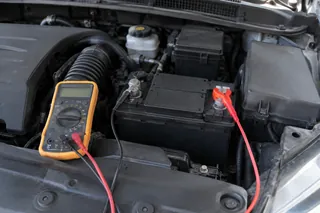
Set the multimeter to DC volts on a range above 12 volts, often the 20V setting. Touch the red probe to the positive (+) terminal and the black probe to the negative (−) terminal. Read the voltage and compare it with the general guide below. These are approximate values for a conventional 12V lead-acid battery at moderate temperature. AGM batteries often read slightly higher when full, and cold temperatures lower readings.
Resting voltage | Approximate state of charge | What it suggests; 12.6 V or higher | About fully charged | Normal resting level; continue with a cranking test; Around 12.4 V | Roughly three-quarters charged | Usable but should be recharged; Around 12.2 V | Roughly half charged | Undercharged; charge before judging health; 12.0 V or lower | Largely discharged | Charge fully and retest; repeated readings here point to a battery, charging or drain problem; Well below 12 V after charging | Not holding charge | Possible failed cell or worn-out battery
Step 4: Charge if needed, then retest
If resting voltage is noticeably below the fully charged level, charge the battery with a charger that matches its type. Many modern chargers have AGM or other battery-type modes. Follow the charger's instructions for connection order and ventilation. After charging, let the battery rest and measure again. A battery that quickly falls back to a low resting voltage after a full charge is likely failing, or something in the vehicle is draining it while parked.
Step 5: Perform a cranking voltage drop test
This simple drop test shows how the battery behaves under the heavy load of the starter. Keep the multimeter connected to the battery terminals, with the leads routed well away from belts, fans and other moving parts. Have a helper crank or start the engine while you watch the lowest reading. Do not crank for more than a few seconds at a time. On many vehicles, a healthy, charged battery stays above roughly 9.6 to 10 volts during cranking at moderate temperatures. A reading that falls well below that level, or an engine that cranks slowly while voltage collapses, points to a weak battery, a poor connection or a starter problem. A professional load test can help tell these apart.
Step 6: Check the charging system with the engine running
With the engine idling, measure across the battery terminals again. A conventional charging system typically holds roughly 13.5 to 14.5 volts. Many newer vehicles use smart charging that deliberately varies voltage, sometimes dropping lower or rising higher depending on battery condition and driving situation, so a single reading outside that range is not automatically a fault on those models. If voltage stays at or below resting battery voltage with the engine running, the alternator may not be charging. If it climbs well above the normal range, the voltage regulation may be faulty. Either result calls for further charging system diagnosis, because replacing the battery alone will not fix it.
Using a 12V battery tester or analyzer at home
Handheld conductance testers work like the units used in parts stores. Connect the clamps to the correct terminals, enter the battery type and the rated CCA from the label, and run the test. The tester reports an estimated CCA and a status. As a general guide, a measured CCA well below the label rating suggests the battery has lost capacity, even if it still starts the car in mild weather. Follow the tester's own instructions, because input settings and result categories differ between models. Like store tests, these tools need a reasonably charged battery to give a meaningful answer.
Doing a traditional load test
A load tester draws a heavy current for a short time. A common general method applies a load of about half the battery's CCA rating for around 15 seconds and checks that voltage stays above roughly 9.6 volts at about room temperature, with lower acceptable limits in colder conditions. Exact procedures depend on the tester, so follow its instructions. Load testers get hot and can spark, so use them only on a charged battery in a ventilated area. If you are not comfortable with this equipment, a parts store analyzer or a repair shop load test is a reasonable alternative.
Checking specific gravity on serviceable flooded batteries
If your battery has removable cell caps, a hydrometer can show whether every cell is charged evenly. Battery acid is corrosive, so wear eye and skin protection and avoid drips on paint. On a charged battery, readings should be similar across all cells. One cell reading noticeably lower than the others usually indicates a bad cell and a battery that needs replacing. Sealed batteries, including most AGM and maintenance-free units, cannot be tested this way and should not be pried open.
What your results mean and what to do next
Result | Likely meaning | Suggested next step; Good resting voltage, good cranking voltage, normal running voltage | Battery and charging system appear healthy | Look elsewhere for starting issues, such as cables, starter or a parasitic drain; Low resting voltage that recovers after charging and passes a load or analyzer test | Battery was discharged, not failed | Find out why: short trips, lights left on, a drain or weak charging; Passes resting voltage but voltage collapses during cranking | Weak battery or poor connection | Clean and tighten terminals, then load test or analyzer test; Won't hold charge or fails analyzer or load test after a full charge | Battery is worn out or has a bad cell | Replace with a battery matching the vehicle's required type, size and rating; Running voltage at or below resting voltage | Charging system not working | Have the alternator, belt and wiring diagnosed; Running voltage well above normal range on a conventional system | Possible overcharging | Get the charging system checked before it damages the battery
When to let a professional handle it
The battery is swollen, cracked, leaking, hot or possibly frozen. The vehicle is a hybrid or electric vehicle. The 12V battery can usually be tested like any other, but the high-voltage system must be left alone and battery location and procedures differ. The vehicle has a start-stop system or battery monitoring sensor. Many such vehicles need the new battery registered or coded with a scan tool after replacement so the charging system manages it correctly. Results are inconsistent or point to the alternator, starter or a parasitic drain that needs further diagnosis. The battery is difficult to reach or remove, or disconnecting it may reset systems that need relearning.
How to confirm the test is complete
You have a reliable answer when you have tested a reasonably charged battery without surface charge and checked both its resting voltage and how it holds up under load, either through a cranking test, an analyzer or a load tester. You also need a running-voltage check to rule the charging system in or out. If all three agree, you can trust the conclusion. If they conflict, recharge fully and retest, or have a store analyzer or repair shop confirm the result before buying a new battery.