How to Install Safety Chains on a Gooseneck Trailer
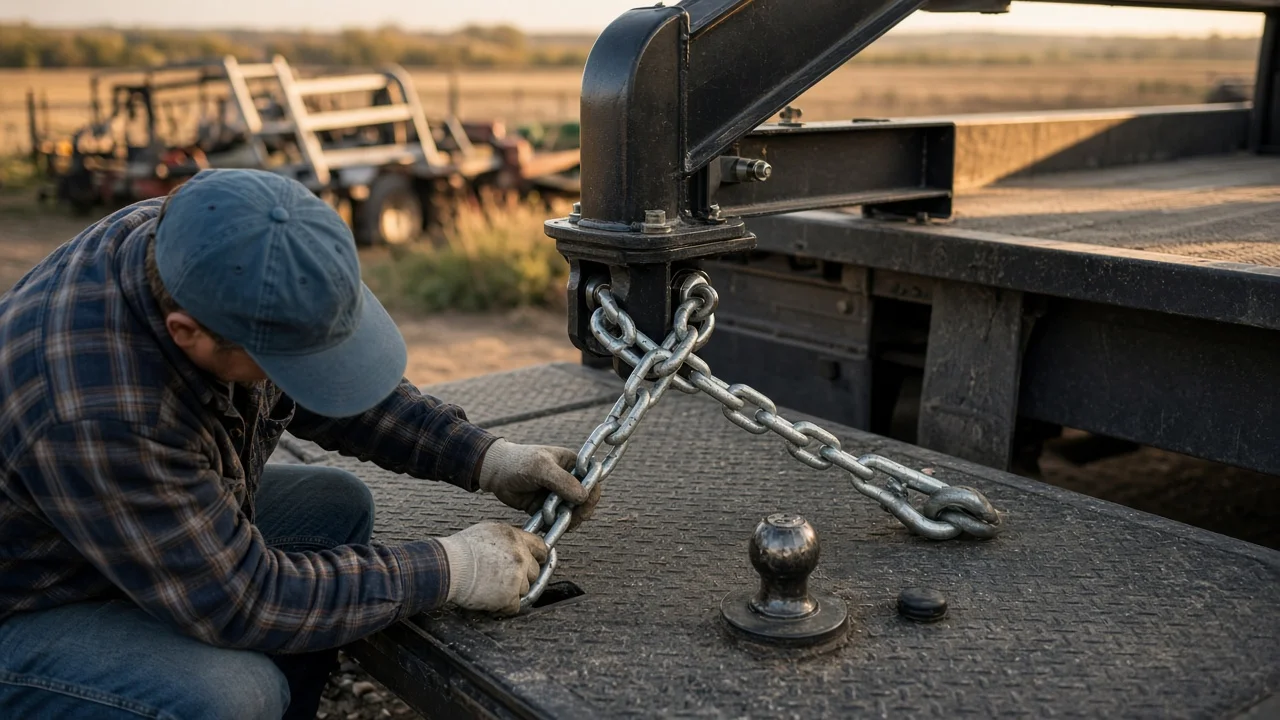
Installing safety chains on a gooseneck trailer is a straightforward but safety-critical task that connects the trailer to the tow vehicle as a backup to the primary coupler. A proper installation depends on matching chain strength to the trailer's gross vehicle weight rating and using attachment points that can handle the load. The chains should be crossed under the gooseneck tongue to create a cradle if the coupler separates, without dragging on the road or binding during turns. This guide outlines the general approach while emphasizing that manufacturer instructions for your specific trailer and hitch configuration must take precedence.
Direct answer
Safety chains on a gooseneck trailer are installed by attaching one end of each chain to the trailer tongue or a designated anchor point and the other end to the tow vehicle's hitch attachment loops. The chains are then routed so they cross beneath the gooseneck tube, forming a cradle that can catch the tongue and prevent it from digging into the road if the coupler disconnects. Chain length must allow full turning articulation without dragging, yet remain short enough to keep the tongue from contacting the ground during a separation.
The correct chain grade and link diameter are selected according to the trailer's gross vehicle weight rating, not the empty trailer weight or the tow vehicle's capacity alone. A trailer loaded near its maximum combined weight rating places more demand on the safety system than an unloaded trailer. Because gooseneck hitches locate the attachment point in the truck bed, the chains often connect to bed-mounted anchor points or to loops integrated into the hitch base. Vehicle-specific layouts vary, so the installation must follow the manufacturer's approved configuration.
How to proceed
Before beginning, confirm the trailer is on level ground, the coupler is latched to the ball, and the tow vehicle is in park with the parking brake set. Inspect the trailer tongue and hitch structure for designated chain anchor holes or welded attachment brackets. Chains must not be wrapped around hydraulic lines, wiring harnesses, or brake cables. If the trailer lacks a dedicated anchor point, a qualified fabricator should add one that preserves the frame's strength rather than drilling through a structural member without engineering guidance.
Attach the chains using rated hooks, clevises, or hammerlocks that close securely and cannot bounce open. Cross the left chain over to the right side anchor and the right chain over to the left side anchor under the gooseneck tube. Leave just enough slack for tight turns and suspension movement, then perform a slow test drive and recheck the chains for twisting or contact with the tailgate, bed sides, or axle. After driving a short distance, stop and verify the connections remain tight and the chains are not dragging.