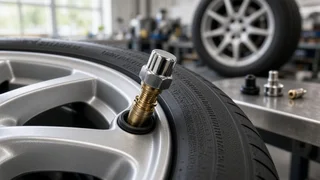
How a Tire Valve Stem Works
A tire valve stem looks like a small metal or rubber fitting, but it performs an essential job: it is the controlled door for every pound of inflation pressure inside the tire. Without a dependable seal at this point, even a healthy tire loses air and changes how the vehicle rides, steers, and wears its tread. Understanding the valve stem explains why a simple core replacement can sometimes fix a slow leak and why the stem must be considered whenever you check tire size, load index, or the vehicle placard pressure.
Essential answer
A tire valve stem is a one-way passage that lets air enter the tire when you inflate it and then seals tightly to keep that air from escaping. It is mounted through the wheel rim, with a spring-loaded core inside acting as the actual check valve. Pressing the center pin briefly opens this core, while the spring and internal air pressure close it again when the chuck is removed.
The stem is not just a convenience for the air pump. It also supports the snap-in or clamp-in mounting style that holds the assembly in the rim, and its cap serves as a secondary seal against dirt and moisture. This small part directly supports correct inflation pressure, which affects tire size performance, load index capacity, and speed rating safety on the road.
How it works
Inside the stem, a threaded core holds a small valve pin that is pushed down by the core spring. When you attach an air chuck, the chuck depresses the pin, opening a gap that allows compressed air to flow past the core and into the tire. Once the supply stops, the spring pushes the pin back against the sealing seat, and the pressure inside the tire presses the seal even tighter.
The outer body of the stem threads into or bonds to the wheel, creating the structural airtight path. A rubber base on snap-in stems flexes against the rim hole for a firm seal, while clamp-in stems use a nut and gasket for a more rigid connection. Both designs work with the core to isolate the tire’s interior from outside contamination, preserving the air volume needed for correct inflation pressure and stable tread depth wear.
Strengths, limitations and suitability
The main strength of a conventional valve stem is simple, reliable operation with very few moving parts. Replacing a worn core is inexpensive, and the stem itself works passively without electronics. For everyday passenger cars, the snap-in rubber design provides good vibration isolation and resists minor contact with curbs or road debris, helping maintain the intended inflation pressure over time.
The material choice creates trade-offs. Rubber stems can age, crack, and lose flexibility, especially after years of sun exposure or high-speed heat cycles. Metal clamp-in stems are better suited for higher-performance use and easier to inspect, but they can be damaged by hard impacts and may require a compatible rim profile. Anyone checking drivetrain compatibility or changing wheel types should also verify the correct stem length and valve hole fit.
Procedure
To inspect a stem, first confirm the tire is holding air at the pressure shown on the vehicle placard. Remove the cap and apply a few drops of soapy water around the core opening and the base where the stem meets the rim. If bubbles appear, the leak is at that point rather than in the tread area or the bead seat.
For a routine check, press the center pin briefly with a small tool to confirm the spring returns it fully and no debris prevents seating. Reinstall the cap snugly because the cap blocks grit that can unseat the core over time. If a core is suspect, the tire must be deflated and the core replaced with a matching threaded part before reinflating to the specified inflation pressure and rechecking with soapy water.
Diagnosing a problem
A slow pressure loss often points to the core rather than the stem body. If the tire loses a few psi over a week but has no visible puncture, check the core seal with soapy water. A loose or contaminated core may show tiny bubbles around the pin, while a cracked rubber base will bubble at the rim hole, indicating the stem itself needs replacement.
If bubbles appear only when the stem is pushed sideways, the rubber base may be torn or incorrectly seated. In that case, the tire should not be driven far until the stem is serviced, because sudden air release can compromise load index safety and damage the tire. A fault at the stem is a sign to repair the specific seal, not automatically replace the tire, but degraded rubber near the rim requires prompt attention to avoid sudden deflation.