Honda Timing Belt Replacement: Models, Intervals and Cost
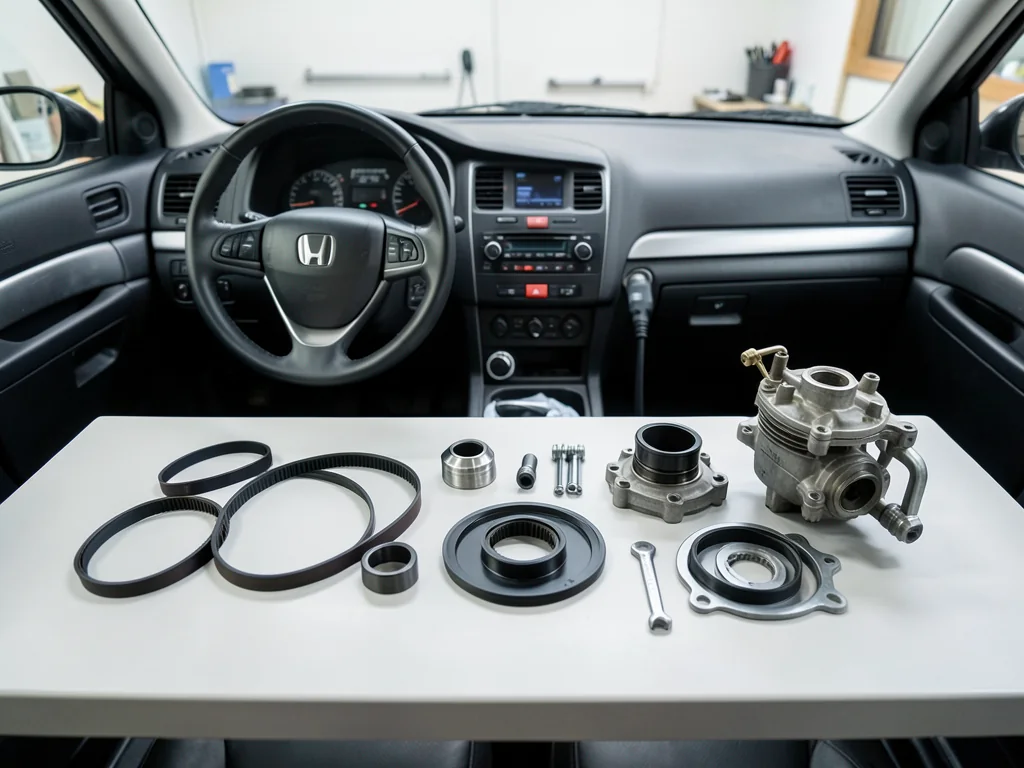
Owners comparing Honda timing belt replacement cost often start with a model name, then learn that a timing belt on Honda engines depends on year, engine, and market. Changing a Honda timing belt is scheduled work on some powerplants and is not used on others. Kit choice, interval, and labor follow engine identification, the maintenance schedule, and service records rather than one brand-wide rule.
Which Honda Models and Engines Use a Timing Belt?
A Civic, Accord, CR-V, Odyssey, Pilot, or Prelude nameplate cannot establish timing-belt fitment by itself. Honda used belt-driven camshafts on specific engines and model years, later shifted many applications to chains, and sold different market versions of the same model. Documented belt examples include older D-series and B-series four-cylinders in many Civic and CR-V configurations, F-series four-cylinders in numerous Accord applications, H-series Prelude engines, and many J-series V6 engines in Accord, Odyssey, Pilot, and Ridgeline vehicles, each limited to those engine families and years.
Engine identification on the under-hood emission label, a build plate, or factory service information is the reliable way to confirm whether belt service applies. Match that engine code to the vehicle-specific maintenance schedule for the model year and market, because a later K-series or R-series four-cylinder successor can use a chain under the same model name. The ribbed accessory belt visible at the front of the engine only drives components such as the alternator or compressor. It neither proves a timing belt is fitted nor shows that belt's condition.
How to Confirm Your Honda’s Replacement Interval
Find the applicable mileage, elapsed-time, or reminder requirement in Honda maintenance information written for that VIN, model year, engine, and operating condition. Some applications publish a distance limit, others add a calendar limit, and later vehicles may call for a Honda timing belt change through Maintenance Minder instead of a single printed number. Heat, short trips, or severe service can change which published line applies. A generic interval circulating online is only a cue to look up the correct schedule, not a brand-wide due date.
A dated service invoice that records mileage and the parts installed is the practical baseline for calculating the next replacement. When that history is missing from the service records, remaining life cannot be read from belt color, surface cracks visible at an edge, or the lack of a warning noise. A professional maintenance assessment can compare the odometer, in-service date, and Maintenance Minder history with the published requirement for that engine. Appearance alone should not be used to postpone or skip the job.
What a Timing Belt Replacement Service Involves
A professional Honda timing belt change begins by confirming the engine uses a belt, then replacing that belt and inspecting associated components while the covers are off. Accurate camshaft-to-crankshaft timing is essential; a skipped tooth or reversed installation can bend valves or damage pistons on interference designs. The shop also verifies that the engine starts, idles, and runs without obvious new noises or leaks before releasing the vehicle. This is a timing-critical service, not an accessory-belt swap performed by eye.
Inspection should include seepage around the water pump and covers, plus roughness, leakage, or looseness at the timing belt tensioner and idler pulley, without treating every stain as a failed part. Findings belong on the work order so extra repairs can be authorized. The finished invoice should record installed parts, service date, mileage, fluids, and the warranty terms that apply to labor and components. That paperwork is what later owners and shops use to judge when the next belt is due.
What to Check in a Honda Timing Belt Kit
Honda timing belt kits vary by catalog listing and are not a single standard box. A Honda timing belt kit may contain only the belt, or it may add a tensioner, idler pulleys, and an adjuster, while a water pump, seals, coolant, and required fasteners often remain separate line items. The printed kit description does not establish that those extras are included. Compare the packing list with the vehicle's application before assuming the set is complete.
Confirm fitment with the exact engine code, model year, and market before selecting a timing belt kit for a Honda, because similar engines can differ in tooth count, width, or tensioner design. A shop may recommend related work when covers and mounts already provide access, when a leak or noisy pulley is documented, or when the service procedure groups those parts with the belt. Shared labor is a cost discussion based on condition and access, not automatic proof that every neighboring part has failed.
What Determines Honda Timing Belt Replacement Cost?
What a Honda timing belt change will cost depends on engine configuration, how much hardware must be removed for access, local labor rates, and whether the parts list is a belt-only set or a fuller group of associated components. Transverse V6 layouts generally require more labor than a compact four-cylinder with simpler covers, so quotes are not interchangeable across the lineup. Coolant, shop supplies, taxes, and fees still belong in the total. Verbal round numbers often omit those lines.
An itemized repair estimate should break out labor, the belt and associated components, fluids, taxes, and shop fees so timing belt replacement cost on a Honda can be compared on equal scope. Water-pump replacement or leak repairs found after the covers come off will change both parts and labor, which is why a low opening quote can grow. Request a written estimate that names included parts, how additional work will be authorized, and what warranty covers the job. No single figure is the cost of timing belt replacement for every Honda.
Warning Signs and When to Stop Driving
A timing belt can reach its replacement limit with no warning sound, so the job should follow the published schedule rather than wait for a squeal. Unusual engine noises, visible fluid leaks near the covers, rough running, or starting trouble are reasons for a professional assessment, yet none of those clues by itself proves the belt has failed. Accessory drives, pulleys, ignition problems, and fuel issues can produce similar complaints. Treat them as evidence to interpret against the actual engine application.
On Honda interference engines, a broken or jumped belt can let pistons strike open valves and cause serious internal damage, but interference status must be confirmed for that specific engine. After a sudden shutdown or suspected timing failure, stop in a safe place and arrange professional assistance. Repeated starting attempts can multiply valve and piston damage if the belt has skipped or snapped. Do not keep driving on a suspected jumped belt simply to reach home; towing is the conservative choice when the engine will not restart cleanly.