Highway attenuators
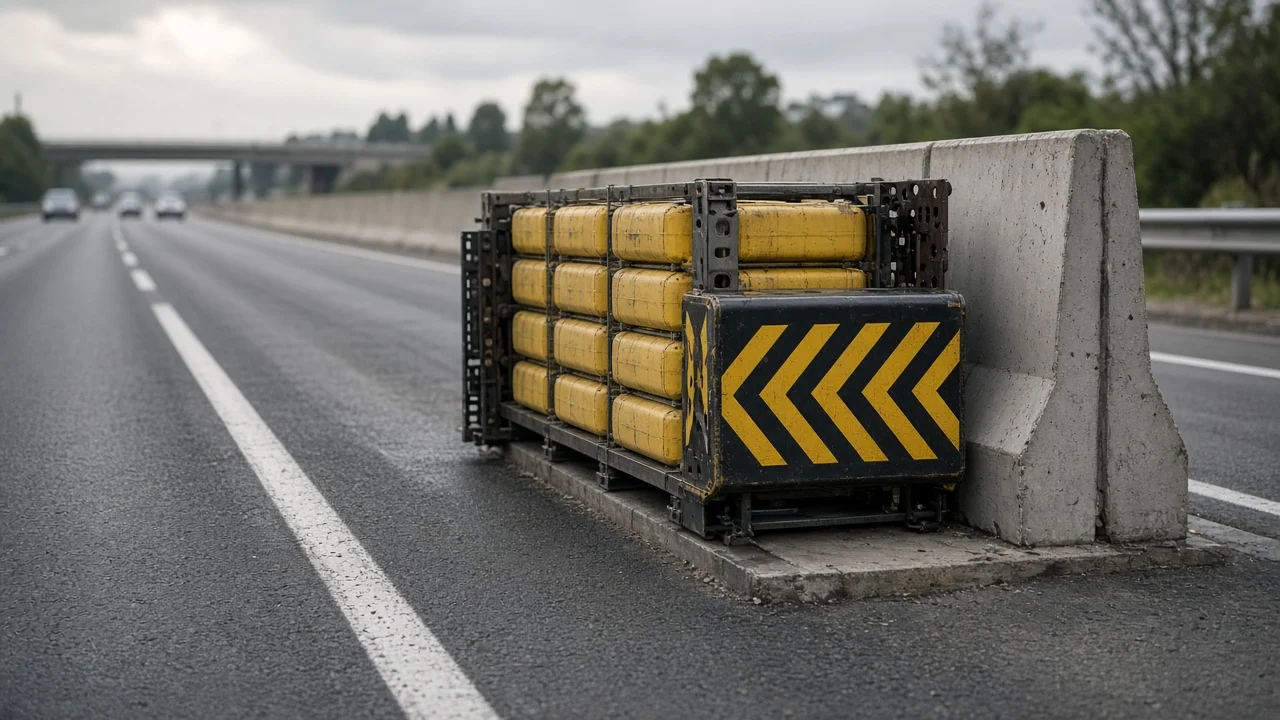
A highway attenuator is a crash cushion placed in front of a fixed roadside hazard, such as a bridge pier or concrete barrier end. It absorbs collision energy and slows a vehicle more gradually than an abrupt impact with a rigid object would. Understanding what an attenuator does on a highway is important for anyone who notices these yellow or orange devices near work zones, exit ramps, and gore areas. They reduce injury risk by managing stopping distance and redirecting or arresting a vehicle before it reaches the hard point behind the device.
Essential answer
At its most basic, a highway attenuator is an energy-absorbing terminal placed upstream of a fixed object or a barrier. It is often a wide, tapered assembly with crumple sections, redirective side panels, or a cartridge of deformable material. Drivers most commonly encounter them in front of concrete median barriers, bridge columns, toll plazas, and abandoned exit ramps. They are the broad, often striped units that look like a flattened nose attached to a guardrail or wall.
The term attenuator can also refer to a truck-mounted attenuator, which is a trailer or rear-mounted structure used on maintenance and construction vehicles. This mobile version protects workers and passing motorists by absorbing an errant vehicle’s impact. Both types share the same role: to manage a collision, extend deceleration time, and reduce the severity of crash forces compared with hitting a rigid hazard directly. They are a central element of crash protection and roadside barrier design.
How it works
A crash cushion works by converting a moving vehicle’s kinetic energy into heat, deformation, and controlled friction over a longer distance. Instead of a near-instant stop at a concrete surface, the attenuator crushes in stages, tears through internal energy-absorbing cartridges, or slides along a rail system. This spreads the deceleration across more time and space, lowering peak forces on occupants. The design may also include side panels that help redirect a glancing hit rather than allowing the vehicle to spear into the hazard.
From the driver’s view, the device also supports the sight line and recognition of the hazard ahead. Its broad reflective face and chevron markings make the transition from open road to barrier more visible, particularly at night or in rain. By drawing attention early, it gives a driver more room to slow, change lanes, or avoid the protected object entirely. This visual function complements the physical crash protection: the attenuator signals a change in the roadway and provides a safer consequence if the traffic exposure leads to a collision.
Strengths, limitations and suitability
The main strength of a highway attenuator is that it substantially lowers the severity of a fixed-object collision. A vehicle that hits a cushion at an angle may be redirected along the barrier rather than brought to a violent stop. For a head-on impact, the crumpling mechanism absorbs much of the energy that would otherwise transfer into the cabin. These systems are suited to high-speed roads, merges, splits, work zones, and anywhere a rigid obstacle sits close to moving traffic.
A limitation is that an attenuator is a sacrificial device. After a crash, it generally requires inspection and repair or replacement before it can provide full protection again. A damaged or partially deployed cushion may not perform as designed for the next collision. Some types also need a clear area behind them to compress properly; if that space is blocked by construction materials or debris, the cushion may bottom out against the hazard. Drivers should understand that the device reduces risk but does not eliminate the need for speed control and awareness of stopping distance.
Procedure
For a motorist, the practical procedure is to recognize the attenuator as a warning and adjust driving accordingly. When you see a striped crash cushion ahead, reduce speed and check mirrors for a lane change opportunity. Maintain a following distance that accounts for the reduced speed zone or work crew near the device. Avoid treating the cushion as a pull-off area or a place to pause; it is an active safety installation, not a parking spot or shaded rest point.
Highway agencies and contractors follow specific inspection and reset procedures after an impact. They check for broken cartridges, shifted rails, damaged reflective sheeting, and debris inside the compression zone. If damage is visible, the lane may remain closed until the attenuator is repaired. A driver passing a damaged or partially collapsed cushion should slow further and increase separation, because the crash protection may be compromised. Reporting the location to the responsible highway authority is a reasonable next step when safe to do so.
Diagnosing a problem
A damaged attenuator is not a vehicle fault, but it can explain why a road hazard suddenly looks more severe. If you see a crushed or missing nose section, exposed concrete, or loose debris around a barrier end, treat the area as a blind spot for protection. The cushion may have already absorbed a prior crash and not yet been restored. In wet or low-light conditions, a unit with faded or missing reflective markings is harder to judge, shortening your available reaction distance.
There is also a diagnostic thought process for a driver approaching an unfamiliar highway feature. If you cannot tell whether the object is an attenuator or a solid barrier, reduce speed and move away from the lane nearest the hazard. A properly functioning cushion should show a clean, tapered face with visible markings and intact side panels. If it looks jagged, flattened, or separated from the barrier behind it, assume a lower level of crash protection and give it a wider berth. Still, do not stop or swerve abruptly; smooth braking and a controlled lane position are the safer response.