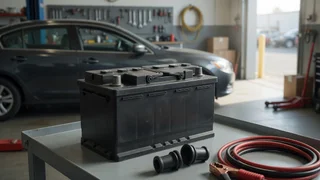
Interstate 31-MHD Battery: What to Check Before You Buy a Group 31 Heavy-Duty Battery
The short answer
An Interstate 31-MHD is a Group 31 battery from the brand's heavy-duty commercial line, built for trucks, buses, equipment and other vehicles that use the large Group 31 case. It is a reasonable choice when your vehicle or machine calls for a Group 31 battery and the 31-MHD's terminal style, cranking rating and construction match what your current battery or equipment documentation specifies. The answer changes if your application uses a different terminal layout, needs a deep-cycle or AGM battery rather than a starting battery, or runs several batteries in a bank that should all be the same type and age.
Before buying, confirm five things: the group size actually fits, the terminals match your cables, the cold cranking amps meet or exceed the requirement, the battery type suits how the vehicle is used, and the charging system is healthy. The sections below explain each check.
What Group 31 and MHD mean
Group 31 is a standardized battery size defined by the Battery Council International (BCI). The group number describes the case dimensions and general layout, not the battery's power or quality. Any Group 31 battery should be close to the same footprint and height, which is why the size is common in heavy trucks, tractors, construction and agricultural equipment, motorhomes, boats and some backup power setups.
The MHD designation in Interstate's naming is generally associated with its medium- and heavy-duty commercial range. In practice, that signals a battery intended for vibration, frequent starts and large diesel engines rather than a typical passenger car. The exact ratings, warranty terms and construction details of the current 31-MHD should be read from the battery label or the retailer's listing at the time you buy, since product lines can be revised.
Check 1: Physical fit and hold-down
Matching the group number is the first step, but it does not guarantee a perfect fit. Compare the new battery against the old one or the tray: length, width, height including terminals, and the way the battery is secured. Some trays use a top bar or frame that clamps across the case, while others rely on a ledge at the base. Make sure the hold-down on your vehicle will grip the new battery firmly, because a loose heavy battery can shift, damage the case or loosen cable connections.
Group 31 batteries are heavy. Plan for safe lifting, and in multi-battery boxes check that there is clearance between batteries and from the lid once everything is installed.
Check 2: Terminal type
This is the most common mismatch with Group 31 batteries. The size is sold with different terminal arrangements, typically threaded stud terminals, standard tapered SAE posts, or both on the same battery. Commercial trucks often use stud terminals with ring-type cable ends, while many marine and RV setups use posts or a combination.
Look at your existing cables: ring terminals bolted onto threaded studs point to a stud-terminal battery; clamp-style ends point to post terminals. Check which side the positive terminal sits on relative to the hold-down and cable length. If the battery you want has dual terminals, confirm the unused set will not contact the hood, lid or a neighboring battery. Avoid relying on terminal adapters as a permanent fix on heavy-duty starting circuits; they add connections that can loosen or corrode.
Check 3: Cold cranking amps and reserve capacity
Cold cranking amps (CCA) measure how much current a battery can deliver at low temperature for a short period while staying above a minimum voltage. It is the key number for starting a large engine, especially a diesel in cold weather. Choose a battery whose CCA meets or exceeds the requirement listed in your vehicle or equipment documentation, or at least matches the battery that has been working reliably.
Reserve capacity (RC) indicates how long a battery can supply a steady load before dropping to a set voltage, usually stated in minutes. It matters when the vehicle runs accessories with the engine off or at idle: liftgates, lights, sleeper-cab electronics, radios or telematics. If your use involves long engine-off loads, give reserve capacity as much weight as CCA.
Read both figures directly from the battery label or listing. Group 31 batteries from different lines, including different Interstate models, can carry noticeably different ratings even though the case size is the same.
Check 4: Starting, deep-cycle or dual-purpose, and flooded vs. AGM
A starting battery is designed to deliver a large burst of current and then be recharged quickly by the alternator. A deep-cycle battery is designed to be discharged more deeply and repeatedly, as in a house bank on an RV or boat. Dual-purpose batteries sit between the two. A heavy-duty commercial battery like the 31-MHD is primarily aimed at starting and chassis duty; if you need a battery that will be drained regularly, confirm that the model is rated for that kind of cycling or choose a deep-cycle Group 31 instead.
Construction matters too. Flooded (wet cell) batteries are generally less expensive and tolerant of a wide range of charging systems, but some designs need periodic electrolyte checks and should be mounted upright. AGM (absorbent glass mat) batteries are sealed, resist vibration well and handle deeper discharges better, but they cost more and should be charged with a compatible voltage profile. Check which construction the specific battery uses before buying, and match it to your vehicle's charging setup and any battery charger or isolator you use.
Check 5: Multi-battery systems
Many trucks and RVs connect two or more Group 31 batteries together. Batteries in the same bank share charge and load, so a mismatch makes the healthier battery work harder and can shorten the life of the whole set.
Use the same type and construction throughout the bank; do not mix flooded and AGM. Keep capacity and ratings as close as possible. Ideally, replace all batteries in a bank at the same time, especially if the others are several years old. Test the remaining batteries before deciding to replace only one.
Rule out charging-system problems first
A new battery will not solve a charging problem, and a weak alternator or bad connection can ruin a new battery quickly. If the old battery failed early, keeps going flat, or a battery or charging warning light is on, have the system checked before or during the replacement.
Load-test the existing battery to confirm it is actually at fault. Check charging voltage with the engine running; a reading that is too low points to undercharging, and one that is too high can overheat and dry out a battery. Inspect cables, ground straps and terminals for corrosion, looseness or damage. Look for parasitic drains, such as accessories, telematics or aftermarket equipment that draw current with the key off. On multi-battery setups, check isolators, battery separators and interconnecting cables.
Purchase details worth checking
Item | Why it matters | Where to look; Date code | A battery that has sat on the shelf for a long time may have lost charge or capacity | Sticker or stamped code on the case; ask the seller how to read it; Warranty terms | Commercial batteries often have different coverage than passenger-car batteries, and free-replacement and prorated periods vary | Retailer listing or warranty card at purchase; Core charge | Many sellers add a refundable charge that is returned when you bring back the old battery | Receipt or price breakdown; Installation | Heavy batteries and multi-battery boxes may justify paid or included installation | Seller or service shop; Recycling | Lead-acid batteries should be returned for recycling rather than discarded | Most battery retailers accept old batteries
Confirming compatibility for your vehicle
Battery fitment can differ by model year, market, trim, engine and optional equipment. A truck with a cold-weather package, a different engine or an added accessory load may call for a different battery specification than a similar-looking model. Use your exact vehicle details in a retailer's fitment lookup, compare against the owner's or equipment manual, and check the label on the battery you are replacing. If those sources disagree, go with the requirement in the vehicle documentation and ask the seller to explain the difference.
Bottom line
An Interstate 31-MHD makes sense when you need a heavy-duty Group 31 starting battery and its terminals, cranking rating, reserve capacity and construction match your vehicle or equipment. Verify the fit and terminal style, meet or exceed the required CCA, choose the right battery type for how the vehicle is used, keep battery banks matched, and confirm the charging system is healthy so the new battery has a fair chance of lasting.