Ford Trucks by Year: A Generation-by-Generation Guide to the F-Series, Super Duty, Ranger and Maverick
Readers who look up Ford trucks by year usually want one of two things: a timeline of which Ford pickups were sold in which years, or a way to confirm the model year of a specific truck. This guide covers both for the US market. It groups Ford's pickups into their main families, lists the commonly cited generation breaks, and explains how model year differs from build date and how to read each from the truck itself.
The Short Answer
Ford's US pickup history centers on the F-Series, which began with the 1948 model year and has run continuously since. Heavy-duty models split off into their own Super Duty line starting with the 1999 model year. Alongside them, Ford sold the compact Ranger from 1983 to 2011, brought it back as a midsize truck for 2019, and added the smaller Maverick for 2022. Within each family, trucks are best grouped by generation, because a generation usually shares its body, frame and most mechanical layouts for several model years.
One qualification changes many answers. A truck's model year, which is the year Ford assigns for sale and registration, is not always the calendar year it was built. A truck built late in one calendar year is often sold as the following model year. When the exact year matters for parts, recalls, valuation or registration, confirm it from the VIN rather than from the body style alone.
F-Series Generations by Model Year
The ranges below reflect the generation breaks that are widely used for US-market F-Series trucks. Some sources draw the lines slightly differently, especially where Ford kept an older design in production alongside a new one. Those overlaps are noted after the table.
Generation | Model years | Notable points; 1st | 1948–1952 | First trucks sold under the F-Series name, in several weight classes; 2nd | 1953–1956 | F-100, F-250 and F-350 naming introduced; 3rd | 1957–1960 | Wider, more squared-off styling; Styleside bed becomes prominent; 4th | 1961–1966 | Lower, longer design; some light-duty versions used an integrated cab and bed; 5th | 1967–1972 | Larger cab; four-door crew cab offered on some heavier models; 6th | 1973–1979 | F-150 name introduced for 1975, positioned between F-100 and F-250; 7th | 1980–1986 | Redesigned, more aerodynamic body; F-100 dropped from the US lineup after 1983; 8th | 1987–1991 | Updated front styling and interior; electronic fuel injection becomes widespread; 9th | 1992–1996 | Further restyling; heavier-duty versions continued into 1997; 10th | 1997–2003 | Rounded, aerodynamic F-150; heavy-duty models moved to the separate Super Duty line; 11th | 2004–2008 | Larger F-150 with a more upright, squared design; 12th | 2009–2014 | EcoBoost turbocharged V6 offered from the 2011 model year; 13th | 2015–2020 | Aluminum-alloy body panels on a steel frame; 14th | 2021–present | Hybrid powertrain offered; all-electric F-150 Lightning added for 2022
Two overlaps cause frequent confusion. When the 1997 F-150 arrived, Ford continued the previous-generation heavy-duty trucks for that model year, so a 1997 Ford truck may belong to either the ninth or tenth generation depending on its weight class. Similarly, when the 2004 F-150 launched, a version of the outgoing design stayed on sale for 2004 under a Heritage label. Checking the VIN and the specific model designation resolves both cases.
Super Duty Generations
Starting with the 1999 model year, Ford's F-250 and heavier pickups became the Super Duty line, built on a different platform from the F-150. A 1999 or later F-250 is therefore not simply a heavier F-150; it has its own frame, body and generation timeline. Commonly cited Super Duty generations are listed below.
Generation | Model years | Notable points; 1st | 1999–2007 | Super Duty introduced as a separate line from the F-150; 2nd | 2008–2010 | Major exterior and interior redesign; 3rd | 2011–2016 | Ford's own 6.7-liter Power Stroke diesel V8 introduced; 4th | 2017–2022 | Aluminum-alloy body panels, following the F-150's approach; 5th | 2023–present | Current-generation redesign
Engine availability within each Super Duty generation varies by model year, cab configuration and weight rating, so a generation alone does not tell you which powertrain a particular truck has. The VIN's engine code and the original window sticker, if available, are more reliable for that detail.
Smaller Ford Pickups: Ranger and Maverick
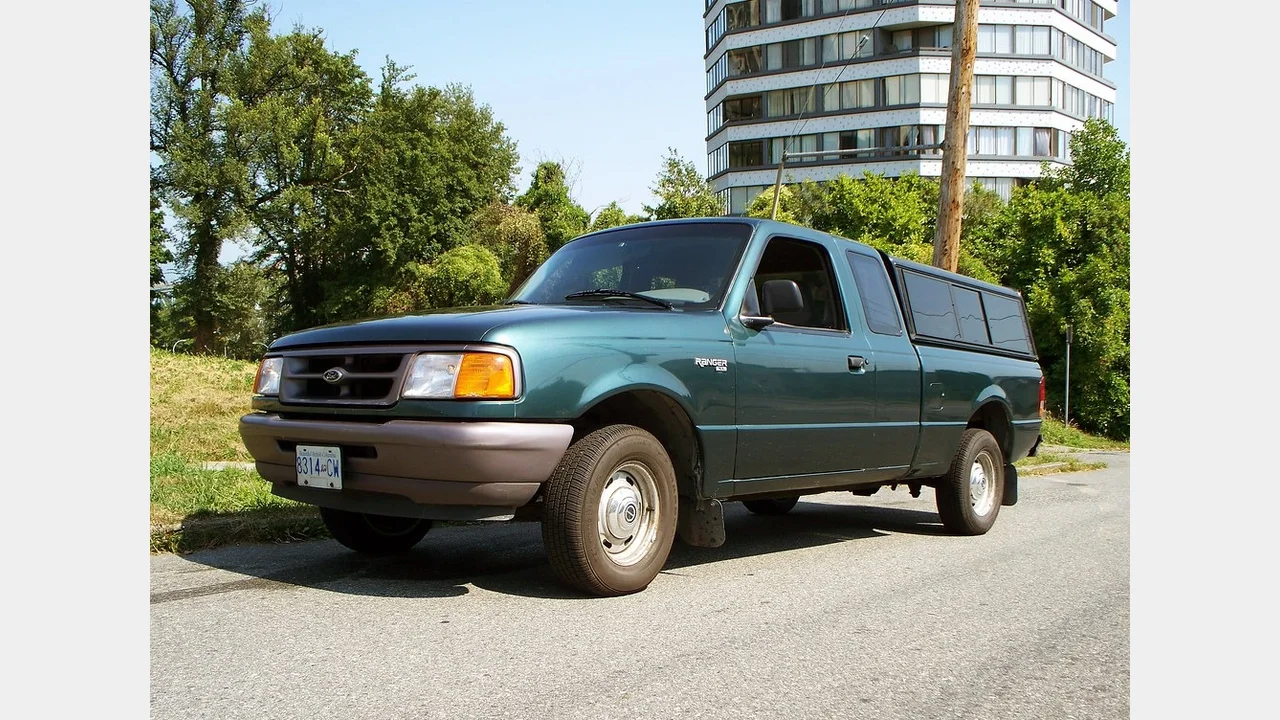
Before the Ranger, Ford sold a compact pickup in the US under the Courier name during the 1970s and early 1980s. The Ranger then took over the compact slot and became a long-running nameplate of its own.
Model | Model years (US) | Notes; Ranger, 1st generation | 1983–1992 | Ford-designed compact pickup replacing the Courier; Ranger, 2nd generation | 1993–1997 | Restyled body and interior; Ranger, 3rd generation | 1998–2011 | Longest-running US Ranger generation; US sales ended after 2011; Ranger (return) | 2019–2023 | Reintroduced as a midsize pickup based on a global design; Ranger (current) | 2024–present | New-generation midsize Ranger for the US; Maverick | 2022–present | Compact unibody pickup; launched with a hybrid powertrain as standard
The gap between 2011 and 2019 matters for shoppers: there is no US-market Ranger for model years 2012 through 2018. Rangers sold in other regions during that period were different vehicles and are not interchangeable with US models for parts or documentation.
Model Year Versus Build Date
The model year is a designation Ford assigns for marketing, registration and parts cataloging. The build date is the month and year the truck left the assembly line. A new model year often starts production in the latter part of the previous calendar year, and changeovers do not always happen on the same date for every plant or model. As a result, a truck built in the fall of one year can legitimately carry the next year's model designation.
The distinction matters in practice. Parts catalogs are organized by model year, but mid-year production changes sometimes mean two trucks of the same model year use different components; in those cases, suppliers may ask for the build date as well. Recall coverage is often defined by VIN or build-date range rather than model year alone. For used-truck valuation and registration, the model year is the figure that counts.
How to Find a Ford Truck's Model Year and Build Date
Read the VIN: on 1981 and later trucks, the 17-character VIN is usually visible through the windshield at the driver's-side base and is also printed on registration and title documents. Check the 10th character of the VIN: this position encodes the model year under the standardized system used for 1981 and later vehicles. Find the certification label on the driver's door jamb or door edge: it typically shows the month and year of manufacture, which is the build date. Compare the two: a build date late in a calendar year paired with the following model year is normal and does not indicate an error. For pre-1981 trucks, VIN formats were not standardized across manufacturers, so decoding requires Ford-specific references for that era.
The 10th VIN character cycles through the same letters and numbers every 30 years, skipping letters that could be mistaken for numbers. The table below shows the codes for recent model years.
10th VIN character | Model year; 1 | 2001; 2 | 2002; 3 | 2003; 4 | 2004; 5 | 2005; 6 | 2006; 7 | 2007; 8 | 2008; 9 | 2009; A | 2010; B | 2011; C | 2012; D | 2013; E | 2014; F | 2015; G | 2016; H | 2017; J | 2018; K | 2019; L | 2020; M | 2021; N | 2022; P | 2023; R | 2024; S | 2025; T | 2026
Because the codes repeat, the letter A can mean 1980 or 2010, B can mean 1981 or 2011, and so on. For light-duty passenger vehicles and light trucks, the 7th VIN character helps separate the cycles: a number in that position generally indicates a 1980–2009 model year, while a letter generally indicates 2010 or later. This convention does not apply to every vehicle class, so for heavier trucks the body style and generation features are a useful cross-check.
Using a Generation Timeline When Shopping or Buying Parts
A generation timeline is most useful as a first filter. If you are comparing used trucks, it tells you which years share a basic design, which helps narrow searches and set expectations about features. For example, a buyer interested in an aluminum-bodied F-150 would focus on 2015 and later, while someone who wants a heavy-duty Ford built on the separate Super Duty platform would look at 1999 and later F-250 and F-350 models.
For parts, treat the generation as a starting point and the VIN as the final word. Trim level, cab and bed configuration, drivetrain, engine and mid-year production changes all affect fitment. Supplying the full VIN to a parts counter or catalog is the most reliable way to get components that match a specific truck.
Key Takeaways
The F-Series has been Ford's core pickup line since the 1948 model year, with the F-150 name arriving for 1975. From 1999 onward, F-250 and heavier pickups belong to the separate Super Duty line with its own generations. The US Ranger ran from 1983 to 2011, was absent for 2012–2018, and returned for 2019; the Maverick joined for 2022. Model year and build date can differ; the VIN's 10th character gives the model year, and the door-jamb label gives the build date. When fitment, recalls or value depend on the exact truck, confirm details by VIN rather than by appearance or generation alone.