Exhaust and Muffler Clamps: Choosing the Right Joint Clamp
Answer Upfront
For most slip-fit exhaust repairs, the right clamp is a corrosion-resistant clamp that matches the outside diameter (OD) of the pipe and is designed for the joint style you have. A band clamp is generally the best choice when you need a low-distortion, reusable seal on a slip joint. A U-bolt clamp can be acceptable for a quick or temporary repair but tends to crush or pinch the pipe, making later disassembly harder and increasing the chance of a leak near the clamp. The choice changes materially if the exhaust is stainless steel, if the joint is flanged, or if the pipe is heavily corroded.
Match the Clamp to the Joint
Exhaust clamps are not universal. The first fitment question is whether the connection is a slip joint or a flange joint. Slip joints overlap two tube ends, so the clamp wraps around the outer pipe. Flange joints use a gasket between two flat faces and are usually held together by bolts and a separate hardware kit rather than a conventional muffler clamp. A clamp intended for a slip joint will not seal a flanged connection properly.
For slip joints, measure the outside diameter of the pipe where the clamp will sit. Many aftermarket replacement pipes use metric or fractional-inch diameters, such as 50 mm, 57 mm, 60 mm, 63 mm, 2.25 in, or 2.5 in. The clamp must fit the actual OD of the outer pipe, not the nominal exhaust size or the inside diameter. A clamp that is only a few millimeters too large may not compress evenly and may leave a leak path.
Band Clamps vs. U-Bolt Clamps
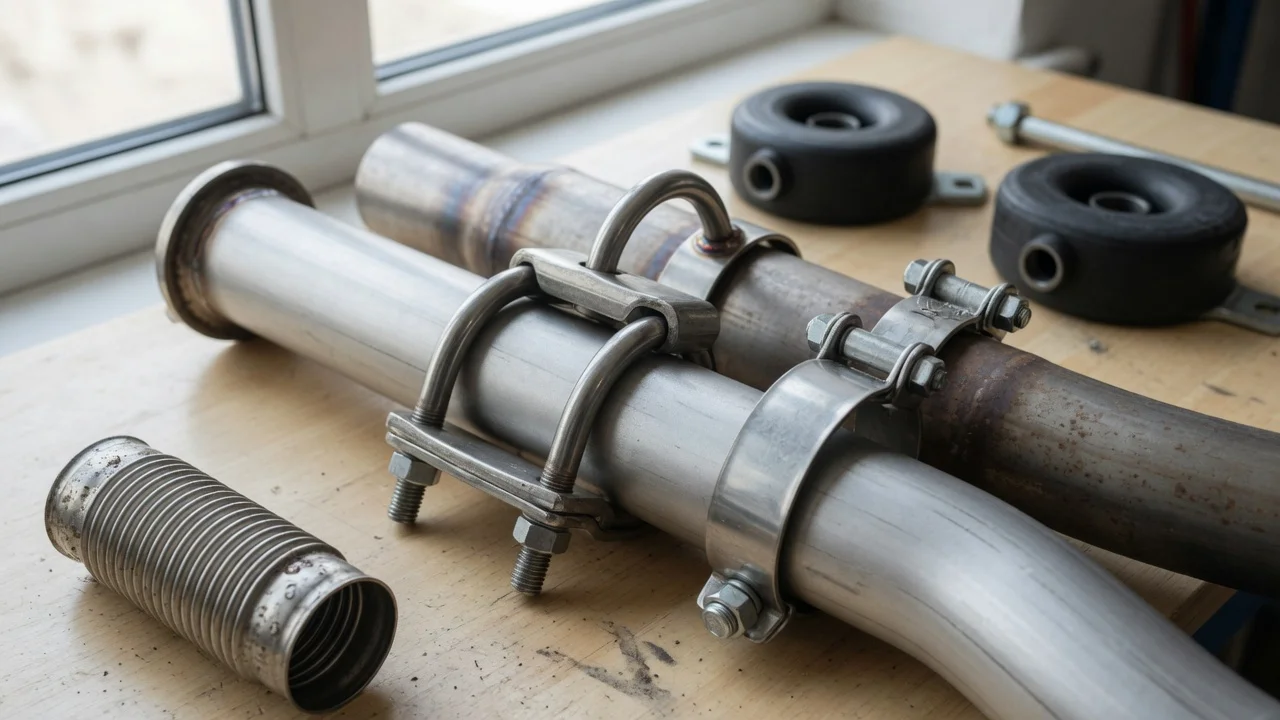
A band clamp, sometimes called a lap-joint band clamp, uses a wide flat band around the pipe. Most designs include a reaction block or stepped bridge that allows the clamp to press the inner and outer pipe together without deeply crushing the tubing. This makes the joint easier to separate later and is especially useful on stainless exhaust systems, where thin tubing can be damaged by a concentrated U-bolt load. Band clamps are commonly offered in stainless steel, which helps them survive the same heat and moisture exposure as the exhaust system.
A U-bolt clamp, also called a saddle clamp, uses a U-shaped bolt, a saddle plate, and nuts. It is inexpensive and widely stocked, but it compresses the pipe at two narrow points and can distort the tubing. On a rusty or weakened pipe, the U-bolt may crush the metal or make the outer pipe difficult to remove. This style is best treated as a short-term or low-budget repair rather than a permanent solution on a clean stainless system.
Steel and Coating Considerations
Exhaust clamps are available in zinc-plated steel, aluminized steel, and stainless steel. Zinc-plated hardware is common on budget replacement parts, but the plating degrades faster under repeated exhaust heat cycles. For a long-lasting repair, stainless clamps give the most consistent corrosion resistance. Do not assume that a stainless-looking finish means the entire clamp is stainless; the bolt, saddle, and nuts may still be a different material. Check the product description for material details when the clamp will be exposed to road salt or coastal moisture.
Pre-Purchase Checks
Confirm the joint type: slip joint or flanged connection. Measure the outside diameter of the pipe at the clamp location. Inspect the pipe ends for deep rust, holes, cracks, or out-of-round sections. Check whether the repair also requires a gasket, sealant, hanger, or replacement pipe section. Compare the clamp width to the available straight length of pipe so the band can seat fully. Match the clamp material to the exhaust system and your expected exposure to salt or moisture.
The most common purchase mistake is ordering by the nominal exhaust diameter rather than by the measured outside diameter. A second common mistake is fitting a new clamp to pipe that is too weak to seal. If the pipe deforms easily by hand at the joint, a clamp alone will not fix the leak; the rusted section needs to be cut back to solid metal and replaced first.
Installation and Ownership Costs
Installation should start with wire-brushing the mating surfaces and checking that the inner pipe slides into the outer pipe without forcing. The clamp should be positioned so that the band covers the slotted or overlap area evenly, and the fasteners should be tightened gradually and in stages. If the clamp has a torque specification, follow it rather than tightening until the clamp stops moving. Exhaust hardware expands and contracts with heat, so a clamp that is overtightened on a cold pipe may lose tension or crack a thin tube as the metal cycles.
For a typical slip-joint repair on a steel exhaust, a quality stainless band clamp is usually a modest increase in part cost over a U-bolt clamp, but it reduces the chance of replacing a crushed pipe later. The total cost also depends on whether the job can be done without welding and without cutting back additional damaged pipe. Because prices vary by brand, size, material, market, and seller, treat any price seen in comparison only as an advertised figure, not as a completed out-the-door cost.
Which Alternative Fits
Choose a stainless band clamp when the exhaust is stainless, when the joints need to be serviceable, or when the pipe is undamaged and the repair should be long-lasting. Band clamps spread the clamp load and are the safer choice for thin-wall tubing. Choose a U-bolt clamp when cost is the main limitation and the repair is temporary, or when working with thick mild-steel pipe where light distortion is less likely to affect sealing. A U-bolt clamp is not the best first choice for a clean stainless system because its narrower contact points can pinch the pipe and make later repairs more difficult.
Information Gaps
This article does not provide universal part numbers or exact pricing for every vehicle and market. Exhaust outside diameters can vary between original equipment and aftermarket replacement systems, and even between model years and engine options. Because no specific vehicle model was supplied, the guidance here relies on measuring the actual pipe and confirming the joint style before ordering. Product availability, warranty terms, and installed cost should be checked with the seller for the specific brand and part being considered.