Exhaust and Muffler Clamps: Choosing the Right Clamp for a Repair
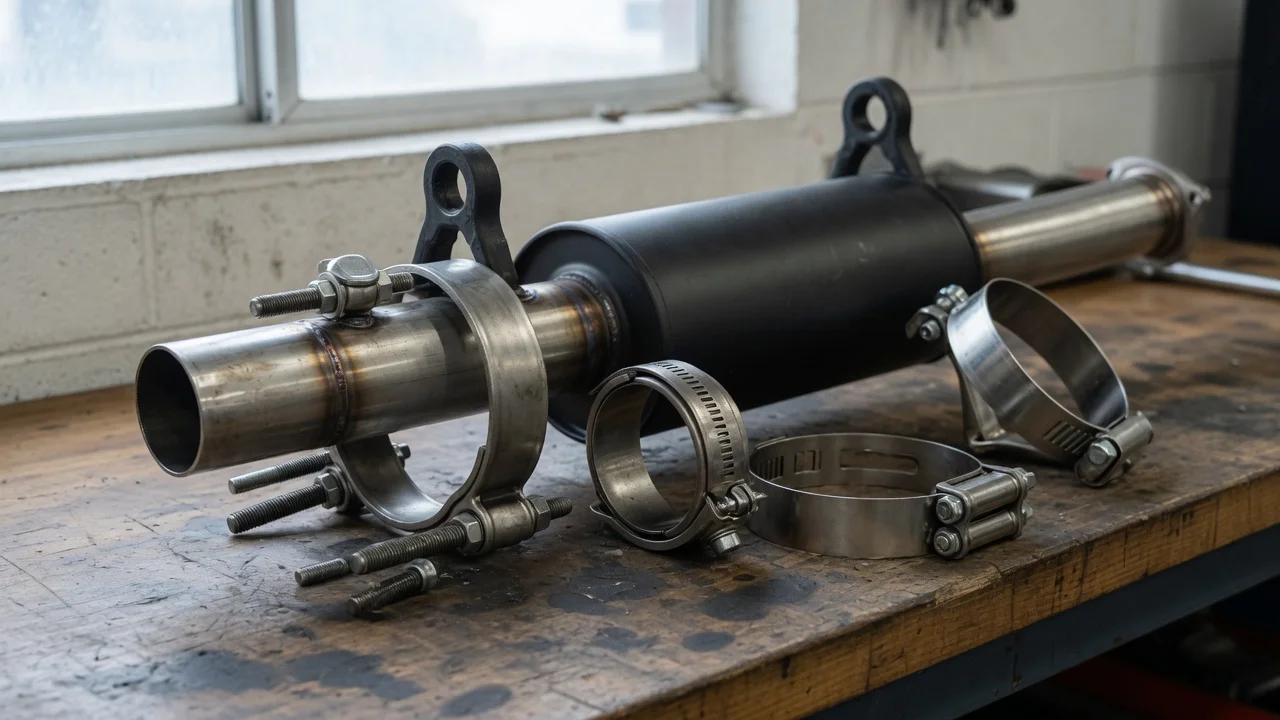
The short answer
The right exhaust clamp depends mainly on the outside diameter of the pipe or joint being repaired and the type of connection. A traditional U-bolt clamp is inexpensive and common, but can crush thin or corroded pipe. A band clamp spreads clamping force more evenly and is often the better choice for stainless tubing, lap joints, and repairs where you want to avoid deforming the pipe. Choose a clamp with the same nominal diameter as the outside of the tubing, and match the clamp material to the components it will contact, especially where stainless is involved.
Start with the joint type and measurement
Measure the outside diameter of the pipe, not the inside diameter. On a slip-on or lap joint, one pipe slides inside another, so measure the larger outer pipe where the clamp will sit. For a butt joint, both pipe ends are the same diameter and frequently need a band clamp rather than a saddle-style clamp.
Check the clamping range listed by the manufacturer. An exhaust clamp only seals correctly within its stated range. If corrosion has enlarged the pipe or the tube is slightly undersized, a clamp that is supposed to be the nominal size may not provide adequate compression.
Clamp styles compared
Type|Best use|Main trade-off; U-bolt clamp|Quick repair on mild-steel pipe|Can deform or crush thin/corroded tube; Band clamp|Lap joints, stainless tube, low-clearance areas|Usually costs more than a U-bolt clamp; V-band clamp|Flanged or grooved connections, fast removal|Requires matching flanges or rings; Wire or strap clamp|Suspension or temporary holding|Limited sealing ability at a joint
An exhaust band clamp uses a wider strap and often a full-round or rolled-edge design to distribute load. Because it does not concentrate force under a U-bolt saddle, it is less likely to create a permanent indentation that makes future removal difficult.
Material and compatibility checks
Mild or aluminized steel clamps can corrode and are generally acceptable on mild-steel exhaust. For stainless systems, check whether the clamp is also stainless. Some stainless exhaust tubing uses a magnetic or ferritic grade, while other grades may be low-magnetic, so a magnet is not a complete material test. Where the seller does not state the grade, treat the material claim cautiously rather than assuming compatibility.
Confirm that the clamp hardware, especially the bolt and nut, is corrosion-resistant enough for the environment. A low-quality bolt is often the first part to seize, and a seized fastener can turn a simple repair into a cut-off job.
What to check before buying
Measure the outside diameter of the joint where the clamp will sit. Check the manufacturer's stated clamping range for that exact diameter. Identify the joint type: lap, butt, or flanged connection. Match the clamp material to the pipe material and the road environment. Verify the hardware size and whether the clamp includes a new nut and bolt. Look for clearance around the joint, since a wide band clamp needs more room to pass over the pipe and rotate during installation.
Prices and availability are not included here because advertised prices vary by seller, region, and time, and a quoted figure may not reflect a completed transaction. Compare the same clamp type and material across sellers, and check whether the listed price includes hardware and shipping.
Installation trade-offs
Tighten the clamp evenly and avoid using an impact wrench at full torque. An over-tightened U-bolt clamp can collapse the pipe or crack a corroded muffler inlet. A band clamp should be drawn down gradually, alternating between the fastener sides when the design has two bolts.
Expect reuse to be limited. Once a clamp has been tightened and exposed to heat cycles, the threads and strap can take a set. If the exhaust must be disassembled later, it is usually safer to plan for a new clamp than to assume the old one will seal again.
Conditional recommendation
For a simple mild-steel repair where pipe deformation is not a concern, a correctly sized U-bolt clamp may be adequate and is usually the lowest-cost option. For a stainless system, a butt joint, or a repair on tubing that is thin or partially corroded, prefer an exhaust band clamp with a matching stainless construction. A V-band clamp is suitable mainly when the flanged or grooved ends are already present; it is not a direct substitute for a plain slip-on clamp.
When to stop and inspect
If tightening does not stop the leak, do not continue increasing torque. Remove the clamp and check for a cracked flange, a hole near the joint, an out-of-round pipe, or a clamp that is too large for the tubing. A clamp cannot repair a broken hanger, a split muffler body, or a failed gasket. Continued use with an exhaust leak near the cabin should be limited because exhaust gases can enter the vehicle; repair or replace the leaking component before prolonged driving.
Evidence gaps
This guide does not list universal torque specifications, specific part numbers, or brand availability. Those values depend on the vehicle, pipe diameter, and clamp supplier. Use the seller's or clamp manufacturer's stated dimensions and tightening guidance for the exact part being installed, and treat generic sizing charts as a starting point rather than a guaranteed fit.