Exhaust Clamps: Choosing the Right Type for a Repair
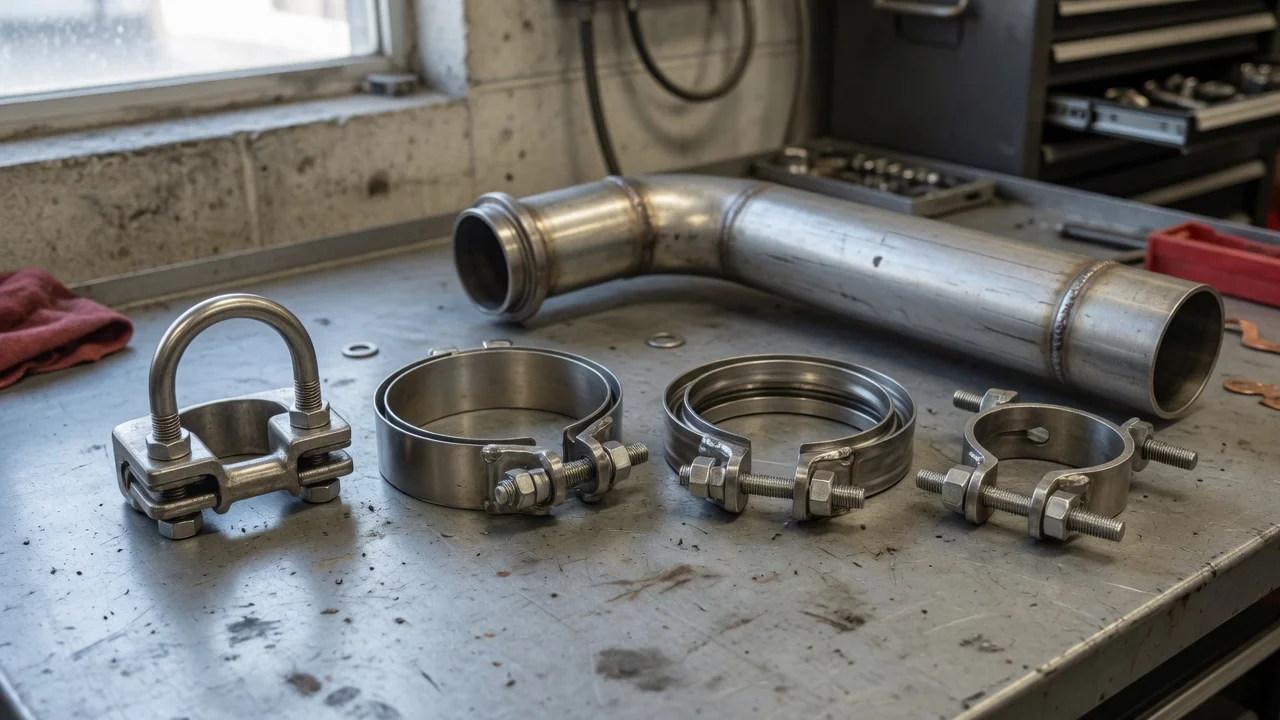
Match the clamp to the joint
The right exhaust clamp is the one that matches the joint design, the pipe’s outside diameter, and the metal already in the system. On a typical overlapping slip joint, a wide band clamp sized to the pipe’s outside diameter is the usual repair because it compresses evenly and is less likely to crush the tube. A U-bolt saddle clamp can hold thick mild-steel aftermarket pipe, but it pinches the tube into an oval and often seizes or weeps. Pipes that meet end to end need a sleeve plus a butt-style clamp, or a weld. A flanged joint needs the matching flanges, gasket or sealing ring, and bolts. If the pipe is rusted through, split, or crushed away from a designed joint, replace or properly sleeve that section first. A clamp only seals a joint that is still round and complete.
Identify the joint before you shop
A slip or lap joint is two pipes of the same nominal size with one end expanded or reduced so they overlap. That is the joint most band and U-bolt clamps are made for. A butt joint is two equal-diameter pipes meeting end to end; without a slightly larger sleeve over the seam, a round clamp has nothing even to compress. Flat, two-bolt, three-bolt, and spherical (donut) flanges seal on a face or ring with fasteners, not with a circumference band. A V-band joint uses two formed flanges with a V-shaped inner profile and a dedicated V-band clamp; that clamp is not interchangeable with a band of the same pipe size. Look at the leaking area and at the nearest factory connection. Do not assume a noisy spot is a clamp-sized slip joint.
Clamp types compared
Rank these by the joint you actually have and by whether the joint must come apart later. Shared criteria are seal evenness, pipe distortion, material match, serviceability, and whether extra parts (sleeve, flanges, gasket) are required. Do not rank types by leak-test numbers unless the figures use the same pipe diameter, wall, overlap, clamp width, and torque.
Clamp type Joint it fits Choose it when Main trade-off; U-bolt / saddle Overlapping slip joint on round pipe Low-cost hold on thick mild-steel tubing Pinches the pipe, uneven seal, often seizes; Wide band / lap-joint Overlapping slip joint Even compression on factory-style or stainless tubing Must match actual outside diameter; some bands are single-use; Butt / sleeve End-to-end pipes of equal diameter No overlap is available and welding is not the plan Needs a proper sleeve; alignment still matters; V-band Matching V-flanges Joints that come apart often, such as turbo and downpipe service Will not work without the mating flanges; Flange hardware Flat, two-bolt, three-bolt, or spherical flange The factory joint is a flange with a gasket or donut A band clamp will not seal a flange face
What to check before you buy
Suitability, compatibility, and the rest of the job matter more than the clamp’s sticker price. Advertised kit prices vary by market and date, and they often omit hangers, gaskets, fasteners, and labor. This article does not quote a typical installed cost; use a dated local parts and labor figure that lists what is included before you treat any number as the ownership cost.
Measure the outside diameter at the joint with a caliper or diameter tape once the old clamp is off and the pipe is still round. Exhaust tubing is commonly specified by outside diameter. A catalog size such as 2 in, 2.25 in, 2.5 in, or 3 in only fits if it is the same measurement you took, in the same units, OD versus ID.
Confirm joint type: slip/lap, butt, flat or spherical flange, or V-band. Buy the clamp family that joint uses.
Match the metal. Stainless clamps belong on stainless tubing, especially downstream of the catalytic converter. Aluminized or coated mild steel is common on budget cat-back kits. A mild-steel clamp on a stainless system rusts first and can stain the pipe. A listing that says stainless does not guarantee the same grade as an original-equipment exhaust.
Check whether the original clamp was a specific factory style (wide band, offset bolt, formed liner). A generic U-bolt of the same nominal size is not a substitute for some OEM band joints. Compatibility still depends on that vehicle’s model year, market, trim, and powertrain; unresolved differences in pipe OD, expander length, or flange pattern mean the part is not confirmed.
Look at clearance for the bolt head, nut, and band around heat shields, hangers, the floor pan, and steering or suspension parts.
Inspect the pipe itself. Rust holes, crushed spots, a slip joint that has fully telescoped, converter shells, and flex-pipe corrugations are the wrong places to clamp. A clamp will not round an ovalized tube.
Decide if the joint must come apart later. Quality band clamps and V-bands favor service. Welding is the more permanent option when the pipes are sound and alignment is correct.
Budget the related parts. Broken hangers, frozen flange bolts, and worn donut gaskets often cost more time than the clamp. A leaking joint caused by a dropped system will return if you only add a clamp.
Size, material, and installation
Measure on the vehicle when you can. Dual-wall tubing, a sleeved repair, or a pipe that has already been crushed will not match the nominal size printed on an old clamp. If the slip joint is loose, the expanded female end is the diameter the band must fit. Follow the clamp maker’s torque and tightening sequence; this article does not assign a universal torque. Overtightening a U-bolt ovalizes the pipe. Do not use the clamp to pull a misaligned system together. Restore hangers and support the pipes so the joint sits naturally, then tighten. Many U-bolts stretch after one use. A band that is already creased is a poor candidate to reuse.
Which type fits which job
Choose by use case rather than by a single “best” clamp.
Thick mild-steel slip joint, easy access, round pipe, lowest parts cost: a U-bolt saddle clamp can hold, with the trade-off of pipe distortion and harder future service.
Factory-style slip joint, stainless or thin-wall pipe, you want a seal without crushing the tube: a wide band or lap-joint clamp matched to the measured outside diameter.
Two pipes of equal outside diameter with no overlap: a sleeve plus a butt clamp, or a weld if the metal is sound.
Turbo outlet, downpipe, or any joint you expect to service often: a V-band only if both sides already have, or will receive, matching V-flanges.
Recurring leak at a joint that already had a U-bolt: inspect for an ovalized or split pipe before buying a “better” clamp. A new band will not seal crushed metal.
Flange with a visible gasket or donut: replace the gasket or ring and fasteners. Adding a band around the pipe behind the flange leaves the face leak untouched.
When a clamp will not finish the repair
A hole in the pipe wall, a broken hanger that let the joint pull apart, a failed flex pipe, a cracked manifold, a blown flange gasket, or a loose oxygen-sensor bung is not a clamp problem. If the joint will not come into round, or if metal flakes when you clean it, stop clamping and replace that section. A leak upstream of an oxygen sensor can affect fueling. A leak near the floor, fuel lines, or brake lines is a reason to park the vehicle until the joint is sealed. Local inspection rules may fail a leaking exhaust; they do not change which clamp family fits the joint.