Double Battery Circuit Problems: Causes, Checks and When to Get Help
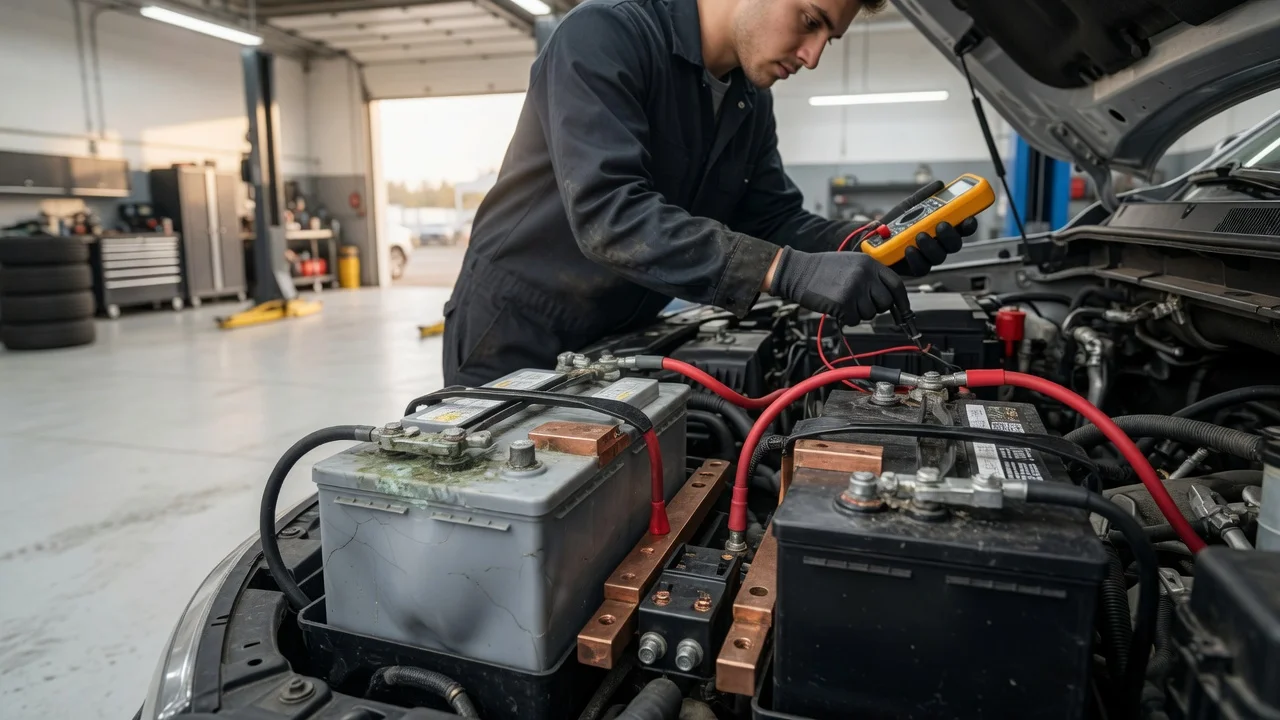
Most problems in a double (dual) battery circuit come from a small set of causes. One battery may be weak and pulling the other down. Batteries may be mismatched in type, age or capacity. Cables, grounds or terminals may have poor connections. The device that links or isolates the batteries may have failed. Or a parasitic load may be draining the system while the vehicle sits. The right fix depends on how your batteries are wired, so the first step is identifying which kind of dual battery setup you have.
The Short Answer and Why Your Setup Type Matters
A double battery circuit is not one standard design. The likely faults, and the checks that make sense, change with the layout. Three common arrangements are described below. Specific wiring, fuse locations and linking hardware vary by manufacturer, model year, powertrain and whether the system was factory-fitted or added later. Confirm the layout from the owner's manual, a wiring diagram or the installer's documentation before working on it.
Setup | How it is wired | Typical use | Problems most associated with it; Two batteries in parallel | Positive to positive and negative to negative; voltage stays the same and capacity is shared | Some factory diesel pickups and vehicles with high starting or electrical demand | A weak or shorted battery drains the healthy one; mismatched batteries charge and discharge unevenly; one bad cable or ground starves one battery; Two batteries in series | Positive of one to negative of the other, doubling system voltage | Heavy vehicles and equipment running higher-voltage systems | One weak battery unbalances the pair; charging problems often show up as one battery overcharged and the other undercharged; Starter battery plus auxiliary battery with an isolator, relay or DC-DC charger | Batteries linked only under set conditions, usually while charging | Campers, RVs, overland and work vehicles running fridges, lights or tools | Auxiliary battery not charging; starter battery drained by accessories; isolator or relay stuck open or closed; charger incompatible with the vehicle's charging system
Common Symptoms and What They Usually Point To
Both batteries go flat overnight or after a few days: a parasitic draw, an isolator or relay stuck closed, or one failing battery discharging the other. The starter battery is fine but the auxiliary battery never fully charges: a failed isolator, relay or DC-DC charger, a blown fuse or tripped breaker in the linking cable, undersized or damaged wiring, or a charger not suited to the vehicle's alternator behaviour. The engine cranks slowly even though one battery tests healthy: a weak partner battery in a parallel or series pair, or high resistance at a terminal, cable or ground. One battery is consistently hotter, swollen or using more electrolyte than the other: uneven charging, an internal battery fault, or a charging system problem. Treat this as a safety concern. Warning lights, charging messages or stored fault codes after fitting a second battery: a possible conflict between the added equipment and the vehicle's battery monitoring or charging control. A code is a starting point for investigation, not proof that a specific part has failed.
Checks to Narrow Down the Cause
These checks rely on observation and a basic digital multimeter. Exact voltage thresholds differ by battery chemistry (flooded lead-acid, AGM, gel or lithium) and by manufacturer. Use the figures published for your specific batteries and charging equipment rather than assuming a universal value. Wear eye protection, remove metal jewellery, and avoid sparks near the batteries.
1) Inspect connections and cabling
Look for corrosion, loose clamps, frayed or heat-discoloured cables, cracked insulation and poorly secured ground straps on both batteries, the chassis and the engine. Check every fuse, circuit breaker or fusible link in the cable joining the batteries. A connection can look intact and still have enough resistance to stop one battery from charging or delivering current. If a cable or terminal feels warm after cranking or while charging, that connection is a strong suspect.
2) Compare the batteries at rest
With the vehicle off and the batteries left to settle, measure the voltage across each one. If the batteries are permanently connected in parallel, they will read the same, so a meaningful comparison requires disconnecting them from each other first. A large difference between two batteries that should match suggests one is weak, sulphated or internally damaged, or that it is not being charged. A battery that cannot hold its voltage after a full charge usually needs a proper load or conductance test, which many battery retailers and workshops can perform.
3) Check charging with the engine running
Measure the voltage at each battery with the engine running. On an auxiliary setup, the reading at the auxiliary battery should rise once the isolator, relay or DC-DC charger engages. If the starter battery shows charging voltage but the auxiliary battery does not change, the fault is likely in the linking device, its fuse, its trigger or ignition signal, or the cable between them. Many isolators and chargers have indicator lights or app readouts; compare what they show with your meter readings.
4) Test the isolator or relay behaviour with the engine off
After shutting the engine off, the starter and auxiliary batteries should separate according to the device's design. If both batteries keep dropping together when only accessories on the auxiliary side are running, the link may be stuck closed. This allows accessories to drain the starter battery and is a common reason for no-start complaints in camper and overland vehicles.
5) Look for a parasitic draw
If the batteries discharge while parked, measure current draw with the vehicle locked and its modules allowed to go to sleep, then remove fuses one at a time to find the circuit responsible. Aftermarket accessories, fridges, dash cameras, inverters and lighting are frequent culprits, but factory modules can also fail to sleep. What counts as a normal draw is vehicle-specific, so compare your reading with the manufacturer's guidance where it is available.
6) Confirm the batteries and charger suit each other and the vehicle
Pairing batteries of different chemistries, ages or capacities in a permanently connected bank tends to cause uneven charging and shortened life. Many vehicles with variable-output or smart alternators, and many with battery monitoring sensors, may not charge an auxiliary battery reliably through a simple relay. These vehicles often need a DC-DC charger. Whether a specific vehicle falls into this group depends on its model year, engine and market, so check the vehicle or equipment maker's guidance.
Reading the Results
What you find | What it most likely indicates | Sensible next step; Corroded, loose or heat-marked connection | High resistance limiting charging or cranking current | Clean or replace the terminal or cable, then retest; One battery reads well below the other after a full charge | Weak or failed battery dragging down the bank | Have that battery load-tested; replace it if confirmed, ideally with a matching pair in a linked bank; Auxiliary battery voltage does not rise with the engine running | Isolator, relay, DC-DC charger, fuse or trigger fault | Check the device's fuse, wiring and trigger signal against its installation instructions; Both batteries drop together with the engine off | Link stuck closed or a load wired to the wrong side | Inspect the isolator or relay and the accessory wiring; Batteries drain while parked with all accessories off | Parasitic draw | Isolate the circuit by fuse pulling, then repair or rewire the offending load; Fault code or charging warning after adding a second battery | Possible conflict with battery monitoring or charging control | Scan and record the code, then investigate the related circuit rather than replacing parts on the code alone
When to Stop and Get Professional Diagnosis
Stop using the vehicle or the battery system, and disconnect the load if it is safe to do so, if you notice any of the following: A rotten-egg or sulphur smell; Visible swelling, cracking or leaking of a battery case; Smoke, melted insulation or a burning odour; A battery or cable that is hot to the touch; Repeated blowing of the fuse or breaker on the linking cable; These signs can indicate overcharging, an internal short or a wiring fault capable of causing fire or battery rupture. Lead-acid batteries can release flammable hydrogen during charging, and lithium batteries have their own thermal risks.
Professional help is also the practical choice in several other situations: when the system is integrated with the vehicle's charging control or battery monitoring, when a charging fault persists after the basic checks, when the vehicle is a hybrid or electric model with a high-voltage system, or when you are not confident working safely around batteries and high-current cables. High-voltage components in electrified vehicles should only be handled by trained technicians.
Limits of This Guide
This is general guidance based on how common dual battery layouts work. It does not include model-specific wiring diagrams, fuse ratings, voltage specifications or test results, and none were available for this article. For exact values and procedures, rely on the service information for your vehicle and the documentation supplied with your batteries, isolator or DC-DC charger.