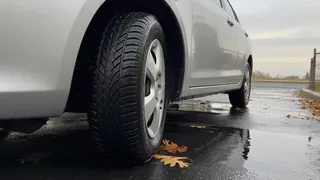
Directional Tread Pattern on Winter Tires

A winter tire's directional tread pattern is more than a visual cue; it is a feature that changes how the tire moves water and slush away from the contact patch. Drivers researching a winter tire directional tread pattern often notice the prominent V-shaped grooves and the rotation arrow stamped on the sidewall. Understanding this design helps explain why a snow tire may deliver better wet-road composure than a tire with a less specialized layout.
Essential answer
A directional tread pattern is a tire design intended to rotate in only one direction. The arrangement of blocks, sipes, and wide circumferential channels usually forms an arrow-like or V shape that points toward the direction of travel. On a winter tire, this layout is meant to push water, slush, and loose snow outward from the center of the tread, helping the rubber maintain contact with the road instead of riding on a film of moisture.
Installation is more specific than with a symmetric tire, but the principle is straightforward. The sidewall arrow or rotation marking must follow the forward rolling direction once the wheel is mounted. If a tire is installed backward, the tread may not channel moisture as intended, so the handling benefit can be reduced. The design does not by itself prove a tire has deep snow traction, but it explains a large part of how the tread manages wet winter pavement.