Direct TPMS Sensor Battery Lifespan

A direct TPMS sensor battery has no rechargeable path; its expected lifespan is typically finite and ends when the sealed cell can no longer transmit a usable pressure signal. Drivers researching this question usually notice an intermittent warning light or a missing readout, not a sudden mechanical fault. Because the sensor is mounted inside the wheel and tire assembly, its operating conditions include vibration, temperature swings, centrifugal force, and long periods of sleep. The practical meaning of lifespan therefore depends less on a simple calendar date and more on how the module manages wake-up cycles, radio transmission, system voltage, and battery drain under real driving conditions.
Essential answer
The essential answer is that a direct TPMS sensor battery is a non-serviceable, sealed power source expected to last roughly several years of normal vehicle use, after which the entire sensor assembly is usually replaced. There is no universal service interval, because battery life is consumed by transmissions, not by engine hours alone. A vehicle that sits parked in a stable environment may preserve the cell longer than one driven constantly over rough roads where wake events and pressure reporting occur more often. The lifespan question is really a service-life estimate for the complete wheel electronics, not a rechargeable or replaceable coin-cell maintenance item in most designs.
Any exact figure must be treated as a range influenced by sensor generation, driving pattern, climate, and whether the receiver loses signal and requests more broadcasts. A sensor that reports low battery voltage through the scan tool is providing evidence of declining capacity, but that code does not by itself prove the exact remaining days of service. In practice, owners should treat the first repeat low-battery diagnostic message as a signal to plan replacement at the next tire service rather than assume immediate failure. The appropriate next step is confirming the issue on the correct wheel before replacing parts.
How it works
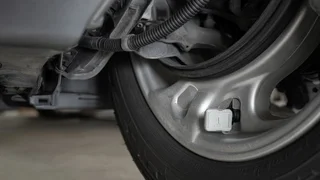
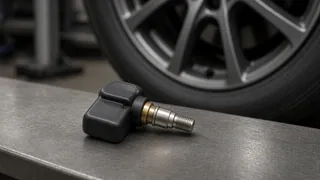
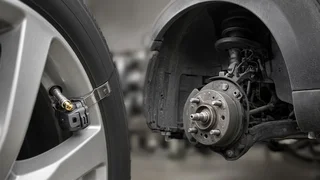
Direct TPMS sensors measure pressure and temperature inside the tire and transmit that data by radio to the vehicle receiver. The sensor spends most of its time in a low-power sleep state, then wakes on a timer, a pressure change, or a rolling-wheel trigger. Each wake event draws current from the sealed battery. The transmitter sends a short burst of data, and the receiver or body control module then displays pressure on the instrument cluster or stores a fault when the signal is missing. Battery capacity is therefore managed by minimizing active time, which is why sensors do not broadcast continuously.
The electrical behavior is similar to other long-life monitoring devices. Battery terminals inside the sensor feed a circuit that must maintain stable voltage during a transmission burst. If internal resistance rises as the cell ages, system voltage can sag and the radio message may become weak or absent. This is a voltage drop under load, not necessarily a dead battery at rest. Temperature also affects chemical capacity: cold weather can temporarily reduce performance, while sustained heat exposure shortens overall calendar life. The tire acts as an oven during summer driving, and parked heat cycles contribute to aging, so a sensor in a warm climate may degrade sooner than one in moderate conditions.
Strengths, limitations and suitability
The main strength of a direct sensor is that it gives actual pressure readings for each wheel, but that benefit depends on a sealed battery with constrained life. The sealed design protects the electronics from tire mounting lubricants, moisture, and road debris, yet it also prevents battery replacement without opening or destroying the sensor. For owners who keep a vehicle beyond one or two tire changes, the limitation is unavoidable: even if the pressure-sensing element is healthy, a depleted battery makes the whole unit unserviceable. This suits drivers who value per-wheel accuracy and are prepared to refresh sensor hardware as part of long-term tire and wheel maintenance.
A vehicle stored outdoors in extreme heat or driven frequently on rough pavement will ask more from the sensor in terms of thermal stress and wake events. Drivers who use seasonal wheel sets often face a second consideration: each set may contain its own sensors, and batteries age whether or not that set is on the vehicle. The sleeping current is low, but it is not zero, and stored wheels still experience ambient temperature swings. The technology is suitable for most passenger vehicles, yet its value depends on accepting that sensor replacement is not just a tire service cost but a long-interval part of vehicle ownership.
Procedure
When planning battery-related TPMS service, the practical job is not replacing a battery cell; it is confirming which sensor has weak output and replacing that sensor assembly. A receiver tool that triggers each wheel can show whether the sensor wakes and reports a stable identification and pressure value. Begin by checking pressure with a calibrated gauge so the reported value can be compared with an external reference. If a sensor transmits at the wrong pressure or not at all, note the wheel position before dismounting. The tire must be broken from the bead and the old sensor removed from the valve stem or mounting point according to the wheel design.
After installing a new sensor, the receiver usually needs a relearn procedure so the vehicle recognizes the sensor identification. Some systems learn positions automatically during driving, while others require a magnet or a scan-tool command. Follow the vehicle-specific relearn method rather than assuming the new sensor will be recognized immediately. The completion check is a steady reading on the display or scan tool for each road wheel. If the warning remains, do not install additional sensors blindly; first verify that the correct sensor identification was stored and that no wiring or receiver concern is present.
Diagnosing a problem
When a low sensor battery message appears, the first useful check is repeatability. A single temporary signal dropout can occur from radio interference or a parking environment, but a message that returns on multiple drives points more strongly toward aging sensor electronics. Have the sensor triggered by a compatible TPMS tool while the wheel is stationary. A sensor that triggers weakly, sends an intermittent identification, or shows a low-battery flag is likely nearing the end of its useful life. Do not treat a generic fault code as proof that one specific part has failed, because manufacturer-dependent codes can describe signal loss, missing calibration, or receiver issues rather than battery capacity alone.
If all sensors stop reporting at once, consider a shared cause such as a receiver power or communication concern before condemning four batteries. A wiring diagram can show whether the receiver shares a fuse or data line with other modules, and a parasitic draw test may reveal an unrelated electrical drain that pulls system voltage low during cranking. The fault should be interpreted as evidence to investigate. If the vehicle shows signs of severe vibration, wheel damage, or repeated pressure loss along with a sensor warning, limit driving until the tire and wheel are safely inspected.