Diagnose Chevy Cruze engine coolant temperature sensor
The short answer
The engine coolant temperature (ECT) sensor tells the Cruze's engine control module how hot the coolant is. The module uses that reading to adjust fuel delivery, idle speed, cooling fan operation and the dashboard temperature gauge. A failing sensor or a problem in its wiring can cause a check engine light, hard starting, poor fuel economy, a gauge that reads wrong, or cooling fans that run constantly or not at all.
However, a coolant temperature reading that looks wrong does not automatically mean the sensor has failed. Low coolant, a stuck thermostat, air trapped in the cooling system, or damaged wiring and connectors can produce the same symptoms. Diagnosis means confirming which of these is responsible before buying parts.
One important qualification: the Cruze was sold across two generations and with several engines, and the sensor's location, connector design and test specifications depend on the model year, engine and market. Use the service information for your exact vehicle for any resistance or voltage values. This guide does not supply those numbers because they were not available in verified form.
How the sensor works
Most coolant temperature sensors are thermistors, meaning their electrical resistance changes with temperature. In the common design, resistance falls as the coolant heats up. The engine control module sends a reference voltage to the sensor and reads the voltage that returns; a change in that return voltage is interpreted as a change in temperature. Because of this, an open circuit, a short to ground or a corroded connector can make the module believe the engine is extremely cold or extremely hot even when the sensor itself is fine.
Symptoms that point toward the coolant temperature circuit
Check engine light with a stored code related to engine coolant temperature; Temperature gauge that stays at cold, jumps erratically, or reads hot while the engine does not appear to be overheating; Cooling fans running continuously, including right after a cold start; Hard starting, rough idle or black smoke, which can occur if the module thinks a warm engine is cold and adds extra fuel; Noticeably worse fuel economy without another obvious cause; Weak cabin heat combined with a low gauge reading, which more often points to a thermostat or coolant level problem than to the sensor
Fault codes to read first
Start with an OBD-II scan tool. Generic OBD-II codes associated with coolant temperature include the following, but confirm the exact definition your scan tool or the manufacturer's information gives for your Cruze, since enhanced manufacturer codes and descriptions can differ.
Code | Generic meaning | What it suggests investigating; P0115 | ECT circuit malfunction | General circuit fault; check wiring, connector and sensor; P0116 | ECT circuit range or performance | Reading is implausible compared with expected warm-up; check coolant level, thermostat and sensor; P0117 | ECT circuit low input | Module sees a signal it interprets as very hot; look for a short to ground or a faulty sensor; P0118 | ECT circuit high input | Module sees a signal it interprets as very cold; look for an open circuit, unplugged connector or faulty sensor; P0119 | ECT circuit intermittent | Loose connector, chafed wire or failing sensor; P0128 | Coolant temperature below thermostat regulating temperature | Most often a thermostat stuck open, though a sensor reading low can also trigger it
Treat any of these codes as a starting point for investigation rather than proof that the sensor must be replaced. A code describes what the module observed in the circuit, not which component caused it.
Step-by-step checks and what each result means
1) Check the coolant level with the engine cold
Look at the coolant reservoir only when the engine is fully cool. If the level is low, the sensor may be surrounded by air or steam rather than liquid, which produces erratic or misleadingly low readings. Low coolant also means there is a leak or consumption issue that needs to be found. If topping up and properly bleeding the system resolves the symptoms, the sensor was likely not the cause.
2) Compare live data with actual engine condition
With a scan tool that shows live data, read the coolant temperature value after the car has sat overnight. A cold engine's coolant reading should be close to the outside air temperature and to the intake air temperature reading. A cold-engine value that is wildly high, wildly low or pinned at an extreme suggests a circuit or sensor fault. Then watch the value as the engine warms. A smooth, steady rise that levels off points to a working sensor. A reading that jumps, drops out, or never climbs while the engine clearly warms up points to the sensor or its wiring.
3) Separate a sensor fault from a thermostat fault
If the reading rises slowly and settles lower than normal, and cabin heat is weak, a thermostat stuck open is a more likely explanation than a bad sensor, particularly with code P0128. If the reading rises quickly and the upper radiator hose stays cool while the engine runs hot, a thermostat stuck closed or a circulation problem is more likely. In both cases the sensor may be reporting accurately; it is the cooling system that is misbehaving.
4) Inspect the connector and wiring
Locate the sensor using the service information for your engine, then inspect the connector for corrosion, coolant contamination, bent pins or a broken locking tab, and follow the harness for chafing or heat damage. Codes for high or low input and intermittent faults frequently trace back to wiring rather than the sensor. Wiggling the harness while watching live data can reveal an intermittent connection: if the reading jumps when the wires move, the fault is in the wiring or connector.
5) Test the sensor electrically
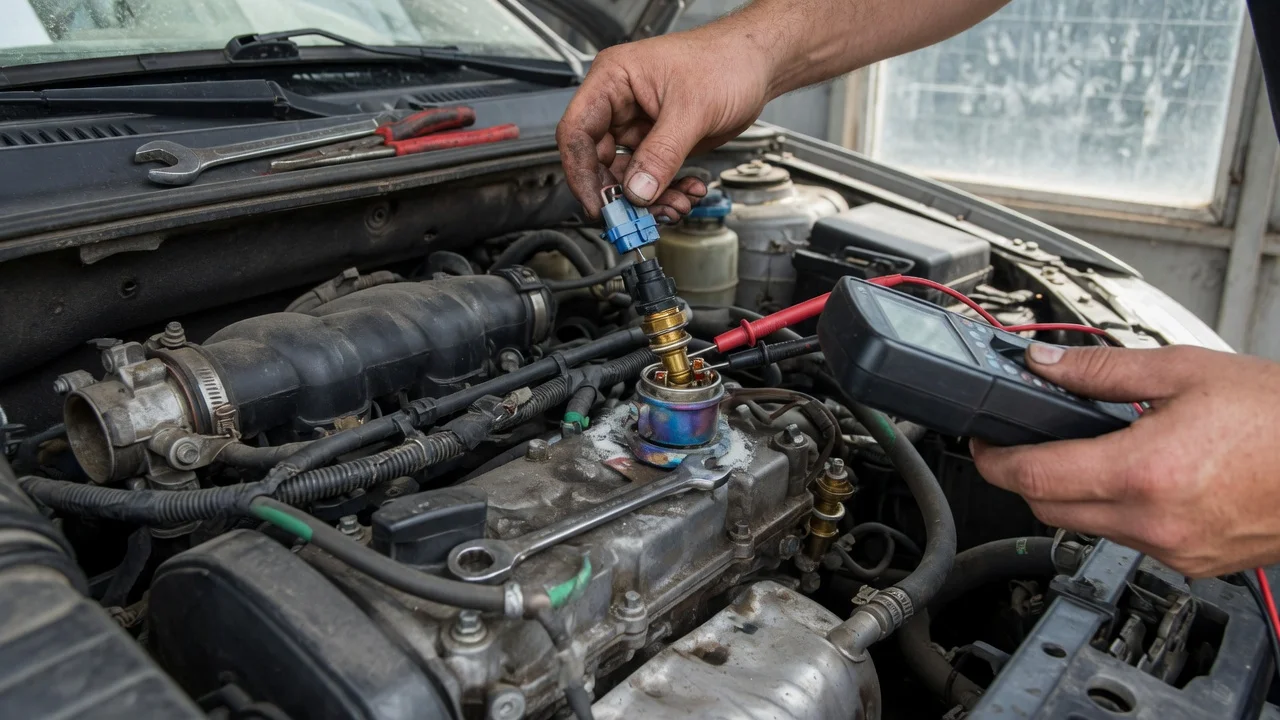
With the connector unplugged, a multimeter can measure the sensor's resistance at a known coolant temperature and compare it with the manufacturer's specification for your engine. A reading of infinite resistance indicates an open sensor; a reading near zero indicates a shorted sensor. Testing the harness side for the correct reference voltage and a good ground confirms whether the module and wiring are delivering what the sensor needs. Exact resistance and voltage values must come from the service information for your model year and engine.
Interpreting the results
What you find | Likely explanation; Low coolant or air in the system | Cooling system leak or incomplete bleeding; fix and bleed before condemning the sensor; Reading tracks real temperature but engine runs cool, P0128 present | Thermostat stuck open more likely than sensor; Reading jumps when harness is moved | Wiring or connector fault; Corroded or coolant-soaked connector | Connector repair needed; check whether coolant is leaking at the sensor; Sensor resistance out of specification at a known temperature | Faulty sensor; Sensor tests correctly but no reference voltage at harness | Wiring or engine control module issue; professional diagnosis advised
When to stop driving or get professional help
Stop driving and switch off the engine if the temperature gauge reads in the hot zone, an overheating warning appears, you see steam, or you smell hot coolant. Continuing to drive an overheating engine risks serious internal damage. Do not trust a low gauge reading alone if other signs of overheating are present, because a faulty sensor can hide a real problem.
Never open the coolant reservoir cap or any cooling system fitting while the engine is hot; the system is pressurised and can spray scalding coolant. Replacing the sensor also usually means some coolant loss, so the system will need refilling and bleeding afterward.
Professional diagnosis is advisable if coolant keeps disappearing without a visible leak, if the sensor and wiring test good but codes return, if multiple unrelated sensor codes appear together, or if you are not comfortable working on the cooling system or reading wiring diagrams.
Information gaps to keep in mind
This guide covers the general diagnostic approach for a coolant temperature sensor and its circuit. It does not provide the sensor's location for each Cruze engine, part numbers, resistance-to-temperature tables, torque values, coolant specifications or any recall or service bulletin details, because verified figures for those were not available. Confirm them against the service information for your specific model year, engine and market before testing or replacing parts.